Department of Population Genetics, Technische Universitaet Muenchen, Freising, Germany.
Department of Ecology, University of Innsbruck, Innsbruck, Austria.
PLoS Genet. 2020 Apr 6;16(4):e1008698. doi: 10.1371/journal.pgen.1008698. eCollection 2020 Apr.
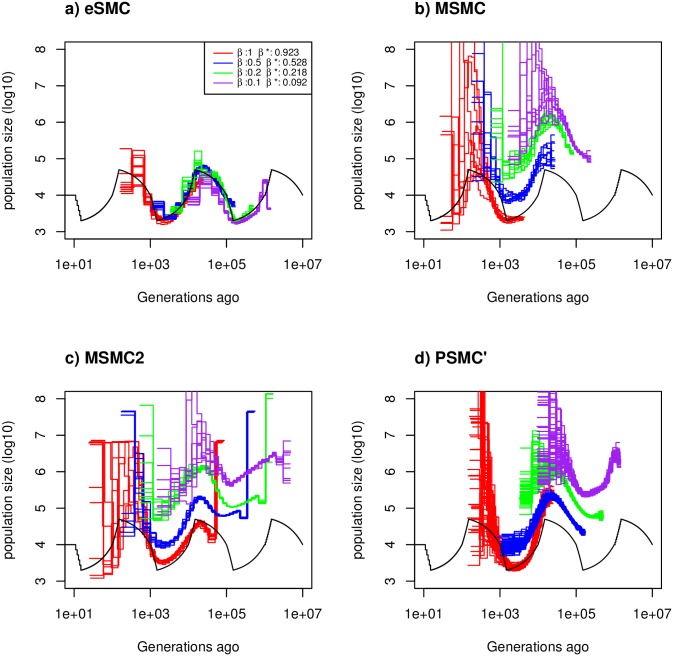
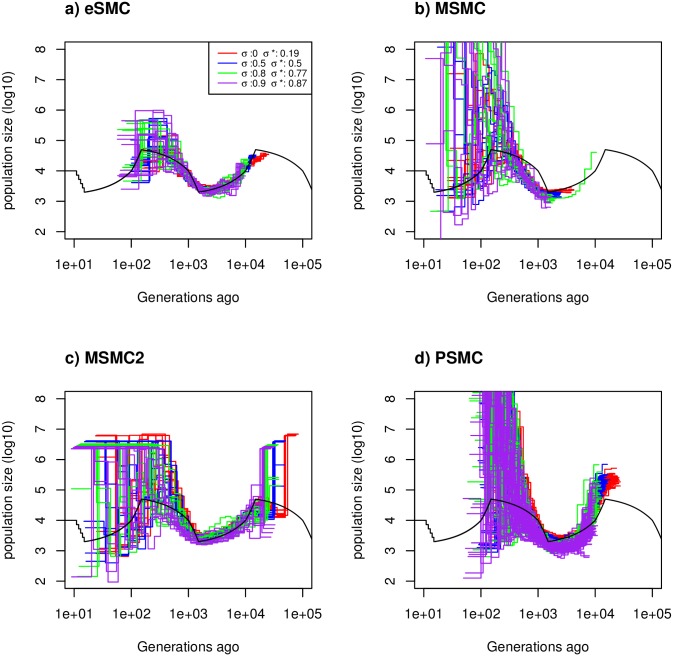
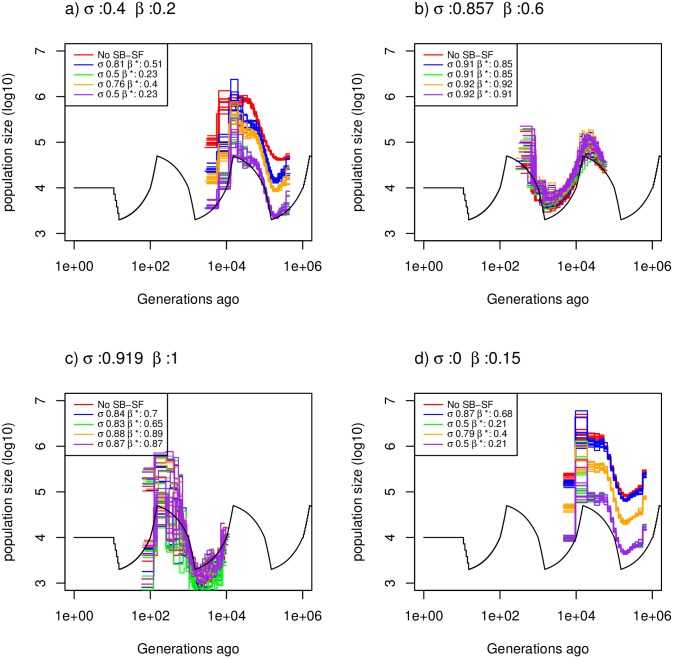
Several methods based on the Sequential Markovian coalescence (SMC) have been developed that make use of genome sequence data to uncover population demographic history, which is of interest in its own right and is a key requirement to generate a null model for selection tests. While these methods can be applied to all possible kind of species, the underlying assumptions are sexual reproduction in each generation and non-overlapping generations. However, in many plants, invertebrates, fungi and other taxa, those assumptions are often violated due to different ecological and life history traits, such as self-fertilization or long term dormant structures (seed or egg-banking). We develop a novel SMC-based method to infer 1) the rates/parameters of dormancy and of self-fertilization, and 2) the populations' past demographic history. Using simulated data sets, we demonstrate the accuracy of our method for a wide range of demographic scenarios and for sequence lengths from one to 30 Mb using four sampled genomes. Finally, we apply our method to a Swedish and a German population of Arabidopsis thaliana demonstrating a selfing rate of ca. 0.87 and the absence of any detectable seed-bank. In contrast, we show that the water flea Daphnia pulex exhibits a long lived egg-bank of three to 18 generations. In conclusion, we here present a novel method to infer accurate demographies and life-history traits for species with selfing and/or seed/egg-banks. Finally, we provide recommendations for the use of SMC-based methods for non-model organisms, highlighting the importance of the per site and the effective ratios of recombination over mutation.
已经开发了几种基于序列马尔可夫凝聚(SMC)的方法,这些方法利用基因组序列数据来揭示种群的历史,这本身就很有意义,也是生成选择测试的零模型的关键要求。虽然这些方法可适用于所有可能的物种,但基本假设是每一代的有性繁殖和非重叠世代。然而,在许多植物、无脊椎动物、真菌和其他类群中,由于不同的生态和生活史特征,如自交或长期休眠结构(种子或卵库),这些假设经常被违反。我们开发了一种新的基于 SMC 的方法来推断 1)休眠和自交的速率/参数,以及 2)种群的过去历史。使用模拟数据集,我们展示了我们的方法在广泛的人口统计情景和从 1 到 30 Mb 的序列长度范围内的准确性,使用了四个抽样基因组。最后,我们将我们的方法应用于瑞典和德国的拟南芥群体,证明了约 0.87 的自交率和没有任何可检测到的种子库。相比之下,我们表明水蚤 Daphnia pulex 具有三到十八代的长期休眠卵库。总之,我们在这里提出了一种新的方法,可以推断出具有自交和/或种子/卵库的物种的准确人口统计和生活史特征。最后,我们为非模型生物提供了基于 SMC 的方法的使用建议,强调了每个位点和重组相对于突变的有效比率的重要性。