Lewis-de Los Angeles C Paula, Williams Paige L, Jenkins Lisanne M, Huo Yanling, Malee Kathleen, Alpert Kathryn I, Uban Kristina A, Herting Megan M, Csernansky John G, Nichols Sharon L, Van Dyke Russell B, Sowell Elizabeth R, Wang Lei
Northwestern University Interdepartmental Neuroscience Program, Northwestern University, Chicago, IL, USA.
Department of Biostatistics, Harvard T.H. Chan School of Public Health, Boston MA, USA; Center for Biostatistics in AIDS Research, Harvard T.H. Chan School of Public Health, Boston, MA, USA.
Neuroimage Clin. 2020;26:102246. doi: 10.1016/j.nicl.2020.102246. Epub 2020 Mar 16.
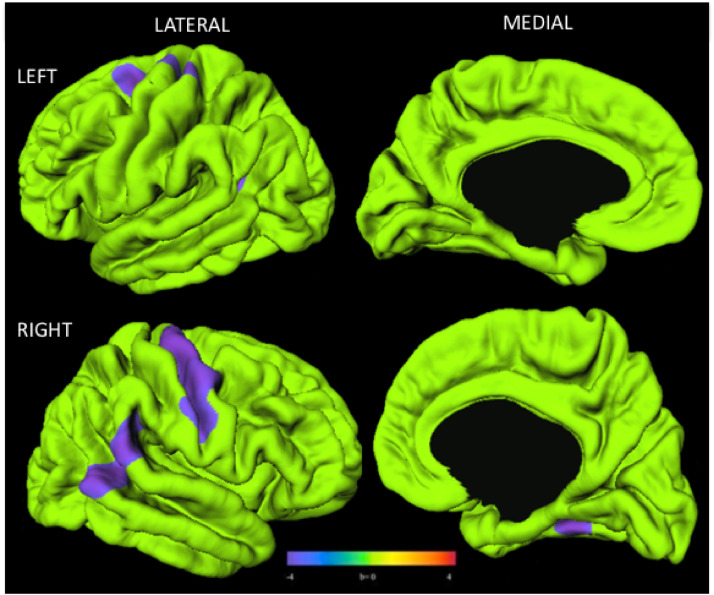
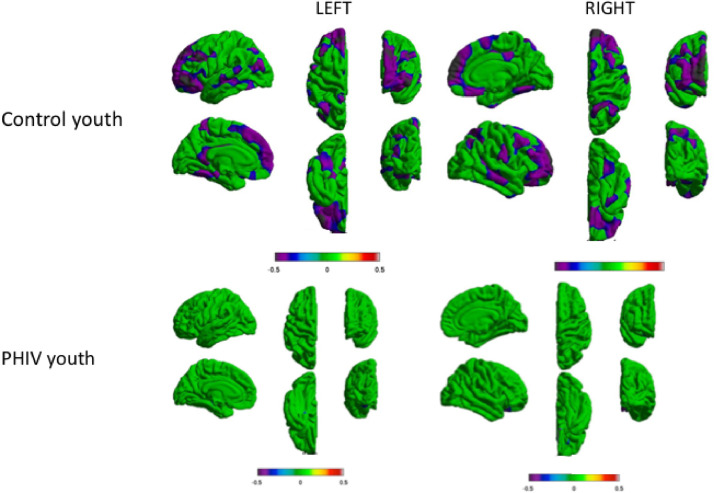
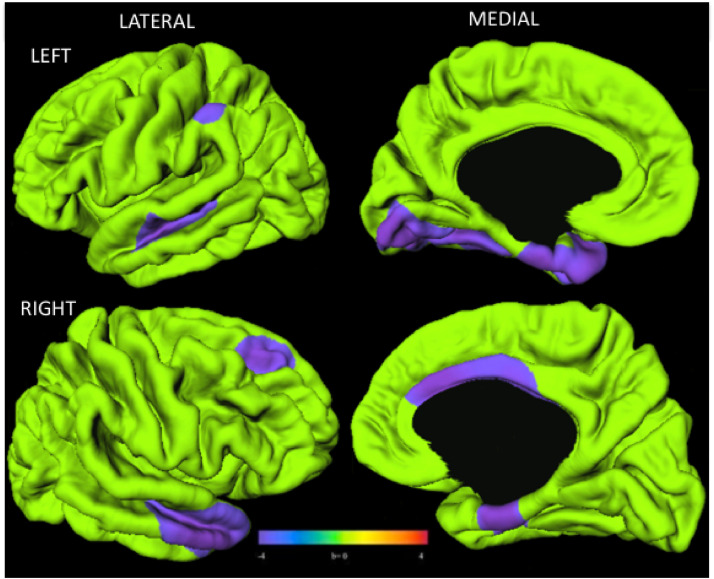
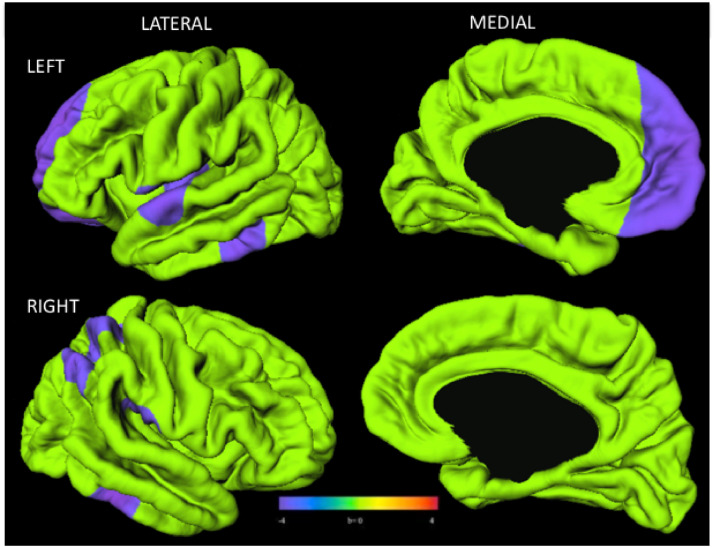
Youth with perinatally-acquired HIV (PHIV) experience specific and global cognitive deficits at increased rates compared to typically-developing HIV-uninfected youth. In youth with PHIV, HIV infects the brain early in development. Neuroimaging studies have demonstrated altered grey matter morphometry in youth with PHIV compared to typically-developing youth. This study examined cortical thickness, surface area, and gyrification of grey matter in youth (age 11-20 years old) with PHIV (n = 40) from the Pediatric HIV/AIDS Cohort Study (PHACS) compared to typically-developing presumed HIV uninfected and unexposed youth (n = 80) from the Pediatric Imaging, Neurocognition and Genetics Study (PING) using structural magnetic resonance imaging. This study also examined the relationship between grey matter morphometry and age. Youth with PHIV had reduced cortical thickness, surface area, and gyrification compared to typically-developing youth. In addition, an inverse relationship between age and grey matter volume was found in typically-developing youth, but was not observed in youth with PHIV. Longitudinal studies are necessary to understand the neurodevelopmental trajectory of youth with PHIV.
与正常发育的未感染艾滋病毒的青年相比,围产期感染艾滋病毒(PHIV)的青年出现特定和全面认知缺陷的几率更高。在患有PHIV的青年中,艾滋病毒在发育早期就会感染大脑。神经影像学研究表明,与正常发育的青年相比,患有PHIV的青年灰质形态学发生了改变。本研究使用结构磁共振成像,对比了来自儿科艾滋病毒/艾滋病队列研究(PHACS)的40名11至20岁患有PHIV的青年与来自儿科影像、神经认知和遗传学研究(PING)的80名推测未感染且未接触过艾滋病毒的正常发育青年的灰质皮质厚度、表面积和脑回形成情况。本研究还考察了灰质形态学与年龄之间的关系。与正常发育的青年相比,患有PHIV的青年皮质厚度、表面积和脑回形成均有所减少。此外,在正常发育的青年中发现年龄与灰质体积呈负相关,但在患有PHIV的青年中未观察到这种关系。有必要进行纵向研究以了解患有PHIV的青年的神经发育轨迹。