Department of Genetic and Metabolic Central Laboratory, Guangxi Maternal and Child Health Hospital, No.59, Xiangzhu Road, Nanning, China.
NanNing Region Center for Disease Prevention and Control, No.55, Xiangzhu Road, Nanning, China.
BMC Med Genet. 2020 Apr 6;21(1):72. doi: 10.1186/s12881-020-01008-y.
Propionic acidemia (PA) is an autosomal recessive metabolic disorder caused by the deficiency of the mitochondrial protein propionyl-CoA carboxylase (PCC) and is associated with pathogenic variants in either of the two genes PCCA or PCCB. The present study aimed to identify the genetic cause of three Chinese patients with PA.
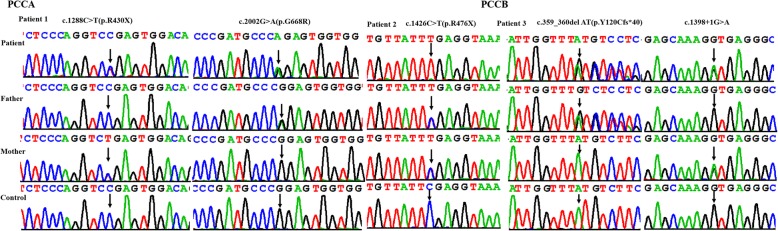
Three Chinese PA patients were diagnosed by using gas chromatography-mass spectrometry(GC-MS), tandem mass spectrometry (MS/MS) and molecular diagnostic methods. All patients had onset in the neonatal period. One patient died of infection and metabolic decompensation, and the other two had mild to moderate developmental delay/mental retardation. Mutation analysis of the PCCA gene identified that patient 1 carried the compound heterozygous c.1288C > T(p.R430X) and c.2002G > A(p.G668R), and patient 2 was homozygous for the c.1426C > T(p.R476X) mutation. Mutation analysis of the PCCB gene identified that patient 3 harbored the compound heterozygous mutations c.359_360del AT(p.Y120Cfs*40) and c.1398 + 1G > A. Among these mutations, three (c.1288C > T, c.359_360del AT and c.1398 + 1G > A) are novel.
We reported three Chinese PA patients who had PCCA or PCCB mutants. Among them, in the PCCA gene, c.1288C > T(p.R430X) was a nonsense mutation, resulting in a truncated protein. c.359_360del AT was a frameshift mutation, leading to a p.Y120Cfs*40 change in the amino acid sequence in the PCCB protein. c.1398 + 1G > A was a splicing mutation, causing skipping of the exons 13-14. In conclusion, the novel mutations uncovered in this study will expands the mutation spectrum of PA.
丙酸血症(PA)是一种常染色体隐性遗传代谢疾病,由线粒体蛋白丙酰基辅酶 A 羧化酶(PCC)缺乏引起,与 PCCA 或 PCCB 两个基因中的任何一个致病性变异有关。本研究旨在确定 3 例中国 PA 患者的遗传病因。
通过气相色谱-质谱联用仪(GC-MS)、串联质谱(MS/MS)和分子诊断方法诊断出 3 例中国 PA 患者。所有患者均在新生儿期发病。1 例患者死于感染和代谢失代偿,另外 2 例患者有轻度至中度发育迟缓/智力障碍。PCCA 基因突变分析发现患者 1 携带复合杂合性 c.1288C>T(p.R430X)和 c.2002G>A(p.G668R),患者 2 为纯合性 c.1426C>T(p.R476X)突变。PCCB 基因突变分析发现患者 3 携带复合杂合性突变 c.359_360del AT(p.Y120Cfs*40)和 c.1398+1G>A。这些突变中,有 3 个(c.1288C>T、c.359_360del AT 和 c.1398+1G>A)是新的。
我们报道了 3 例中国 PA 患者,他们携带 PCCA 或 PCCB 突变体。其中,在 PCCA 基因中,c.1288C>T(p.R430X)是无义突变,导致截短蛋白。c.359_360del AT 是移码突变,导致 PCCB 蛋白的氨基酸序列发生 p.Y120Cfs*40 改变。c.1398+1G>A 是剪接突变,导致外显子 13-14 跳过。总之,本研究发现的新突变扩展了 PA 的突变谱。