School of Biomedical Sciences, Faculty of Medicine, The Chinese University of Hong Kong, Hong Kong, China.
Department of Nephrology, The Seventh Affiliated Hospital, Sun Yat-sen University, Shenzhen, China.
J Am Soc Nephrol. 2020 May;31(5):946-961. doi: 10.1681/ASN.2019101052. Epub 2020 Apr 6.
The serine/threonine kinases MST1 and MST2 are core components of the Hippo pathway, which has been found to be critically involved in embryonic kidney development. Yes-associated protein (YAP) and transcriptional coactivator with PDZ-binding motif (TAZ) are the pathway's main effectors. However, the biologic functions of the Hippo/YAP pathway in adult kidneys are not well understood, and the functional role of MST1 and MST2 in the kidney has not been studied.
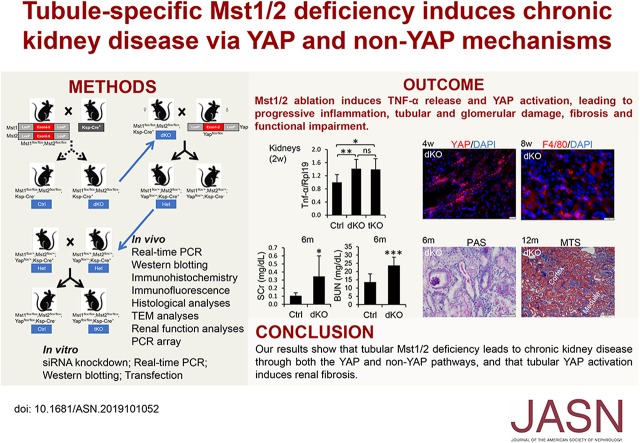
We used immunohistochemistry to examine expression in mouse kidneys of MST1 and MST2, homologs of Hippo in . We generated mice with tubule-specific double knockout of Mst1 and Mst2 or triple knockout of Mst1, Mst2, and Yap. PCR array and mouse inner medullary collecting duct cells were used to identify the primary target of Mst1/Mst2 deficiency.
MST1 and MST2 were predominantly expressed in the tubular epithelial cells of adult kidneys. Deletion of Mst1/Mst2 in renal tubules increased activity of YAP but not TAZ. The kidneys of mutant mice showed progressive inflammation, tubular and glomerular damage, fibrosis, and functional impairment; these phenotypes were largely rescued by deletion of Yap in renal tubules. TNF- expression was induced both YAP-dependent and YAP-independent mechanisms, and TNF- and YAP amplified the signaling activities of each other in the tubules of kidneys with double knockout of Mst1/Mst2.
Our findings show that tubular Mst1/Mst2 deficiency leads to CKD through both the YAP and non-YAP pathways and that tubular YAP activation induces renal fibrosis. The pathogenesis seems to involve the reciprocal stimulation of TNF- and YAP signaling activities.
丝氨酸/苏氨酸激酶 MST1 和 MST2 是 Hippo 通路的核心组成部分,该通路被发现对胚胎肾脏发育至关重要。Yes 相关蛋白 (YAP) 和含有 PDZ 结合基序的转录共激活因子 (TAZ) 是该通路的主要效应物。然而,Hippo/YAP 通路在成人肾脏中的生物学功能尚不清楚,MST1 和 MST2 在肾脏中的功能作用也尚未研究。
我们使用免疫组织化学方法检测. 中 Hippo 的同源物 MST1 和 MST2 在小鼠肾脏中的表达。我们生成了小管特异性双敲除 Mst1 和 Mst2 或三重敲除 Mst1、Mst2 和 yap 的小鼠。使用 PCR 阵列和小鼠内髓集合管细胞鉴定 Mst1/Mst2 缺失的主要靶标。
MST1 和 MST2 在成年肾脏的管状上皮细胞中表达丰富。肾小管中 Mst1/Mst2 的缺失增加了 YAP 的活性,但不增加 TAZ 的活性。突变小鼠的肾脏表现出进行性炎症、肾小管和肾小球损伤、纤维化和功能障碍;这些表型在肾小管中缺失 yap 后得到了很大程度的挽救。TNF-的表达通过 YAP 依赖和非 YAP 依赖机制被诱导,并且在 Mst1/Mst2 双敲除的肾小管中,TNF-和 YAP 相互放大彼此的信号活性。
我们的研究结果表明,肾小管 Mst1/Mst2 的缺乏通过 YAP 和非 YAP 途径导致 CKD,并且肾小管中 YAP 的激活诱导肾脏纤维化。发病机制似乎涉及 TNF-和 YAP 信号活性的相互刺激。