School of Coastal and Marine Systems Science, Coastal Carolina University, Conway, SC 29526, USA.
School of Zoology, Faculty of Life Sciences, Tel Aviv University, Tel Aviv 69978, Israel
J Exp Biol. 2020 May 11;223(Pt 9):jeb214734. doi: 10.1242/jeb.214734.
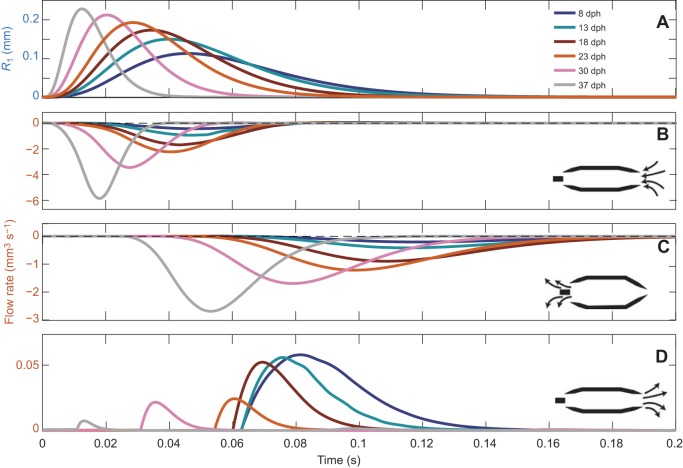
Fish larvae are the smallest self-sustaining vertebrates. As such, they face multiple challenges that stem from their minute size, and from the hydrodynamic regime in which they dwell. This regime, of intermediate Reynolds numbers, was shown to affect the swimming of larval fish and impede their ability to capture prey. Prey capture is impeded because smaller larvae produce weaker suction flows, exerting weaker forces on the prey. Previous observations on feeding larvae also showed prey exiting the mouth after initially entering it (hereafter 'in-and-out'), although the mechanism causing such failures had been unclear. In this study, we used numerical simulations to investigate the hydrodynamic mechanisms responsible for the failure to feed caused by this in-and-out prey movement. Detailed kinematics of the expanding mouth during prey capture by larval were used to parameterize age-specific numerical models of the flows inside the mouth. These models revealed that for small larvae which expand their mouth slowly, fluid entering the mouth cavity is expelled through the mouth before it is closed, resulting in flow reversal at the orifice. This relative efflux of water through the mouth was >8% of the influx through the mouth for younger ages. However, similar effluxes were found when we simulated slow strikes by larger fish. The simulations can explain the observations of larval fish failing to feed because of the in-and-out movement of the prey. These results further highlight the importance of transporting the prey from the gape deeper into the mouth cavity in determining suction-feeding success.
鱼类幼体是最小的自维持脊椎动物。由于体型微小,以及所处的中等雷诺数水动力环境,它们面临着诸多挑战。这种水动力环境会影响幼鱼的游动,阻碍它们捕食猎物的能力。幼鱼捕食受阻是因为较小的幼体产生的吸力流较弱,对猎物施加的力较弱。先前对摄食幼鱼的观察也表明,猎物在最初进入口腔后会离开口腔(以下简称“进进出出”),尽管导致这种失败的机制尚不清楚。在这项研究中,我们使用数值模拟来研究导致这种进进出出猎物运动导致摄食失败的水动力机制。通过对幼鱼在捕食过程中口部扩张的详细运动学进行研究,我们对口腔内的流动进行了年龄特异性的数值模拟。这些模型表明,对于口部扩张缓慢的小型幼鱼,在口部关闭之前,进入口腔的流体就会被排出口腔,导致口部的流动发生逆转。在幼鱼时期,这种通过口部的相对水流反流大于通过口部的流入量的 8%。然而,当我们模拟较大鱼类的缓慢攻击时,也发现了类似的反流。这些模拟结果可以解释幼鱼因猎物的进进出出运动而无法进食的观察结果。这些结果进一步强调了将猎物从口裂深处输送到口腔腔室中对于确定抽吸摄食成功的重要性。