Callara Alejandro Luis, Magliaro Chiara, Ahluwalia Arti, Vanello Nicola
Research Center "E. Piaggio" - University of Pisa, Pisa, Italy.
Dipartimento di Ingegneria dell'Informazione, University of Pisa, Pisa, Italy.
Front Neuroinform. 2020 Mar 17;14:9. doi: 10.3389/fninf.2020.00009. eCollection 2020.
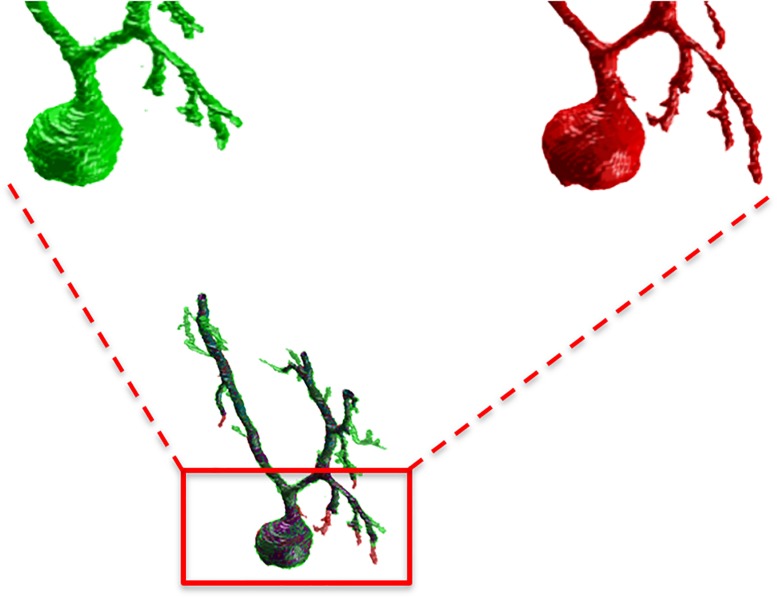
Accurately digitizing the brain at the micro-scale is crucial for investigating brain structure-function relationships and documenting morphological alterations due to neuropathies. Here we present a new Smart Region Growing algorithm (SmRG) for the segmentation of single neurons in their intricate 3D arrangement within the brain. Its Region Growing procedure is based on a homogeneity predicate determined by describing the pixel intensity statistics of confocal acquisitions with a mixture model, enabling an accurate reconstruction of complex 3D cellular structures from high-resolution images of neural tissue. The algorithm's outcome is a 3D matrix of logical values identifying the voxels belonging to the segmented structure, thus providing additional useful volumetric information on neurons. To highlight the algorithm's full potential, we compared its performance in terms of accuracy, reproducibility, precision and robustness of 3D neuron reconstructions based on microscopic data from different brain locations and imaging protocols against both manual and state-of-the-art reconstruction tools.
在微观尺度上精确数字化大脑对于研究脑结构-功能关系以及记录神经病变引起的形态学改变至关重要。在此,我们提出一种新的智能区域生长算法(SmRG),用于分割大脑中复杂三维排列的单个神经元。其区域生长过程基于一个同质性谓词,该谓词通过用混合模型描述共聚焦采集的像素强度统计来确定,从而能够从神经组织的高分辨率图像中准确重建复杂的三维细胞结构。该算法的结果是一个逻辑值的三维矩阵,用于识别属于分割结构的体素,从而提供有关神经元的额外有用体积信息。为了突出该算法的全部潜力,我们基于来自不同脑区和成像协议的微观数据,将其在三维神经元重建的准确性、可重复性、精度和稳健性方面的性能与手动和最先进的重建工具进行了比较。