Kc Pramod, Chu Xi, Kvello Pål, Zhao Xin-Cheng, Wang Gui-Rong, Berg Bente Gunnveig
Chemosensory Laboratory, Department of Psychology, Norwegian University of Science and Technology (NTNU), Trondheim, Norway.
Department of Teacher Education, Norwegian University of Science and Technology (NTNU), Trondheim, Norway.
Front Physiol. 2020 Mar 17;11:202. doi: 10.3389/fphys.2020.00202. eCollection 2020.
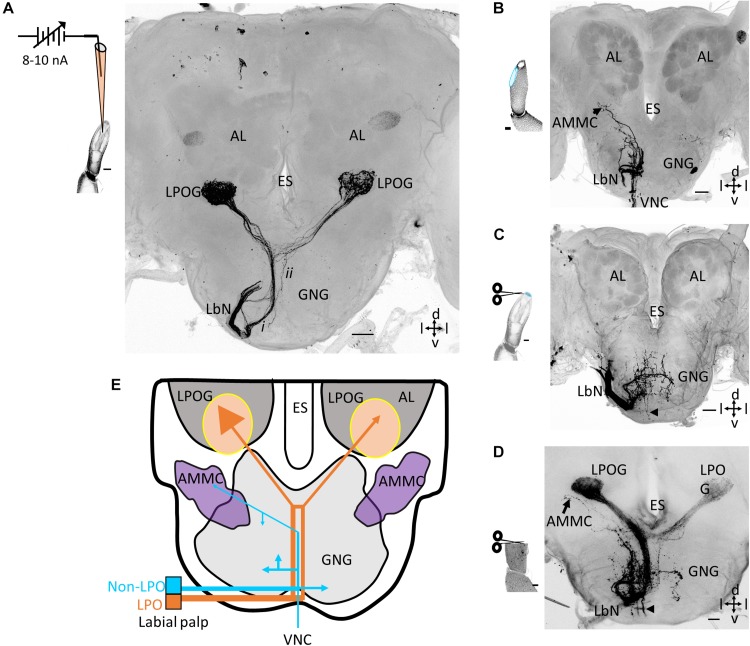
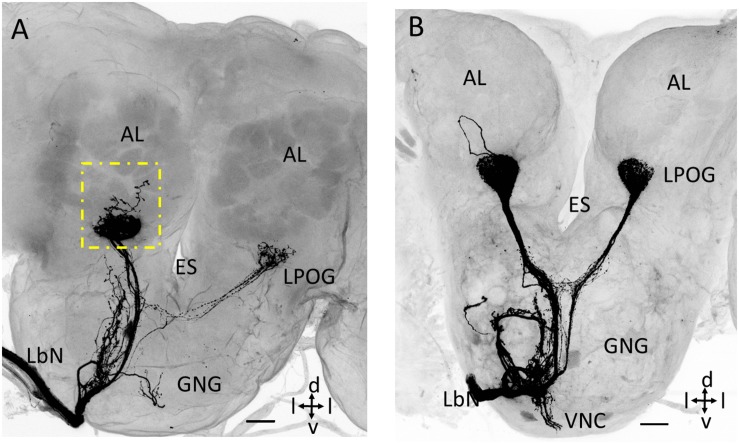
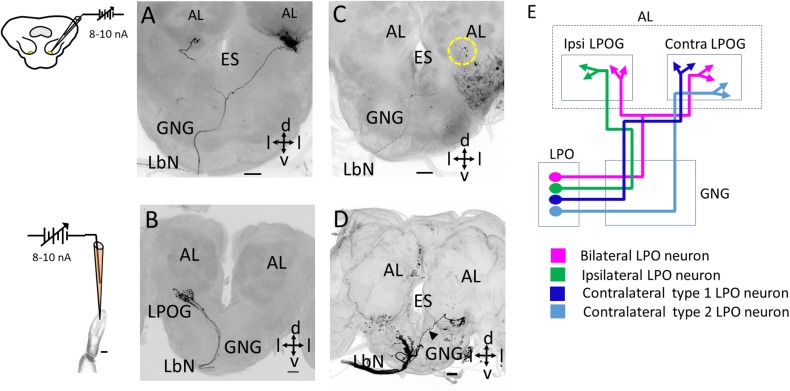
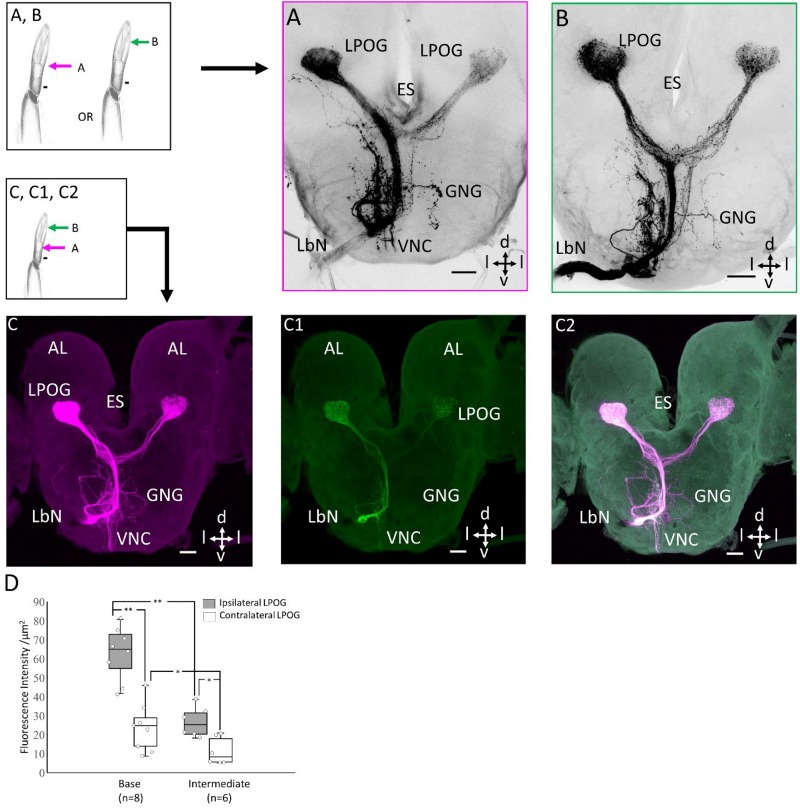
Lepidopteran species detect CO via a specialized organ located on the peripheral segment of the labial palps, the labial palp pit organ (LPO). Based on tracing of LPO sensory neurons targeting one distinct antennal-lobe glomerulus, Kent and her colleagues described the projections originating from the LPO in the sphinx moth as "" already in the 1980 ties. In spite of similar reports from studies of other lepidopteran species, however, it has been an unresolved issue whether additional termination areas of the labial nerve, such as the gnathal ganglion (GNG) and the ventral nerve cord, are actually output sites of LPO neurons. Since the previous studies have interpreted slightly differently about the projection pattern occurring from the classical mass staining, we performed selective mass staining from the inside of the pit and from the outer surface of the peripheral palp. The results demonstrated that the LPO sensory neurons project exclusively to the LPO glomerulus (LPOG), whereas the non-LPO sensory neurons target the GNG and the ventral nerve cord. Additional iontophoretic staining of individual LPO sensory neurons, performed from the LPO and the LPOG, showed three morphological neuron types: one bilateral targeting the LPOG in both antennal lobes, one unilateral targeting the ipsilateral LPOG only, and one contralateral targeting the LPOG in the other antennal lobe. Finally, to explore putative differences in the projection pattern of neurons housed by two previously reported sensillum types in the pit, i.e., hair-shaped sensilla located distally and club-shaped sensilla located proximally, we performed mass staining from two different levels of the peripheral palp. We found a projection pattern implying stronger innervation of the ipsi- than the contralateral LPOG in both staining experiments.
鳞翅目昆虫通过位于唇须外周节段的一个特殊器官——唇须凹器官(LPO)来检测二氧化碳。基于对靶向一个独特触角叶神经球的LPO感觉神经元的追踪,肯特及其同事在20世纪80年代就描述了天蛾中源自LPO的投射。然而,尽管其他鳞翅目昆虫的研究也有类似报道,但唇神经的其他终末区域,如颚神经节(GNG)和腹神经索,是否实际上是LPO神经元的输出位点,一直是一个未解决的问题。由于先前的研究对经典的整体染色所呈现的投射模式解释略有不同,我们从凹内部和外周唇须的外表面进行了选择性整体染色。结果表明,LPO感觉神经元仅投射到LPO神经球(LPOG),而非LPO感觉神经元则靶向GNG和腹神经索。从LPO和LPOG对单个LPO感觉神经元进行的额外离子电渗染色显示出三种形态的神经元类型:一种双侧靶向两个触角叶中的LPOG,一种单侧仅靶向同侧的LPOG,还有一种对侧靶向另一个触角叶中的LPOG。最后,为了探究凹中先前报道的两种感觉器类型(即远端的毛形感觉器和近端的棒形感觉器)所包含的神经元投射模式的假定差异,我们从外周唇须的两个不同水平进行了整体染色。我们发现在两个染色实验中,投射模式都表明同侧LPOG的神经支配比异侧更强。