Ma Bai-Wei, Zhao Xin-Cheng, Berg Bente G, Xie Gui-Ying, Tang Qing-Bo, Wang Gui-Rong
Department of Entomology, College of Plant Protection, Henan Agricultural University, Zhengzhou, China.
Department of Psychology, Norwegian University of Science and Technology, Trondheim, Norway.
Front Cell Neurosci. 2017 Nov 21;11:370. doi: 10.3389/fncel.2017.00370. eCollection 2017.
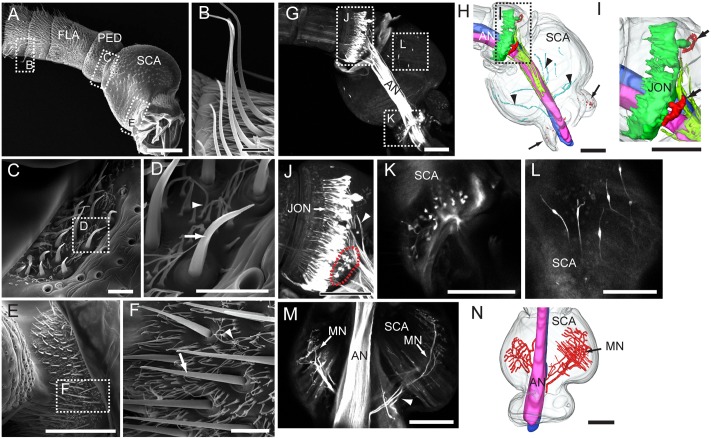
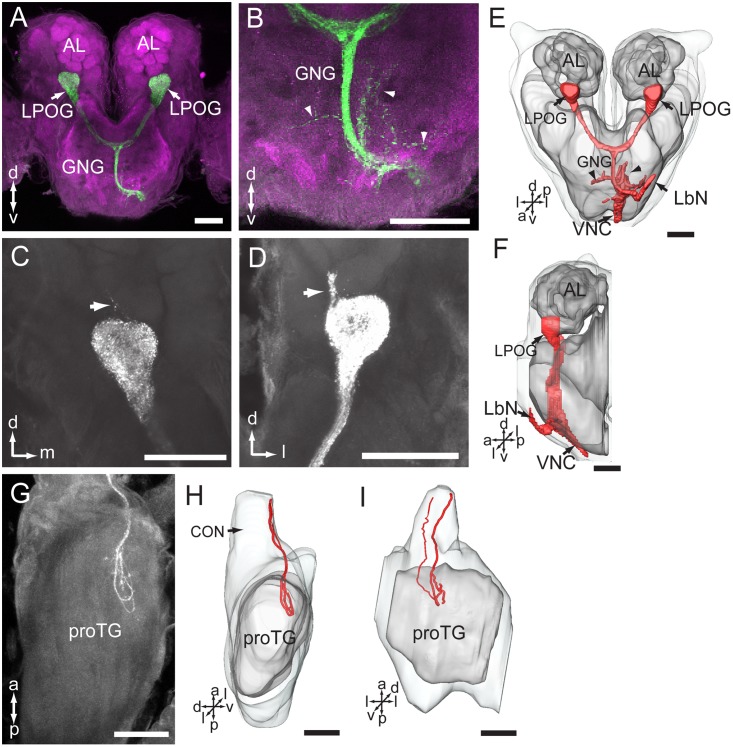
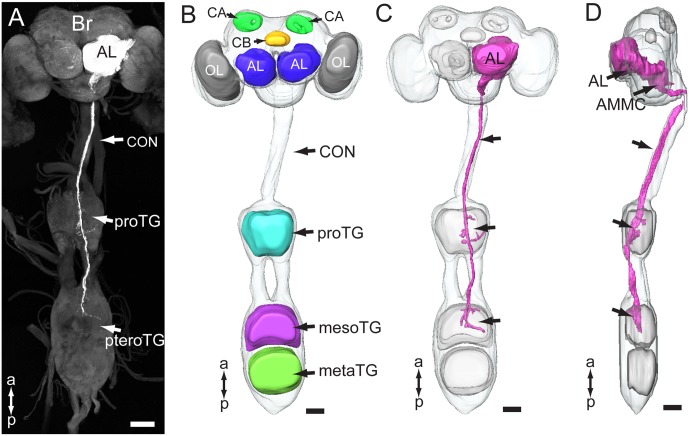
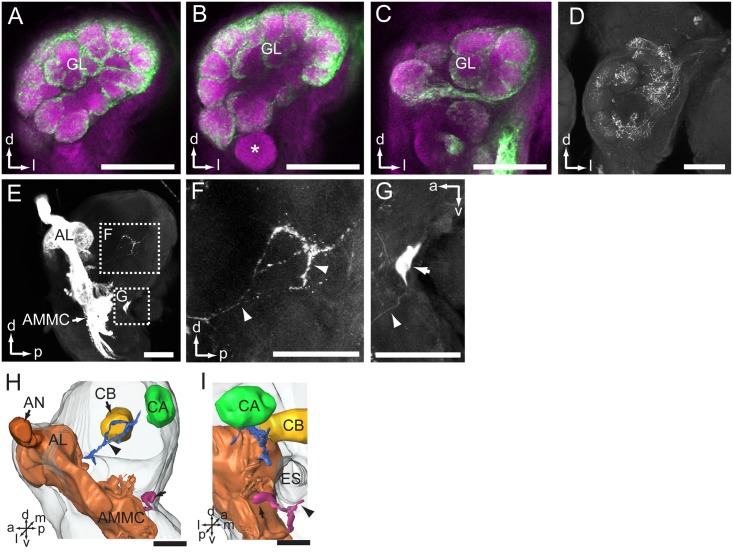
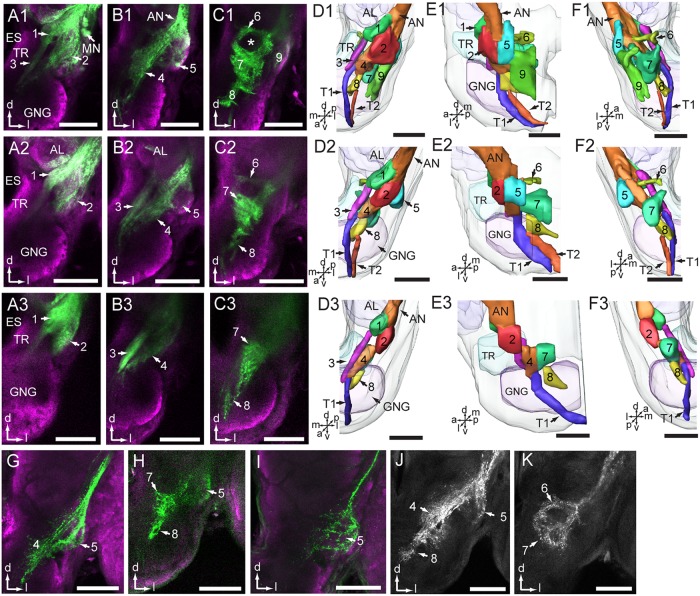
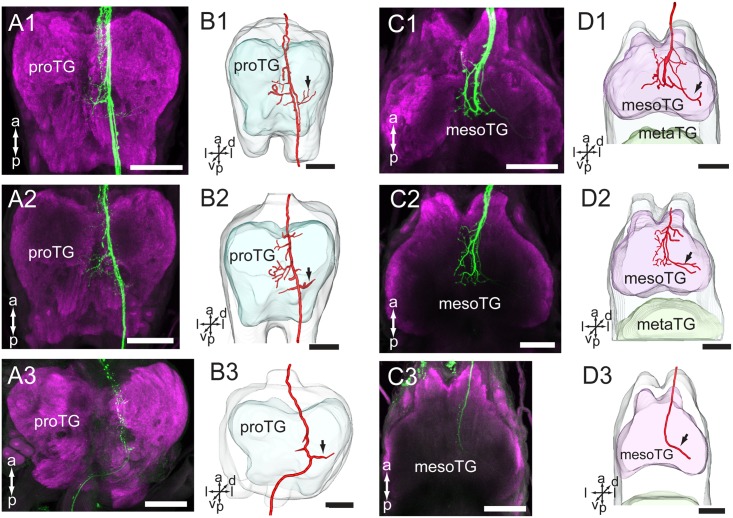
The oriental armyworm, (Walker), is a polyphagous, migratory pest relying on olfactory cues to find mates, locate nectar, and guide long-distance flight behavior. In the present study, a combination of neuroanatomical techniques were utilized on this species, including backfills, confocal microscopy, and three-dimensional reconstructions, to trace the central projections of sensory neurons from the antenna and the labial pit organ, respectively. As previously shown, the axons of the labial sensory neurons project via the ipsilateral labial nerve and terminate in three main areas of the central nervous system: (1) the labial-palp pit organ glomerulus of each antennal lobe, (2) the gnathal ganglion, and (3) the prothoracic ganglion of the ventral nerve cord. Similarly, the antennal sensory axons project to multiple areas of the central nervous system. The ipsilateral antennal nerve targets mainly the antennal lobe, the antennal mechanosensory and motor center, and the prothoracic and mesothoracic ganglia. Specific staining experiments including dye application to each of the three antennal segments indicate that the antennal lobe receives input from flagellar olfactory neurons exclusively, while the antennal mechanosensory and motor center is innervated by mechanosensory neurons from the whole antenna, comprising the flagellum, pedicle, and scape. The terminals in the mechanosensory and motor center are organized in segregated zones relating to the origin of neurons. The flagellar mechanosensory axons target anterior zones, while the pedicular and scapal axons terminate in posterior zones. In the ventral nerve cord, the processes from the antennal sensory neurons terminate in the motor area of the thoracic ganglia, suggesting a close connection with motor neurons. Taken together, the numerous neuropils innervated by axons both from the antenna and labial palp indicate the multiple roles these sensory organs serve in insect behavior.
东方黏虫(Walker)是一种多食性迁飞害虫,依靠嗅觉线索寻找配偶、定位花蜜并引导远距离飞行行为。在本研究中,对该物种运用了多种神经解剖学技术,包括反向填充、共聚焦显微镜和三维重建,以分别追踪来自触角和唇窝器官的感觉神经元的中枢投射。如先前所示,唇感觉神经元的轴突通过同侧唇神经投射,并在中枢神经系统的三个主要区域终止:(1)每个触角叶的唇须窝器官小球;(2)颚神经节;(3)腹神经索的前胸神经节。同样,触角感觉轴突投射到中枢神经系统的多个区域。同侧触角神经主要靶向触角叶、触角机械感觉和运动中心以及前胸和中胸神经节。包括对触角的三个节段分别进行染料涂抹的特定染色实验表明,触角叶仅接收来自鞭节嗅觉神经元的输入,而触角机械感觉和运动中心由来自整个触角(包括鞭节、梗节和柄节)的机械感觉神经元支配。机械感觉和运动中心的终端按与神经元起源相关的隔离区域组织。鞭节机械感觉轴突靶向前部区域,而梗节和柄节的轴突在后部区域终止。在腹神经索中,触角感觉神经元的突起在胸神经节的运动区域终止,表明与运动神经元有密切联系。综上所述,来自触角和唇须的轴突支配的众多神经纤维网表明这些感觉器官在昆虫行为中发挥的多种作用。