Gkolfinopoulos Stavros, Jones Robin L, Constantinidou Anastasia
BOC Oncology Center, Nicosia, Cyprus.
The Royal Marsden Hospital NHS Foundation Trust and Institute of Cancer Research, London, United Kingdom.
Front Oncol. 2020 Mar 18;10:374. doi: 10.3389/fonc.2020.00374. eCollection 2020.
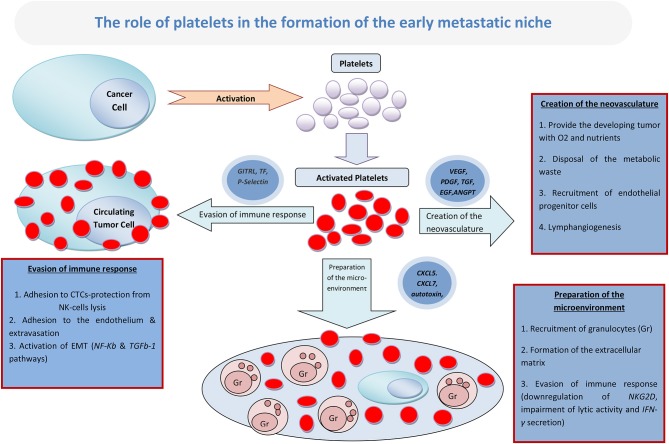
Accumulating evidence suggests that platelets play a key role in cancer metastatic dissemination through their multilevel interaction with tumor cells. Most crucial is the contribution of platelets to the formation and expansion of the early metastatic niche, a protective microenvironment that nurtures the first metastatic cells and is necessary for the establishment of overt metastatic disease. A multitude of mechanisms have been proposed toward this effect. The current review examines the implication of platelets in the three most well-studied mechanisms: (a) the initial preparation of the metastatic microenvironment by the formation of the extracellular matrix (ECM) and the recruitment of granulocytes, (b) the creation of the neovasculature (important for providing the developing tumor with oxygen and nutrients and clearing away the metabolic waste), and (c) the evasion of the immune response by the creation of an immune-suppressive environment around the developing metastases. Finally, the review provides current perspectives on the potential clinical relevance of platelets in cancer progression and their consequent role in cancer therapeutics.
越来越多的证据表明,血小板通过与肿瘤细胞的多层次相互作用,在癌症转移扩散中发挥关键作用。血小板对早期转移微环境的形成和扩展的贡献最为关键,早期转移微环境是一种保护性微环境,滋养着首批转移细胞,对于明显转移性疾病的建立至关重要。针对这一效应,人们提出了多种机制。本综述探讨了血小板在三种研究最为充分的机制中的作用:(a) 通过形成细胞外基质(ECM)和募集粒细胞对转移微环境进行初始准备;(b) 形成新血管(这对于为发育中的肿瘤提供氧气和营养物质以及清除代谢废物很重要);(c) 通过在发育中的转移灶周围创建免疫抑制环境来逃避免疫反应。最后,本综述提供了关于血小板在癌症进展中的潜在临床相关性及其在癌症治疗中相应作用的当前观点。