Sarkar Dipayan, Walker-Swaney Jacob, Shetty Kalidas
Department of Plant Sciences.
Environmental and Conservation Science Program.
Curr Dev Nutr. 2019 Sep 2;4(Suppl 1):3-11. doi: 10.1093/cdn/nzz099. eCollection 2020 Jan.
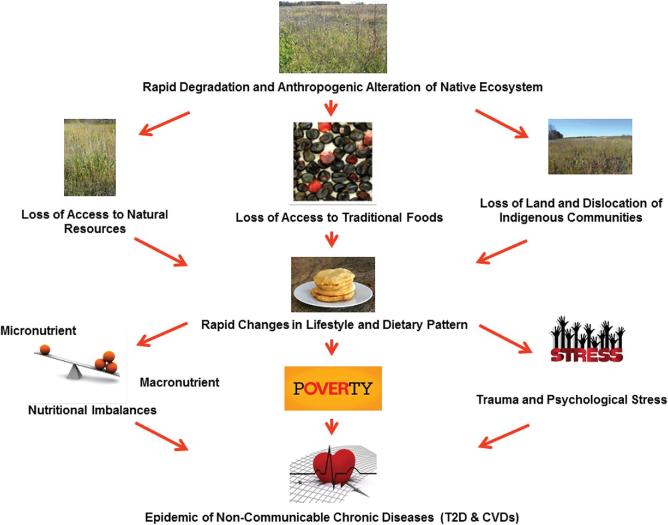
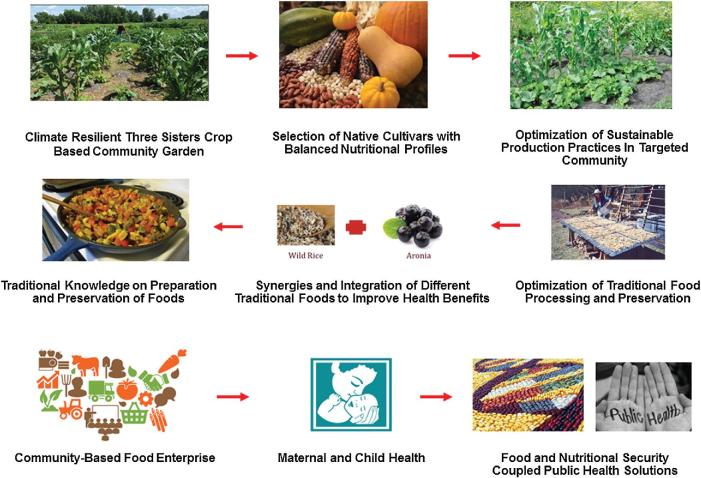
Improving food and nutritional diversity based on the diversity of traditional plant-based foods is an important dietary strategy to address the challenges of rapidly emerging diet- and lifestyle-linked noncommunicable chronic diseases (NCDs) of indigenous communities worldwide. Restoration of native ecosystems, revival of traditional food crop cultivation, and revival of traditional knowledge of food preparation, processing, and preservation are important steps to build dietary support strategies against an NCD epidemic of contemporary indigenous communities. Recent studies have indicated that many traditional plant-based foods of Native Americans provide a rich source of human health-relevant bioactive compounds with diverse health benefits. Based on this rationale of health benefits of traditional plant-based foods, the objective of this review is to present a state-of-the-art comprehensive framework for ecologically and culturally relevant sustainable strategies to restore and integrate the traditional plant food diversity of Native Americans to address the NCD challenges of indigenous and wider nonindigenous communities worldwide.
基于传统植物性食物的多样性来改善食物和营养多样性,是应对全球土著社区迅速出现的与饮食和生活方式相关的非传染性慢性病(NCDs)挑战的一项重要饮食策略。恢复原生生态系统、复兴传统粮食作物种植以及复兴食物制备、加工和保存的传统知识,是构建应对当代土著社区非传染性疾病流行的饮食支持策略的重要步骤。最近的研究表明,许多美洲原住民的传统植物性食物富含与人类健康相关的生物活性化合物,具有多种健康益处。基于传统植物性食物对健康有益的这一基本原理,本综述的目的是提出一个最新的综合框架,以制定生态和文化相关的可持续策略,恢复并整合美洲原住民的传统植物食物多样性,应对全球土著及更广泛非土著社区的非传染性疾病挑战。