Zhou Minghui, Lankelma Marianne, van der Vlugt Jarl Ivar, de Bruin Bas
Homogeneous, Supramolecular and Bio-Inspired Catalysis group (HomKat), Van't Hoff Institute for Molecular Sciences (HIMS), University of Amsterdam (UvA), Science Park 904, 1098, XH, Amsterdam, The Netherlands.
Angew Chem Int Ed Engl. 2020 Jun 26;59(27):11073-11079. doi: 10.1002/anie.202002674. Epub 2020 Apr 24.
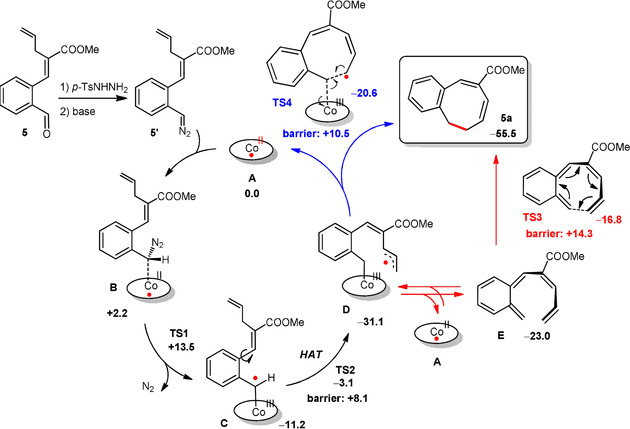
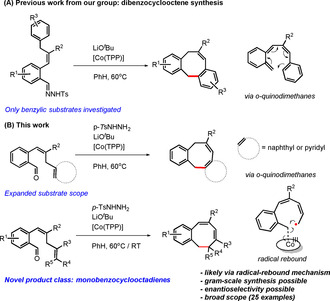
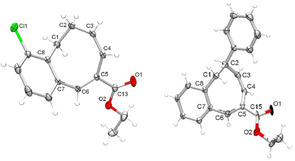
The metalloradical activation of o-aryl aldehydes with tosylhydrazide and a cobalt(II) porphyrin catalyst produces cobalt(III)-carbene radical intermediates, providing a new and powerful strategy for the synthesis of medium-sized ring structures. Herein we make use of the intrinsic radical-type reactivity of cobalt(III)-carbene radical intermediates in the [Co (TPP)]-catalyzed (TPP=tetraphenylporphyrin) synthesis of two types of 8-membered ring compounds; novel dibenzocyclooctenes and unprecedented monobenzocyclooctadienes. The method was successfully applied to afford a variety of 8-membered ring compounds in good yields and with excellent substituent tolerance. Density functional theory (DFT) calculations and experimental results suggest that the reactions proceed via hydrogen atom transfer from the bis-allylic/benzallylic C-H bond to the carbene radical, followed by two divergent processes for ring-closure to the two different types of 8-membered ring products. While the dibenzocyclooctenes are most likely formed by dissociation of o-quinodimethanes (o-QDMs) which undergo a non-catalyzed 8π-cyclization, DFT calculations suggest that ring-closure to the monobenzocyclooctadienes involves a radical-rebound step in the coordination sphere of cobalt. The latter mechanism implies that unprecedented enantioselective ring-closure reactions to chiral monobenzocyclooctadienes should be possible, as was confirmed for reactions mediated by a chiral cobalt-porphyrin catalyst.
用对甲苯磺酰肼和钴(II)卟啉催化剂对邻芳基醛进行金属自由基活化可生成钴(III)-卡宾自由基中间体,这为中型环结构的合成提供了一种全新且强大的策略。在此,我们利用钴(III)-卡宾自由基中间体在[Co(TPP)](TPP = 四苯基卟啉)催化下的固有自由基型反应活性,合成了两类八元环化合物;新型二苯并环辛烯和前所未有的单苯并环辛二烯。该方法成功应用于多种八元环化合物的合成,产率良好且具有出色的取代基耐受性。密度泛函理论(DFT)计算和实验结果表明,反应通过双烯丙基/苄基C-H键向卡宾自由基的氢原子转移进行,随后通过两个不同的过程闭环生成两种不同类型的八元环产物。虽然二苯并环辛烯很可能是由邻醌二甲烷(o-QDMs)解离形成的,后者经历了非催化的8π环化,但DFT计算表明,单苯并环辛二烯的闭环涉及钴配位球中的自由基反弹步骤。后一种机制意味着,对手性单苯并环辛二烯进行前所未有的对映选择性闭环反应应该是可行的,这在手性钴卟啉催化剂介导的反应中得到了证实。