Department of Anatomy, Physiology, and Cell Biology, School of Veterinary Medicine, University of California Davis, 1 Shields Ave, Davis, CA, United States.
Department of Molecular Biosciences, School of Veterinary Medicine, University of California Davis, Davis, CA, United States.
Physiol Behav. 2020 Jul 1;221:112894. doi: 10.1016/j.physbeh.2020.112894. Epub 2020 Apr 4.
Consumption of high-fat diet (HF) leads to hyperphagia and increased body weight in male rodents. Female rodents are relatively resistant to hyperphagia and weight gain in response to HF, in part via effects of estrogen that suppresses food intake and increases energy expenditure. However, sex differences in energy expenditure and activity levels with HF challenge have not been systemically described. We hypothesized that, in response to short-term HF feeding, female mice will have a higher energy expenditure and be more resistant to HF-induced hyperphagia than male mice.
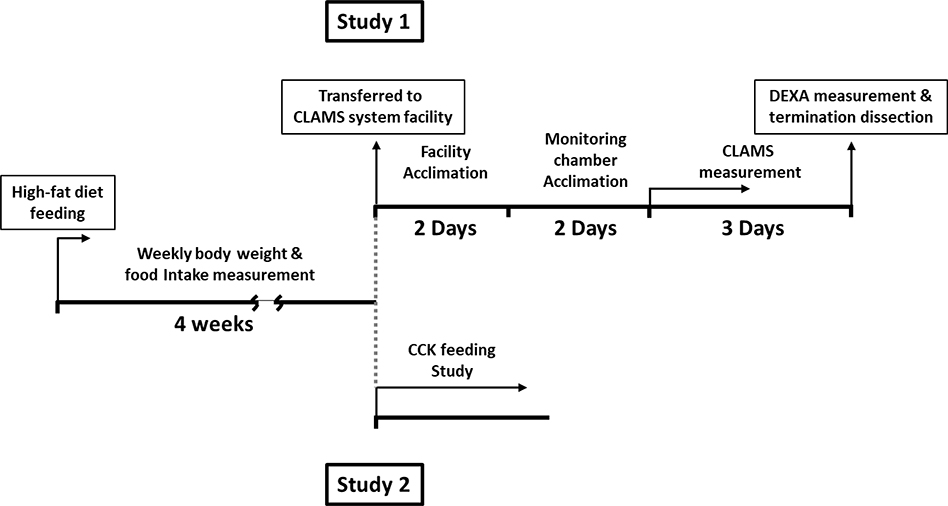
Six-week-old male and female C57BL/6 J mice were fed either low fat (LF, 10% fat) or moderate HF (45% fat) for 5 weeks, and energy expenditure, activity and meal pattern measured using comprehensive laboratory animal monitoring system (CLAMS).
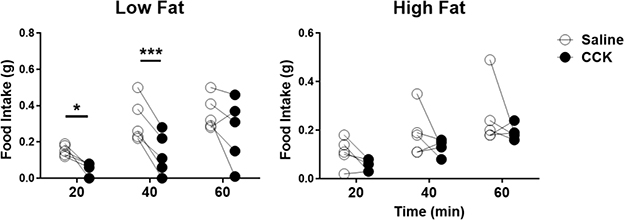
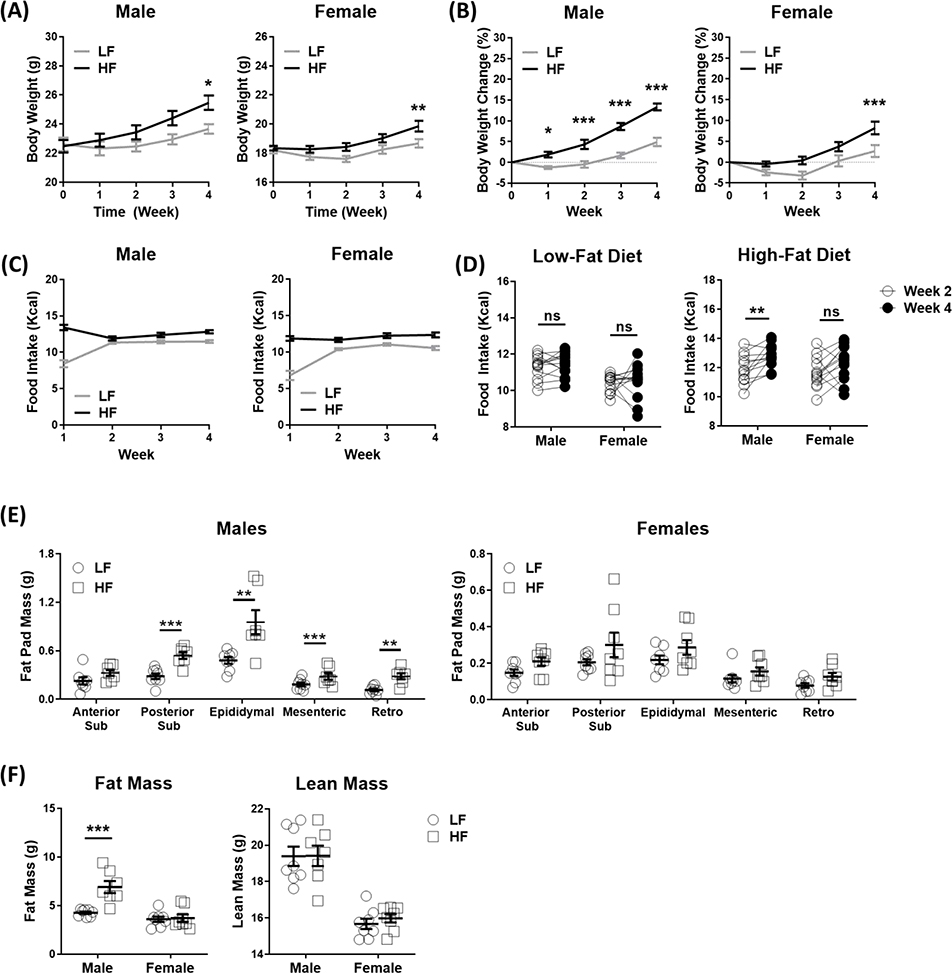
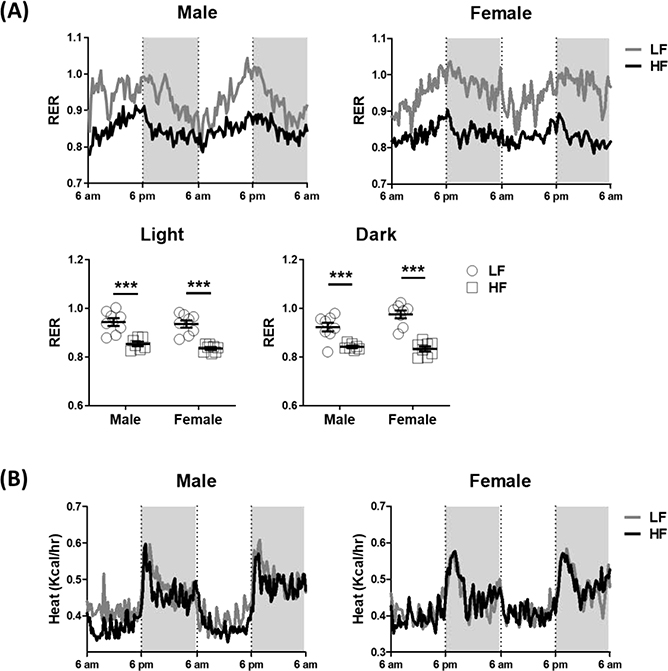
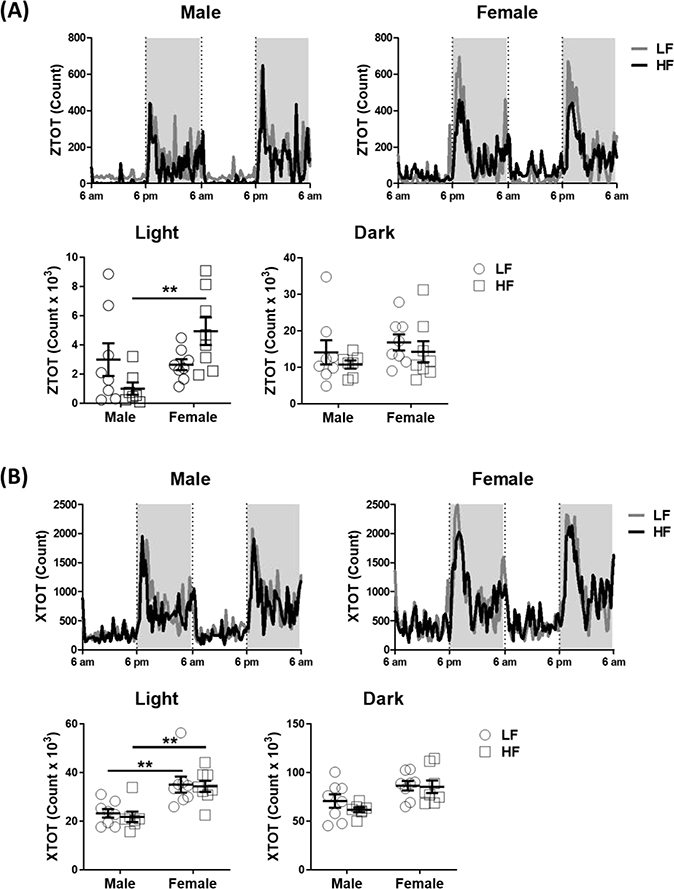
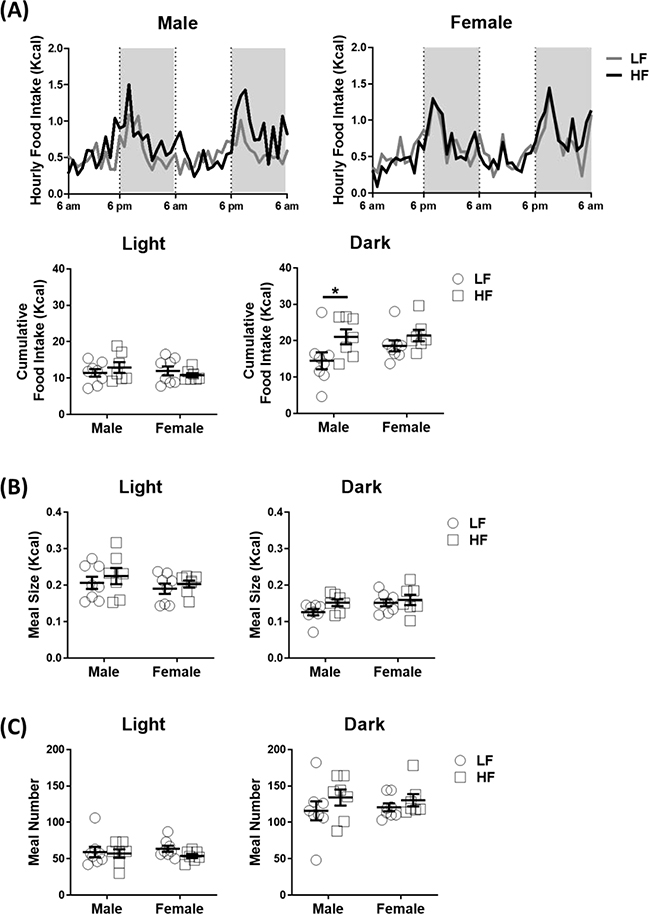
After 5 weeks, HF-fed male mice had a significant increase in body weight and fat mass, compared with LF-fed male mice. HF-fed female had a significant increase in body weight compared with LF-fed female mice, but there was no significant difference in fat mass. HF-fed male mice had lower energy expenditure compared to HF-fed female mice, likely due in part to reduced physical activity in the light phase. HF-fed male mice also had increased energy intake in the dark phase compared to LF-fed male mice and a reduced response to exogenous cholecystokinin-induced inhibition of food intake. In contrast, there was no difference in energy intake between LF-fed and HF-fed female mice.
The data show that female mice are generally protected from short-term HF-induced alterations in energy balance, possibly by maintaining higher energy expenditure and an absence of hyperphagia. However, HF-feeding in male mice induced weight and fat mass gain and hyperphagia. These findings suggest that there is a sex difference in the response to short-term HF-feeding in terms of both energy expenditure and control of food intake.
高脂肪饮食(HF)的摄入会导致雄性啮齿动物摄食量增加和体重增加。雌性啮齿动物对 HF 引起的摄食增加和体重增加相对具有抵抗力,部分原因是雌激素的作用,它抑制食物摄入并增加能量消耗。然而,HF 挑战下能量消耗和活动水平的性别差异尚未得到系统描述。我们假设,在短期 HF 喂养的情况下,雌性小鼠的能量消耗更高,并且比雄性小鼠更能抵抗 HF 引起的摄食增加。
六周龄雄性和雌性 C57BL/6J 小鼠分别喂食低脂肪(LF,10%脂肪)或中等 HF(45%脂肪)饮食 5 周,使用综合实验室动物监测系统(CLAMS)测量能量消耗、活动和摄食模式。
5 周后,与 LF 喂养的雄性小鼠相比,HF 喂养的雄性小鼠体重和脂肪量显著增加。与 LF 喂养的雌性小鼠相比,HF 喂养的雌性小鼠体重显著增加,但脂肪量没有显著差异。与 HF 喂养的雌性小鼠相比,HF 喂养的雄性小鼠能量消耗较低,部分原因可能是光照期体力活动减少。HF 喂养的雄性小鼠在暗期的能量摄入也高于 LF 喂养的雄性小鼠,对外源性胆囊收缩素诱导的食物摄入抑制反应降低。相比之下,LF 喂养和 HF 喂养的雌性小鼠之间的能量摄入没有差异。
数据表明,雌性小鼠通常受到短期 HF 引起的能量平衡改变的保护,可能是通过维持较高的能量消耗和没有摄食增加。然而,HF 喂养的雄性小鼠诱导体重和脂肪量增加和摄食增加。这些发现表明,在短期 HF 喂养的反应方面,能量消耗和食物摄入的控制存在性别差异。