Malopolska Centre of Biotechnology, Jagiellonian University, 30-387 Krakow, Poland.
Cells. 2020 Apr 4;9(4):887. doi: 10.3390/cells9040887.
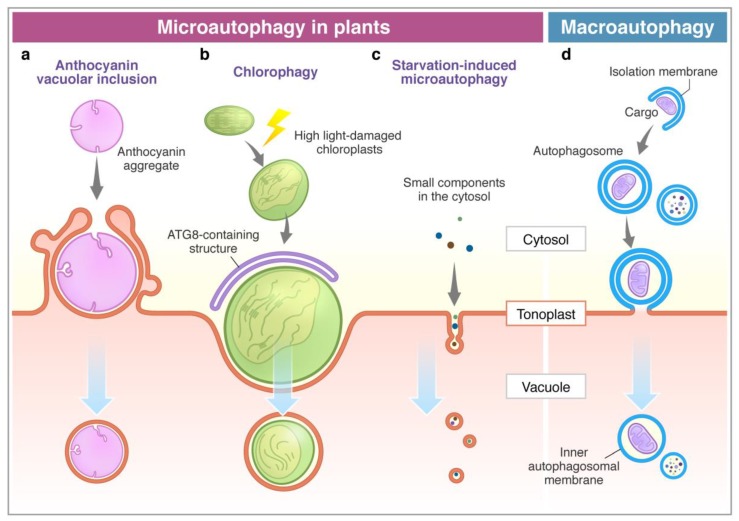
Microautophagy is a type of autophagy. It is characterized by direct enclosing with the vacuolar/lysosomal membrane, which completes the isolation and uptake of cell components in the vacuole. Several publications present evidence that plants exhibit microautophagy. Plant microautophagy is involved in anthocyanin accumulation in the vacuole, eliminating damaged chloroplasts and degrading cellular components during starvation. However, information on the molecular mechanism of microautophagy is less available than that on the general macroautophagy, because the research focusing on microautophagy has not been widely reported. In yeast and animals, it is suggested that microautophagy can be classified into several types depending on morphology and the requirements of autophagy-related () genes. This review summarizes the studies on plant microautophagy and discusses possible techniques for a future study in this field while taking into account the information on microautophagy obtained from yeast and animals.
微自噬是一种自噬方式。其特征为直接与液泡/溶酶体膜结合,完成液泡内细胞成分的隔离和摄取。有几项出版物提供了证据表明植物表现出微自噬。植物微自噬参与了液泡中花色素苷的积累,在饥饿时消除受损的叶绿体并降解细胞成分。然而,与普遍的巨自噬相比,关于微自噬的分子机制的信息较少,因为专注于微自噬的研究尚未得到广泛报道。在酵母和动物中,根据形态和自噬相关()基因的要求,微自噬可以分为几种类型。这篇综述总结了植物微自噬的研究,并讨论了在考虑从酵母和动物获得的微自噬信息的情况下,该领域未来研究的可能技术。