Faculty of Technical Sciences, Center for Quantitative Genetics and Genomics, Aarhus University, 8830, Tjele, Denmark.
Department of Animal Sciences, University of Agriculture in Kraków, 30-059, Kraków, Poland.
Genet Sel Evol. 2020 Apr 7;52(1):19. doi: 10.1186/s12711-020-00538-6.
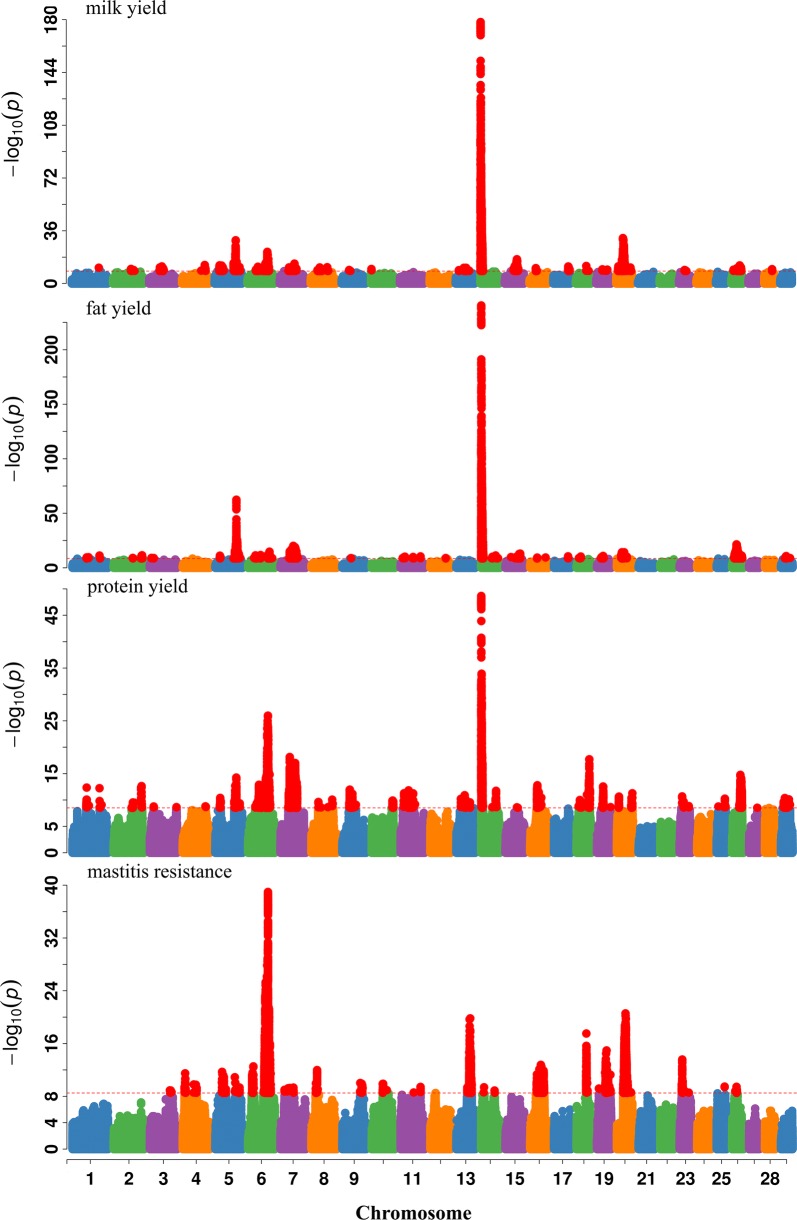
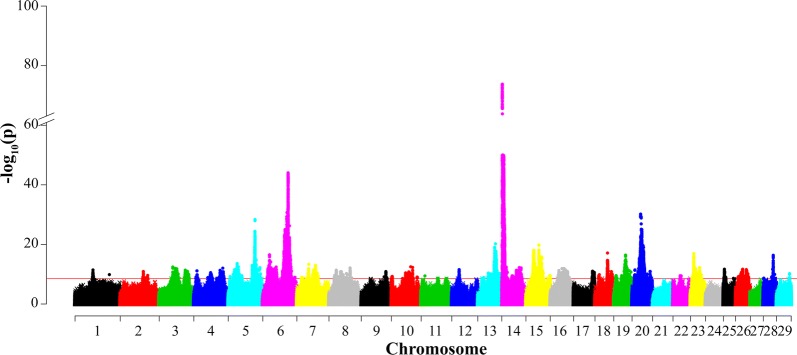
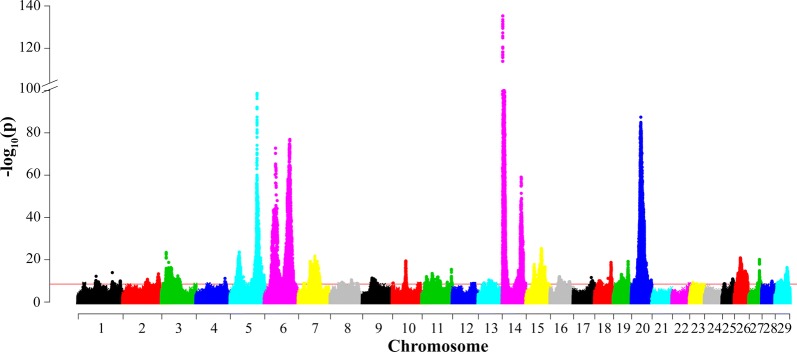
Production and health traits are central in cattle breeding. Advances in next-generation sequencing technologies and genotype imputation have increased the resolution of gene mapping based on genome-wide association studies (GWAS). Thus, numerous candidate genes that affect milk yield, milk composition, and mastitis resistance in dairy cattle are reported in the literature. Effect-bearing variants often affect multiple traits. Because the detection of overlapping quantitative trait loci (QTL) regions from single-trait GWAS is too inaccurate and subjective, multi-trait analysis is a better approach to detect pleiotropic effects of variants in candidate genes. However, large sample sizes are required to achieve sufficient power. Multi-trait meta-analysis is one approach to deal with this problem. Thus, we performed two multi-trait meta-analyses, one for three milk production traits (milk yield, protein yield and fat yield), and one for milk yield and mastitis resistance.
For highly correlated traits, the power to detect pleiotropy was increased by multi-trait meta-analysis compared with the subjective assessment of overlapping of single-trait QTL confidence intervals. Pleiotropic effects of lead single nucleotide polymorphisms (SNPs) that were detected from the multi-trait meta-analysis were confirmed by bivariate association analysis. The previously reported pleiotropic effects of variants within the DGAT1 and MGST1 genes on three milk production traits, and pleiotropic effects of variants in GHR on milk yield and fat yield were confirmed. Furthermore, our results suggested that variants in KCTD16, KCNK18 and ENSBTAG00000023629 had pleiotropic effects on milk production traits. For milk yield and mastitis resistance, we identified possible pleiotropic effects of variants in two genes, GC and DGAT1.
Multi-trait meta-analysis improves our ability to detect pleiotropic interactions between milk production traits and identifies variants with pleiotropic effects on milk production traits and mastitis resistance. In particular, this should contribute to better understand the biological mechanisms that underlie the unfavorable genetic correlation between milk yield and mastitis.
生产性能和健康性状是牛育种的核心。下一代测序技术和基因型推断的进步提高了基于全基因组关联研究(GWAS)的基因定位的分辨率。因此,大量影响奶牛产奶量、乳成分和乳腺炎抗性的候选基因在文献中被报道。具有效应的变异通常会影响多个性状。由于从单性状 GWAS 中检测重叠的数量性状位点(QTL)区域过于不准确和主观,因此多性状分析是检测候选基因中变异的多效性的更好方法。然而,需要大量的样本量才能达到足够的功效。多性状荟萃分析是解决此问题的一种方法。因此,我们进行了两次多性状荟萃分析,一次用于三个产奶性状(产奶量、蛋白产量和脂肪产量),另一次用于产奶量和乳腺炎抗性。
对于高度相关的性状,与重叠单性状 QTL 置信区间的主观评估相比,多性状荟萃分析增加了检测多效性的功效。通过双变量关联分析证实了从多性状荟萃分析中检测到的主要单核苷酸多态性(SNP)的多效性。先前报道的 DGAT1 和 MGST1 基因内变异对三个产奶性状的多效性,以及 GHR 基因内变异对产奶量和脂肪产量的多效性得到了证实。此外,我们的结果表明,KCTD16、KCNK18 和 ENSBTAG00000023629 基因内的变异对产奶性状具有多效性。对于产奶量和乳腺炎抗性,我们鉴定了两个基因 GC 和 DGAT1 内变异的可能的多效性。
多性状荟萃分析提高了我们检测产奶性状之间多效性相互作用的能力,并确定了对产奶性状和乳腺炎抗性具有多效性的变异。特别是,这应该有助于更好地理解产奶量和乳腺炎之间不利遗传相关性的生物学机制。