Department of Molecular Cardiovascular Biology and Pharmacology, Ehime University, Graduate School of Medicine, Shitsukawa, Tohon, Ehime, 791-0295, Japan.
Division of Analytical Bio-Medicine, Advanced Research Support Center (ADRES), Ehime University, Graduate School of Medicine, Tohon, Ehime, 791-0295, Japan.
J Neuroinflammation. 2020 Apr 7;17(1):106. doi: 10.1186/s12974-020-01775-8.
To promote understanding of the pathogenesis of cognitive impairment or dementia, we explored the potential interaction between transient cerebral ischemia and amyloid-β (Aβ) infusion in mediating cognitive decline and examined the possible ameliorative effect of angiotensin II type 2 (AT) receptor activation in vascular smooth muscle cells (VSMC) on this cognitive deficit.
Adult male wild-type mice (WT) and mice with VSMC-specific AT receptor overexpression (smAT) were subjected to intracerebroventricular (ICV) injection of Aβ1-40. Transient cerebral ischemia was induced by 15 min of bilateral common carotid artery occlusion (BCCAO) 24 h after Aβ injection.
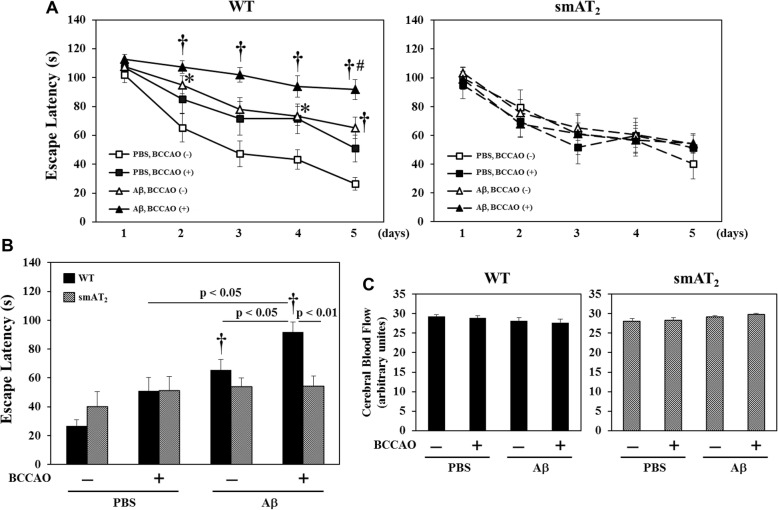
Aβ injection in WT induced a cognitive decline, whereas BCCAO did not cause a significant cognitive deficit. In contrast, WT with BCCAO following Aβ injection exhibited more marked cognitive decline compared to Aβ injection alone, in concert with increases in superoxide anion production, nicotinamide adenine dinucleotide phosphate (NADPH) oxidase activity, and expression of p22phox, p40phox, monocyte chemoattractant protein (MCP)-1 and interleukin (IL)-1β in the hippocampus, and upregulation of RAGE (receptor for advanced glycation end product), an Aβ transporter. BCCAO following Aβ injection further enhanced neuronal pyknosis in the hippocampus, compared with BCCAO or Aβ injection alone. In contrast, smAT did not show a cognitive decline, increase in oxidative stress, inflammation, and RAGE level or neuronal pyknosis, which were induced by BCCAO with/without Aβ injection in WT.
Transient cerebral ischemia might worsen Aβ infusion-mediated cognitive decline and vice versa, with possible involvement of amplified oxidative stress and inflammation and impairment of the RAGE-mediated Aβ clearance system, contributing to exaggerated neuronal degeneration. AT receptor activation in VSMC could play an inhibitory role in this cognitive deficit.
为了促进对认知障碍或痴呆症发病机制的理解,我们探讨了短暂性脑缺血与淀粉样β(Aβ)输注在介导认知下降方面的潜在相互作用,并研究了血管平滑肌细胞(VSMC)中血管紧张素 II 型 2(AT)受体激活对这种认知缺陷的可能改善作用。
成年雄性野生型(WT)小鼠和 VSMC 特异性 AT 受体过表达(smAT)小鼠接受 Aβ1-40 侧脑室(ICV)注射。在 Aβ 注射后 24 小时,通过双侧颈总动脉闭塞(BCCAO)诱导短暂性脑缺血。
WT 中 Aβ 注射引起认知下降,而 BCCAO 未引起明显认知缺陷。相比之下,与单独 Aβ 注射相比,WT 中 BCCAO 后 Aβ 注射表现出更明显的认知下降,伴随着超氧化物阴离子产生、烟酰胺腺嘌呤二核苷酸磷酸(NADPH)氧化酶活性以及 p22phox、p40phox、单核细胞趋化蛋白-1(MCP-1)和白细胞介素(IL)-1β在海马中的表达增加,以及 Aβ 转运体 RAGE(晚期糖基化终产物受体)的上调。与单独 BCCAO 或 Aβ 注射相比,BCCAO 后 Aβ 注射进一步增强了海马中的神经元固缩。相比之下,smAT 没有表现出认知下降、氧化应激增加、炎症和 RAGE 水平增加或神经元固缩,这些变化是由 WT 中 BCCAO 伴/不伴 Aβ 注射引起的。
短暂性脑缺血可能会加重 Aβ 输注介导的认知下降,反之亦然,可能涉及放大的氧化应激和炎症以及 RAGE 介导的 Aβ 清除系统受损,导致神经元变性加剧。VSMC 中的 AT 受体激活可能在这种认知缺陷中发挥抑制作用。