Protein research group, Department of Biochemistry and Molecular Biology, University of Southern Denmark, DK-5230 Odense M, Denmark; The Danish Diabetes Academy, Odense, Denmark.
The Kovler Diabetes Center, Department of Medicine Section of Endocrinology, Diabetes & Metabolism, University of Chicago, Chicago, Illinois 60637; Cardiovascular, Renal and Metabolic Disease, BioPharmaceuticals Research and Development, AstraZeneca Gaithersburg, Maryland 20878.
Mol Cell Proteomics. 2020 Jun;19(6):971-993. doi: 10.1074/mcp.RA119.001882. Epub 2020 Apr 7.
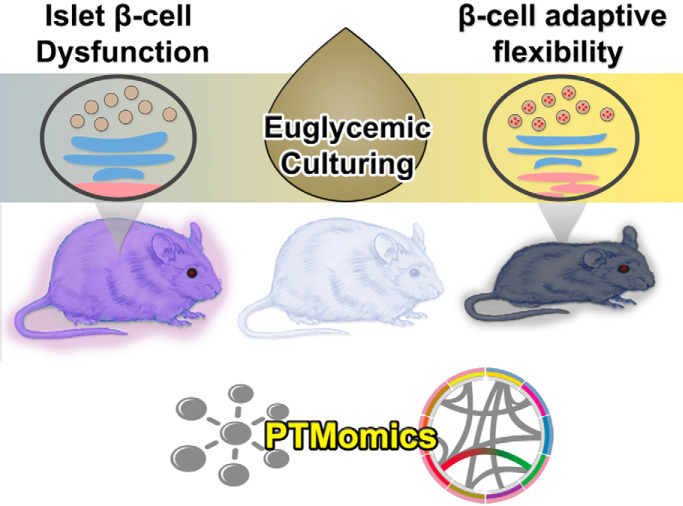
The onset of obesity-linked type 2 diabetes (T2D) is marked by an eventual failure in pancreatic β-cell function and mass that is no longer able to compensate for the inherent insulin resistance and increased metabolic load intrinsic to obesity. However, in a commonly used model of T2D, the mouse, β-cells have an inbuilt adaptive flexibility enabling them to effectively adjust insulin production rates relative to the metabolic demand. Pancreatic β-cells from these animals have markedly reduced intracellular insulin stores, yet high rates of (pro)insulin secretion, together with a substantial increase in proinsulin biosynthesis highlighted by expanded rough endoplasmic reticulum and Golgi apparatus. However, when the metabolic overload and/or hyperglycemia is normalized, β-cells from mice quickly restore their insulin stores and normalize secretory function. This demonstrates the β-cell's adaptive flexibility and indicates that therapeutic approaches applied to encourage β-cell rest are capable of restoring endogenous β-cell function. However, mechanisms that regulate β-cell adaptive flexibility are essentially unknown. To gain deeper mechanistic insight into the molecular events underlying β-cell adaptive flexibility in β-cells, we conducted a combined proteomic and post-translational modification specific proteomic (PTMomics) approach on islets from mice and wild-type controls (WT) with or without prior exposure to normal glucose levels. We identified differential modifications of proteins involved in redox homeostasis, protein refolding, K48-linked deubiquitination, mRNA/protein export, focal adhesion, ERK1/2 signaling, and renin-angiotensin-aldosterone signaling, as well as sialyltransferase activity, associated with β-cell adaptive flexibility. These proteins are all related to proinsulin biosynthesis and processing, maturation of insulin secretory granules, and vesicular trafficking-core pathways involved in the adaptation of insulin production to meet metabolic demand. Collectively, this study outlines a novel and comprehensive global PTMome signaling map that highlights important molecular mechanisms related to the adaptive flexibility of β-cell function, providing improved insight into disease pathogenesis of T2D.
肥胖相关性 2 型糖尿病(T2D)的发病标志是胰岛β细胞功能和数量的最终衰竭,β细胞已无法代偿肥胖所固有胰岛素抵抗和代谢负荷增加。然而,在 T2D 的一种常用模型——小鼠中,β细胞具有内在的适应性灵活性,能够根据代谢需求有效调节胰岛素产生率。这些动物的胰岛β细胞细胞内胰岛素储存明显减少,但(前)胰岛素分泌率高,内质网和高尔基体扩张提示前胰岛素生物合成大量增加。然而,当代谢负荷和/或高血糖正常化时,小鼠的β细胞迅速恢复其胰岛素储存并使分泌功能正常化。这表明β细胞具有适应性灵活性,并表明应用于鼓励β细胞恢复的治疗方法能够恢复内源性β细胞功能。然而,调节β细胞适应性灵活性的机制在本质上尚不清楚。为了更深入地了解β细胞适应性灵活性的分子机制,我们对正常葡萄糖水平暴露前后的小鼠胰岛β细胞和野生型对照(WT)胰岛β细胞进行了联合蛋白质组学和翻译后修饰特异性蛋白质组学(PTMomics)研究。我们鉴定了参与氧化还原稳态、蛋白质重折叠、K48 连接去泛素化、mRNA/蛋白质输出、黏附斑、ERK1/2 信号和肾素-血管紧张素-醛固酮信号以及唾液酸转移酶活性的差异修饰的蛋白质,这些蛋白质都与β细胞适应性灵活性有关。这些蛋白质都与前胰岛素生物合成和加工、胰岛素分泌颗粒成熟以及囊泡运输——涉及胰岛素产生适应代谢需求的核心途径有关。总之,本研究概述了一个新的全面的 PTMome 信号图谱,突出了与β细胞功能适应性灵活性相关的重要分子机制,为 T2D 的发病机制提供了更好的认识。