Laboratory of Nano-Regenerative Medicine, Faculty of Medicine, Universidad de los Andes, Santiago, Chile
Cells for Cells and consorcio Regenero, Chilean Consortium for Regenerative Medicine, Santiago, Chile.
Eur Respir J. 2020 Jun 4;55(6). doi: 10.1183/13993003.00858-2020. Print 2020 Jun.
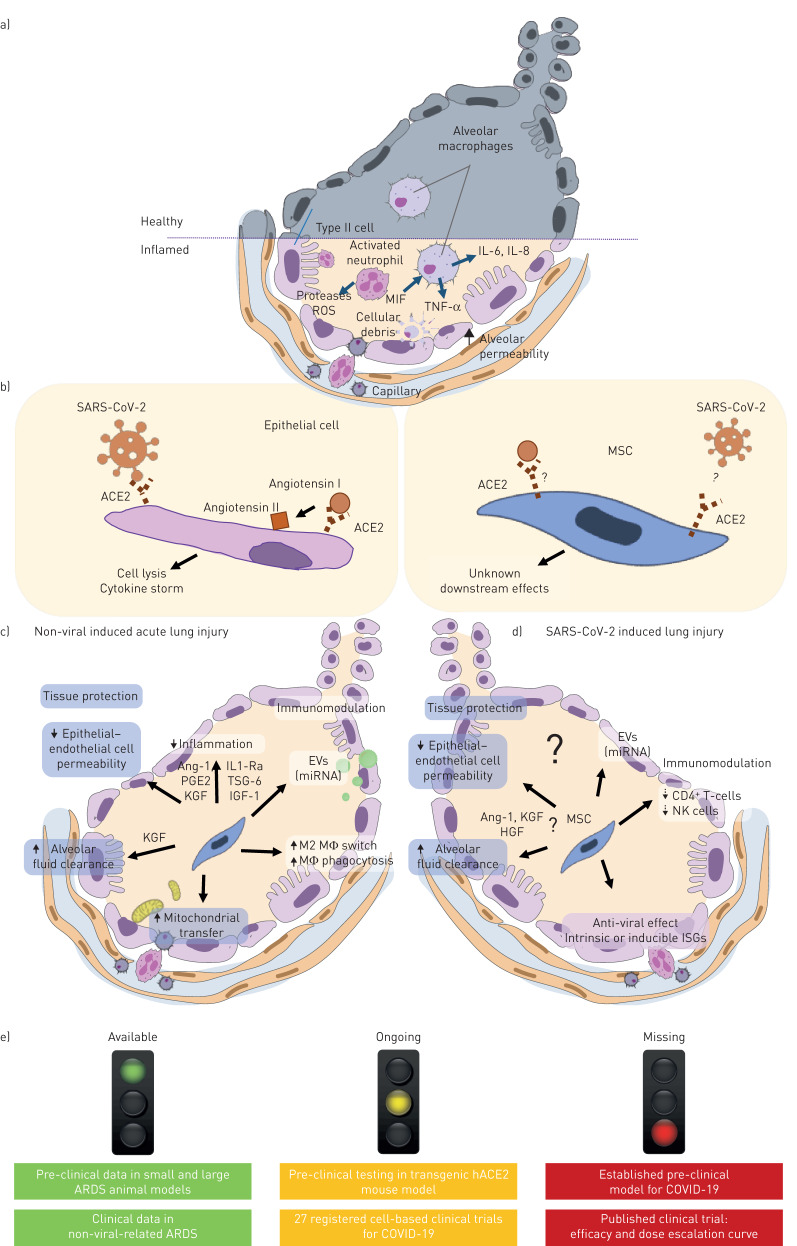
The severe respiratory consequences of the coronavirus disease 2019 (COVID-19) pandemic have prompted urgent need for novel therapies. Cell-based approaches, primarily using mesenchymal stem (stromal) cells (MSCs), have demonstrated safety and possible efficacy in patients with acute respiratory distress syndrome (ARDS), although they are not yet well studied in respiratory virus-induced ARDS. Limited pre-clinical data suggest that systemic MSC administration can significantly reduce respiratory virus (influenza strains H5N1 and H9N2)-induced lung injury; however, there are no available data in models of coronavirus respiratory infection.There is a rapidly increasing number of clinical investigations of cell-based therapy approaches for COVID-19. These utilise a range of different cell sources, doses, dosing strategies and targeted patient populations. To provide a rational strategy to maximise potential therapeutic use, it is critically important to understand the relevant pre-clinical studies and postulated mechanisms of MSC actions in respiratory virus-induced lung injuries. This review presents these, along with consideration of current clinical investigations.
2019 年冠状病毒病(COVID-19)大流行对呼吸系统造成严重影响,促使人们急需新的治疗方法。基于细胞的方法主要使用间充质干细胞(MSCs),在急性呼吸窘迫综合征(ARDS)患者中已显示出安全性和可能的疗效,尽管它们在呼吸道病毒引起的 ARDS 中的研究还不够充分。有限的临床前数据表明,全身 MSC 给药可显著减轻呼吸道病毒(H5N1 和 H9N2 流感株)引起的肺损伤;然而,在冠状病毒呼吸道感染的模型中尚无可用数据。目前针对 COVID-19 的细胞治疗方法的临床研究数量正在迅速增加。这些研究使用了一系列不同的细胞来源、剂量、给药策略和靶向患者人群。为了提供最大化潜在治疗用途的合理策略,了解 MSCs 在呼吸道病毒引起的肺损伤中的相关临床前研究和假设作用机制至关重要。本文介绍了这些研究,以及对当前临床研究的考虑。