Department of Health Services Research & Policy, London School of Hygiene and Tropical Medicine, 15-17 Tavistock Place, London, WC1H 9SH, UK.
Oncology Unit, Ospedale del Mare, Napoli, Italy.
Br J Cancer. 2020 Jun;122(12):1754-1759. doi: 10.1038/s41416-020-0817-7. Epub 2020 Apr 8.
In the Phase 3 REFLECT trial in patients with unresectable hepatocellular carcinoma (uHCC), the multitargeted tyrosine kinase inhibitor, lenvatinib, was noninferior to sorafenib in the primary outcome of overall survival. Post-hoc review revealed imbalances in prognostic variables between treatment arms. Here, we re-analyse overall survival data from REFLECT to adjust for the imbalance in covariates.
Univariable and multivariable adjustments were undertaken for a candidate set of covariate values that a physician panel indicated could be prognostically associated with overall survival in uHCC. The values included baseline variables observed pre- and post-randomisation. Univariable analyses were based on a stratified Cox model. The multivariable analysis used a "forwards stepwise" Cox model.
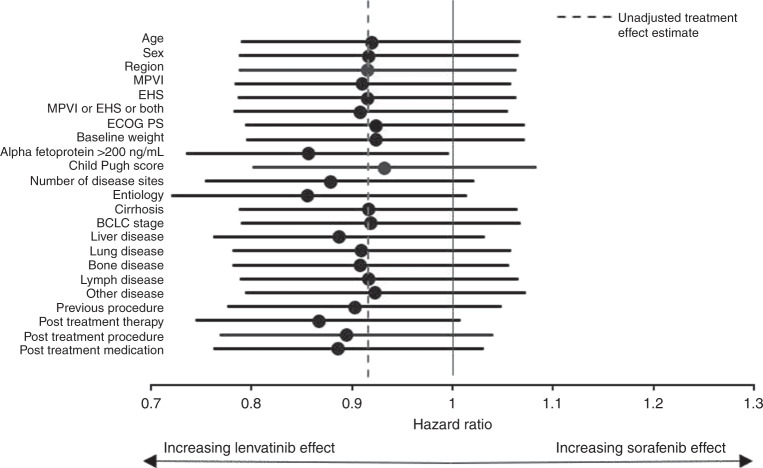
Univariable analysis identified alpha-fetoprotein (AFP) as the most influential variable. The chosen multivariable Cox model analysis resulted in an estimated adjusted hazard ratio for lenvatinib of 0.814 (95% CI: 0.699-0.948) when only baseline variables were included. Adjusting for post-randomisation treatment variables further increased the estimated superiority of lenvatinib.
Covariate adjustment of REFLECT suggests that the original noninferiority trial likely underestimated the true effect of lenvatinib on overall survival due to an imbalance in baseline prognostic covariates and the greater use of post-treatment therapies in the sorafenib arm.
Trial number: NCT01761266 (Submitted January 2, 2013).
在不可切除肝细胞癌(uHCC)患者的 3 期 REFLECT 试验中,多靶点酪氨酸激酶抑制剂仑伐替尼在总生存期的主要结局方面不劣于索拉非尼。事后审查发现治疗组之间的预后变量存在不平衡。在这里,我们重新分析 REFLECT 的总生存数据,以调整协变量的不平衡。
针对一个候选协变量值集进行单变量和多变量调整,该值集由一个医师小组表示可能与 uHCC 的总生存相关。这些值包括随机分组前后观察到的基线变量。单变量分析基于分层 Cox 模型。多变量分析使用“向前逐步”Cox 模型。
单变量分析确定甲胎蛋白(AFP)为最具影响力的变量。选择的多变量 Cox 模型分析显示,仅包括基线变量时,仑伐替尼的估计调整后风险比为 0.814(95%CI:0.699-0.948)。调整随机分组后治疗变量进一步增加了仑伐替尼的优越性估计。
REFLECT 的协变量调整表明,由于基线预后协变量的不平衡以及索拉非尼组中更多地使用治疗后疗法,原始非劣效试验可能低估了仑伐替尼对总生存期的真实影响。
NCT01761266(2013 年 1 月 2 日提交)。