Gage Stephanie L, Calle Samantha, Jacobson Natalia, Carroll Mark, DeGrandi-Hoffman Gloria
Carl Hayden Bee Research Center, Agricultural Research Service, United States Department of Agriculture, Tucson, AZ, United States.
Front Neurosci. 2020 Mar 24;14:231. doi: 10.3389/fnins.2020.00231. eCollection 2020.
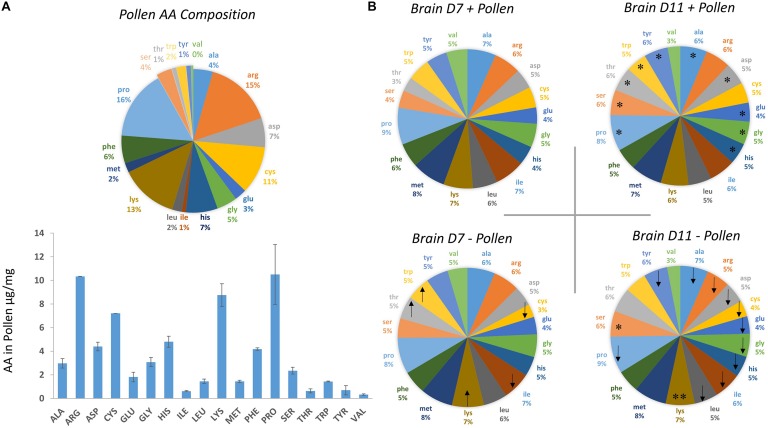
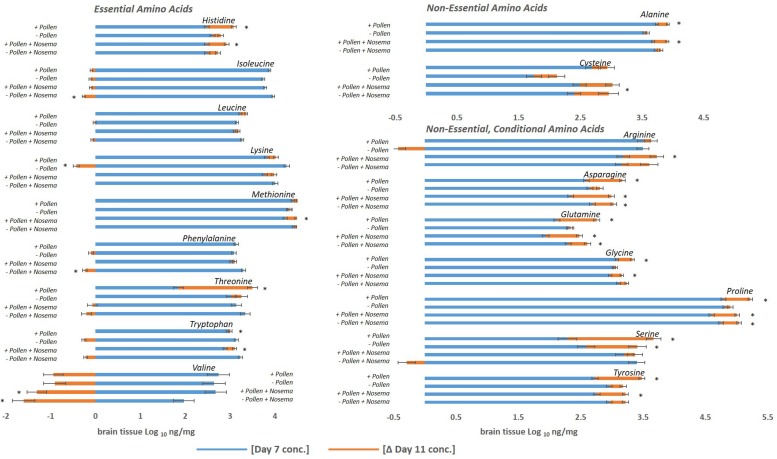
Pollen nutrition is necessary for proper growth and development of adult honey bees. Yet, it is unclear how pollen affects the honey bee brain and behavior. We investigated whether pollen affects amino acids in the brains of caged, nurse-aged bees, and what the behavioral consequences might be. We also tested whether parasitic stress altered this relationship by analyzing bees infected with prevalent stressor, . Levels of 18 amino acids in individual honey bee brains were measured using Gas Chromatography - Mass Spectrometry at two different ages (Day 7 and Day 11). We then employed the proboscis extension reflex to test odor learning and memory. We found that the honey bee brain was highly responsive to pollen. Many amino acids in the brain were elevated and were present at higher concentration with age. The majority of these amino acids were non-essential. Without pollen, levels of amino acids remained consistent, or declined. -infected bees showed a different profile. Infection altered amino acid levels in a pollen-dependent manner. The majority of amino acids were lower when pollen was given, but higher when pollen was deprived. Odor learning and memory was not affected by feeding pollen to uninfected bees; but pollen did improve performance in -infected bees. These results suggest that pollen in early adulthood continues to shape amino acid levels in the brain with age, which may affect neural circuitry and behavior over time. Parasitic stress by modifies this relationship revealing an interaction between infection, pollen nutrition, and behavior.
花粉营养对于成年蜜蜂的正常生长和发育至关重要。然而,目前尚不清楚花粉如何影响蜜蜂的大脑和行为。我们研究了花粉是否会影响关在笼中的保育期蜜蜂大脑中的氨基酸,以及可能产生的行为后果。我们还通过分析感染常见应激源的蜜蜂,测试了寄生应激是否会改变这种关系。使用气相色谱 - 质谱法在两个不同年龄(第7天和第11天)测量了单个蜜蜂大脑中18种氨基酸的水平。然后,我们采用喙伸展反射来测试气味学习和记忆。我们发现蜜蜂大脑对花粉高度敏感。大脑中的许多氨基酸含量升高,并且随着年龄增长而呈现更高的浓度。这些氨基酸中的大多数是非必需氨基酸。没有花粉时,氨基酸水平保持稳定或下降。感染[寄生虫名称未给出]的蜜蜂表现出不同的情况。感染以花粉依赖的方式改变氨基酸水平。喂食花粉时,大多数氨基酸含量较低,但剥夺花粉时则较高。给未感染的蜜蜂喂食花粉不会影响气味学习和记忆;但花粉确实改善了感染[寄生虫名称未给出]的蜜蜂的表现。这些结果表明,成年早期的花粉会随着年龄的增长持续影响大脑中的氨基酸水平,这可能会随着时间的推移影响神经回路和行为。[寄生虫名称未给出]引起的寄生应激会改变这种关系,揭示了感染、花粉营养和行为之间的相互作用。