Brown Felicity L, Aoun May, Taha Karine, Steen Frederik, Hansen Pernille, Bird Martha, Dawson Katie S, Watts Sarah, El Chammay Rabih, Sijbrandij Marit, Malik Aiysha, Jordans Mark J D
Research and Development Department, War Child Holland, Amsterdam, Netherlands.
Amsterdam Institute of Social Science Research, University of Amsterdam, Amsterdam, Netherlands.
Front Psychiatry. 2020 Mar 23;11:212. doi: 10.3389/fpsyt.2020.00212. eCollection 2020.
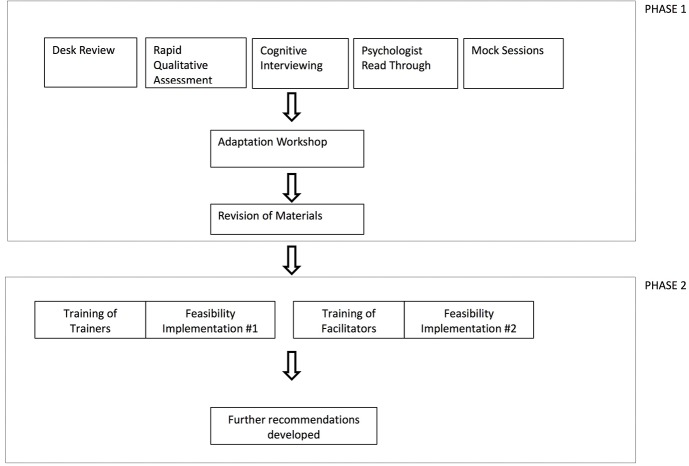
Armed conflict leads to increased risk of emotional distress among children and adolescents, and increased exposure to significant daily stressors such as poverty and community and family violence. Unfortunately, these increased risks usually occur in the context of largely unavailable mental health services. There is growing empirical support that evidence-based treatment techniques can be adapted and delivered by non-specialists with high fidelity and effectiveness. However, in order to improve feasibility, applicability, and outcomes, appropriate cultural and contextual adaptation is essential when delivering in different settings and cultures. This paper reports the adaptation process conducted on a new World Health Organization psychological intervention-Early Adolescent Skills for Emotions (EASE)-for use in the north of Lebanon. Lebanon is a middle-income country that hosts the largest number of refugees per capita globally. We conducted: i) a scoping review of literature on mental health in Lebanon, with a focus on Syrian refugees; ii) a rapid qualitative assessment with adolescents, caregivers, community members, and health professionals; iii) cognitive interviews regarding the applicability of EASE materials; iv) a psychologist review to reach optimal and consistent Arabic translation of key terms; v) "mock sessions" of the intervention with field staff and clinical psychology experts; vi) gathering feedback from the Training of Trainers workshop, and subsequent implementation of practice sessions; and vii) gathering feedback from the Training of Facilitators workshop, and subsequent implementation of practice sessions. Several changes were implemented to the materials-some were Lebanon-specific cultural adaptations, while others were incorporated into original materials as they were considered relevant for all contexts of adversity. Overall, our experience with adaptation of the EASE program in Lebanon is promising and indicates the acceptability and feasibility of a brief, non-specialist delivered intervention for adolescents and caregivers. The study informs the wider field of global mental health in terms of opportunities and challenges of adapting and implementing low-intensity psychological interventions in settings of low resources and high adversity.
武装冲突导致儿童和青少年出现情绪困扰的风险增加,且他们日益暴露于贫困、社区及家庭暴力等重大日常压力源之下。不幸的是,这些增加的风险通常发生在心理健康服务基本无法获取的背景下。越来越多的实证支持表明,循证治疗技术可由非专业人员以高保真度和有效性进行调整和实施。然而,为了提高可行性、适用性和效果,在不同环境和文化中实施时,进行适当的文化和情境调整至关重要。本文报告了对世界卫生组织一项新的心理干预措施——青少年情绪技能(EASE)——进行调整以用于黎巴嫩北部的过程。黎巴嫩是一个中等收入国家,人均接待全球最多数量的难民。我们开展了以下工作:i)对黎巴嫩心理健康相关文献进行范围界定审查,重点关注叙利亚难民;ii)对青少年、照料者、社区成员和卫生专业人员进行快速定性评估;iii)就EASE材料的适用性进行认知访谈;iv)由心理学家进行审查以实现关键术语的最佳且一致的阿拉伯语翻译;v)与实地工作人员和临床心理学专家进行干预措施的“模拟课程”;vi)收集培训师培训工作坊的反馈,并随后开展实践课程;vii)收集促进者培训工作坊的反馈,并随后开展实践课程。对材料进行了多项修改——一些是针对黎巴嫩的特定文化调整,而其他一些则被纳入原始材料,因为它们被认为适用于所有逆境情境。总体而言,我们在黎巴嫩对EASE项目进行调整的经验很有前景,表明了一种由非专业人员提供的简短干预措施对青少年和照料者的可接受性和可行性。该研究就低资源和高逆境环境中调整和实施低强度心理干预措施的机遇和挑战,为全球心理健康这一更广泛领域提供了参考。