Clinic for Orthopedics and Trauma Surgery, University Hospital Bonn, Bonn, Germany.
Tufts University School of Medicine, Boston, MA, United States.
Front Immunol. 2020 Mar 24;11:487. doi: 10.3389/fimmu.2020.00487. eCollection 2020.
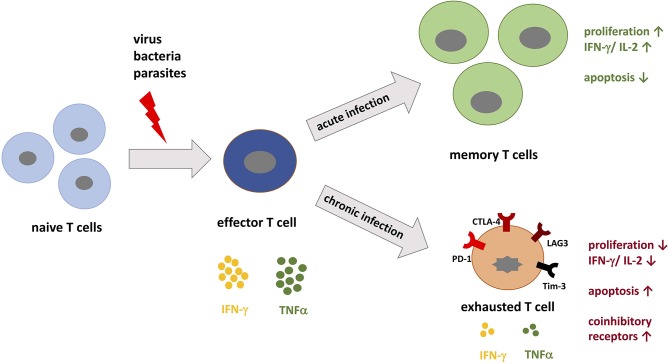
PD-1 as an immune checkpoint molecule down-regulates T cell activity during immune responses in order to prevent autoimmune tissue damage. In chronic infections or tumors, lasting antigen-exposure leads to permanent PD-1 expression that can limit immune-mediated clearance of pathogens or degenerated cells. Blocking PD-1 can enhance T cell function; in cancer treatment PD-1 blockade is already used as a successful therapy. However, the role of PD-1 expression and blocking in the context of acute and chronic infections is less defined. Building on its success in cancer therapy leads to the hypothesis that blocking PD-1 in infectious diseases is also beneficial in acute or chronic infections. This review will focus on the role of PD-1 expression in acute and chronic infections with virus, bacteria, and parasites, with a particular focus on recent studies regarding PD-1 blockade in infectious diseases.
PD-1 作为一种免疫检查点分子,在免疫反应中下调 T 细胞活性,以防止自身免疫性组织损伤。在慢性感染或肿瘤中,持续的抗原暴露导致 PD-1 的持续表达,从而限制了免疫介导的病原体或变性细胞的清除。阻断 PD-1 可以增强 T 细胞功能;在癌症治疗中,PD-1 阻断已被用作一种成功的治疗方法。然而,PD-1 表达和阻断在急性和慢性感染中的作用还不太明确。基于其在癌症治疗中的成功,人们假设在急性或慢性感染中阻断 PD-1 也是有益的。本综述将重点关注 PD-1 表达在病毒、细菌和寄生虫引起的急性和慢性感染中的作用,并特别关注最近关于感染性疾病中 PD-1 阻断的研究。