Liao Pan, Leung King Pong, Lung Shiu-Cheung, Panthapulakkal Narayanan Saritha, Jiang Liwen, Chye Mee-Len
School of Biological Sciences, The University of Hong Kong, Pokfulam, China.
State Key Laboratory of Agrobiotechnology, CUHK, New Territories, China.
Front Plant Sci. 2020 Mar 24;11:331. doi: 10.3389/fpls.2020.00331. eCollection 2020.
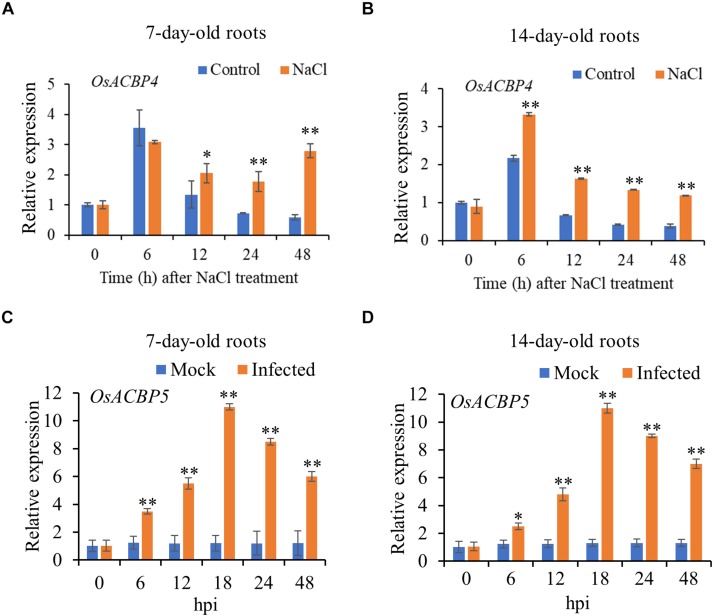
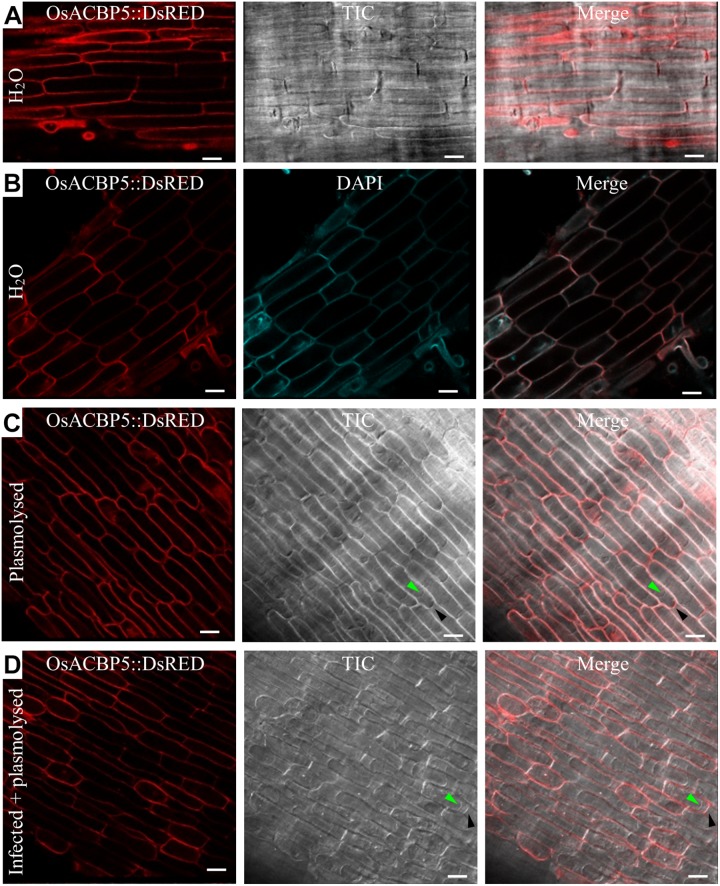
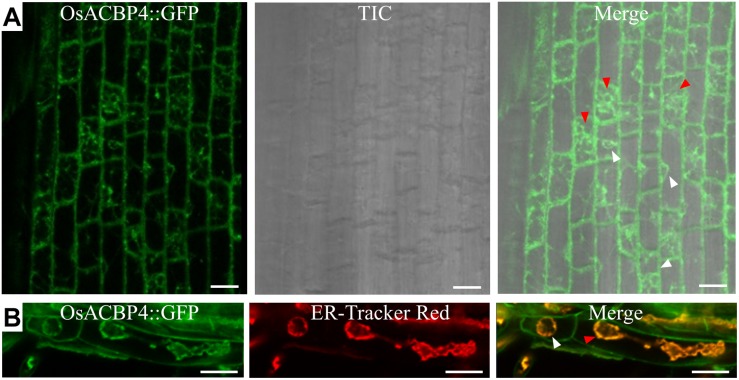
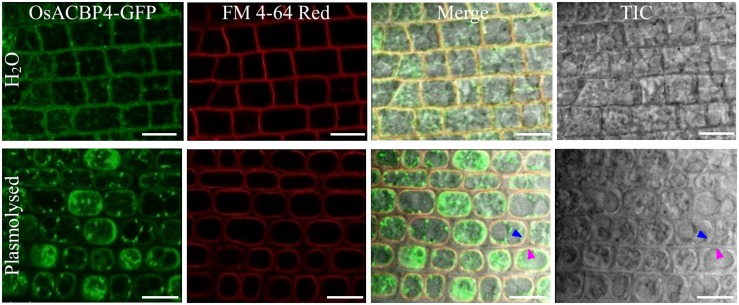
Acyl-CoA-binding proteins (ACBPs), conserved at the acyl-CoA-binding domain, can bind acyl-CoA esters as well as transport them intracellularly. Six ACBPs co-exist in each model plant, dicot (thale cress) and monocot (rice). Although Arabidopsis ACBPs have been studied extensively, less is known about the rice ACBPs. is highly induced by salt treatment, but down-regulated following pathogen infection, while is up-regulated by both wounding and pathogen treatment. Their differential expression patterns under various stress treatments suggest that they may possess non-redundant functions. When expressed from the promoter, OsACBP4 and OsACBP5 were subcellularly localized to different endoplasmic reticulum (ER) domains in transgenic Arabidopsis. As these plants were not stress-treated, it remains to be determined if OsACBP subcellular localization would change following treatment. Given that the subcellular localization of proteins may not be reliable if not expressed in the native plant, this study addresses and expression from their native promoters to verify their subcellular localization in transgenic rice. The results indicated that OsACBP4:GFP was targeted to the plasma membrane besides the ER, while OsACBP5:DsRED was localized at the apoplast, in contrast to their only localization at the ER in transgenic Arabidopsis. Differences in tagged-protein localization in transgenic Arabidopsis and rice imply that protein subcellular localization studies are best investigated in the native plant. Likely, initial targeting to the ER in a non-native plant could not be followed up properly to the final destination(s) unless it occurred in the native plant. Also, monocot (rice) protein targeting may not be optimally processed in a transgenic dicot (Arabidopsis), perhaps arising from the different processing systems for routing between them. Furthermore, changes in the subcellular localization of OsACBP4:GFP and OsACBP5:DsRED were not detectable following salt and pathogen treatment, respectively. These results suggest that OsACBP4 is likely involved in the intracellular shuttling of acyl-CoA esters and/or other lipids between the plasma membrane and the ER, while OsACBP5 appears to participate in the extracellular transport of acyl-CoA esters and/or other lipids, suggesting that they are non-redundant proteins in lipid trafficking.
酰基辅酶A结合蛋白(ACBPs)在酰基辅酶A结合结构域具有保守性,能够结合酰基辅酶A酯并在细胞内运输它们。在每种模式植物中,双子叶植物(拟南芥)和单子叶植物(水稻)中都共存有六种ACBPs。尽管对拟南芥ACBPs已经进行了广泛研究,但对水稻ACBPs的了解较少。 受盐处理高度诱导,但在病原体感染后下调,而 在创伤和病原体处理后均上调。它们在各种胁迫处理下的差异表达模式表明它们可能具有非冗余功能。当从 启动子表达时,OsACBP4和OsACBP5在转基因拟南芥中定位于不同的内质网(ER)结构域。由于这些植物未经过胁迫处理,因此OsACBP的亚细胞定位在处理后是否会发生变化仍有待确定。鉴于如果不在天然植物中表达,蛋白质的亚细胞定位可能不可靠,本研究从其天然启动子研究 和 的表达,以验证它们在转基因水稻中的亚细胞定位。结果表明,除了内质网外,OsACBP4:GFP还靶向质膜,而OsACBP5:DsRED定位于质外体,这与它们在转基因拟南芥中仅定位于内质网形成对比。转基因拟南芥和水稻中标记蛋白定位的差异表明,蛋白质亚细胞定位研究最好在天然植物中进行。很可能,除非在天然植物中发生,否则在非天然植物中最初靶向内质网的过程无法正确跟进到最终目的地。此外,单子叶植物(水稻)的蛋白质靶向在转基因双子叶植物(拟南芥)中可能无法得到最佳处理,这可能源于它们之间不同的转运加工系统。此外,分别在盐处理和病原体处理后未检测到OsACBP4:GFP和OsACBP5:DsRED亚细胞定位的变化。这些结果表明,OsACBP4可能参与酰基辅酶A酯和/或其他脂质在质膜和内质网之间的细胞内穿梭,而OsACBP5似乎参与酰基辅酶A酯和/或其他脂质的细胞外运输,这表明它们在脂质运输中是非冗余蛋白。