Ewertowska Marlena, Grześk Elżbieta, Urbańczyk Anna, Dąbrowska Anna, Bąbol-Pokora Katarzyna, Łęcka Monika, Kołtan Sylwia
1Faculty of Medicine, Collegium Medicum in Bydgoszcz, Nicolaus Copernicus University in Toruń, Jagiellońska 13, 85-067 Bydgoszcz, Poland.
2Department of Paediatrics, Hematology and Oncology, Collegium Medicum in Bydgoszcz, Nicolaus Copernicus University in Toruń, Curie Skłodowskiej 9, 85-092 Bydgoszcz, Poland.
Allergy Asthma Clin Immunol. 2020 Apr 1;16:22. doi: 10.1186/s13223-020-00420-6. eCollection 2020.
Activated PI3K delta syndrome (APDS) belongs to the heterogeneous group of primary immunodeficiency disorders (PIDs). Progress in next-generation sequencing (NGS) enabled identification of gain-of-function mutations in phosphoinositide 3-kinase (PI3K) genes. Depending on the type of causative mutation, APDS is classified into two types: APDS 1 and APDS 2. To date, less than 100 cases of APDS have been reported. Clinical symptoms of APDS result from impaired immune regulation and are clinically manifested by recurrent infections, allergies, lymphoproliferation and autoimmunity. They show similarity to other PIDs. Therefore, many patients were diagnosed incorrectly. The availability of genetic testing has allowed establishing the correct diagnosis in increasing number of patients suffering from APDS.
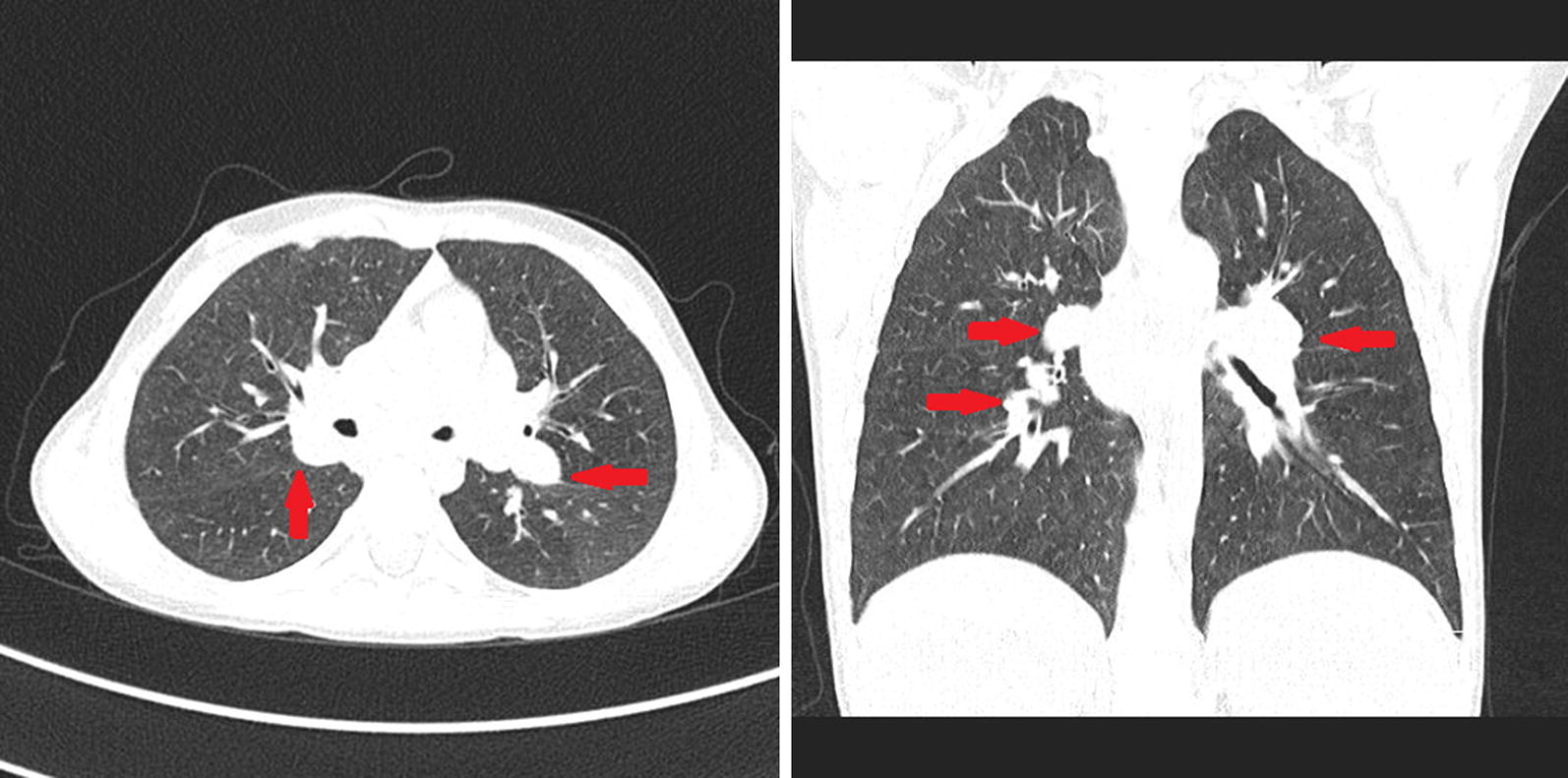
The first male patient presented in infancy with recurrent infections. Subsequently he was found to suffer from hepatosplenomegaly, early portal hypertension, massive lymphoproliferation and hypogammaglobulinemia. The common E1021K mutation in the PI3KCD gene was identified. The patient underwent successful hematopoietic stem cell transplantation with resolution of most symptoms. The second patient suffered from persistent growth retardation since early life, facial dysmorphism and recurrent respiratory infections from early childhood. He was found to have systemic lympho-proliferation, panhypoglobulinemia and impaired antibody responses to vaccines. The introduction of NGS in Poland enabled rapid identification of a mutation in the PI3KR1 gene. Growth hormone administration seemed to have worsened the lymphoproliferation.
Patients with suspected common variable immunodeficiency (CVID) and additional symptoms, such as allergy, facial dysmorphia, short stature, enhanced lymphoproliferation and lack of adequate response to human immunoglobulin replacement therapy, should be considered for NGS-based genetic testing. It may substantially shorten the time needed to establish the correct diagnosis, direct appropriate treatment and avoid potentially harmful therapies. To date, few cases of APDS have been described. It is important to report each of them to establish clinical indices and laboratory biomarkers of APDS 1 and APDS 2, to develop the standards of care in these conditions.
活化磷脂酰肌醇3-激酶δ综合征(APDS)属于原发性免疫缺陷病(PID)这一异质性疾病组。下一代测序(NGS)技术的进展使得能够鉴定磷脂酰肌醇3-激酶(PI3K)基因中的功能获得性突变。根据致病突变的类型,APDS分为两种类型:APDS 1和APDS 2。迄今为止,报道的APDS病例不到100例。APDS的临床症状源于免疫调节受损,临床表现为反复感染、过敏、淋巴细胞增殖和自身免疫。它们与其他PID有相似之处。因此,许多患者被误诊。基因检测的可用性使得越来越多的APDS患者能够确诊。
首例男性患者在婴儿期出现反复感染。随后发现他患有肝脾肿大、早期门静脉高压、大量淋巴细胞增殖和低丙种球蛋白血症。在PI3KCD基因中鉴定出常见的E1021K突变。该患者接受了成功的造血干细胞移植,大多数症状得到缓解。第二例患者自幼年起就患有持续性生长发育迟缓、面部畸形,幼儿期起反复出现呼吸道感染。发现他有全身性淋巴细胞增殖、全低球蛋白血症以及对疫苗的抗体应答受损。波兰引入NGS技术后迅速鉴定出PI3KR1基因中的一个突变。生长激素治疗似乎使淋巴细胞增殖恶化。
对于疑似常见变异型免疫缺陷(CVID)且伴有其他症状(如过敏、面部畸形、身材矮小、淋巴细胞增殖增强以及对人免疫球蛋白替代疗法反应不足)的患者,应考虑进行基于NGS的基因检测。这可能会大幅缩短确诊所需时间,指导恰当治疗并避免潜在有害的治疗方法。迄今为止,APDS的病例报道较少。报告每一例病例对于确立APDS 1和APDS 2的临床指标和实验室生物标志物、制定这些疾病的护理标准很重要。