Laboratory of Lymphocyte Signaling and Development, The Babraham Institute, Cambridge, CB22 3AT, United Kingdom.
Annu Rev Immunol. 2013;31:675-704. doi: 10.1146/annurev-immunol-032712-095946. Epub 2013 Jan 16.
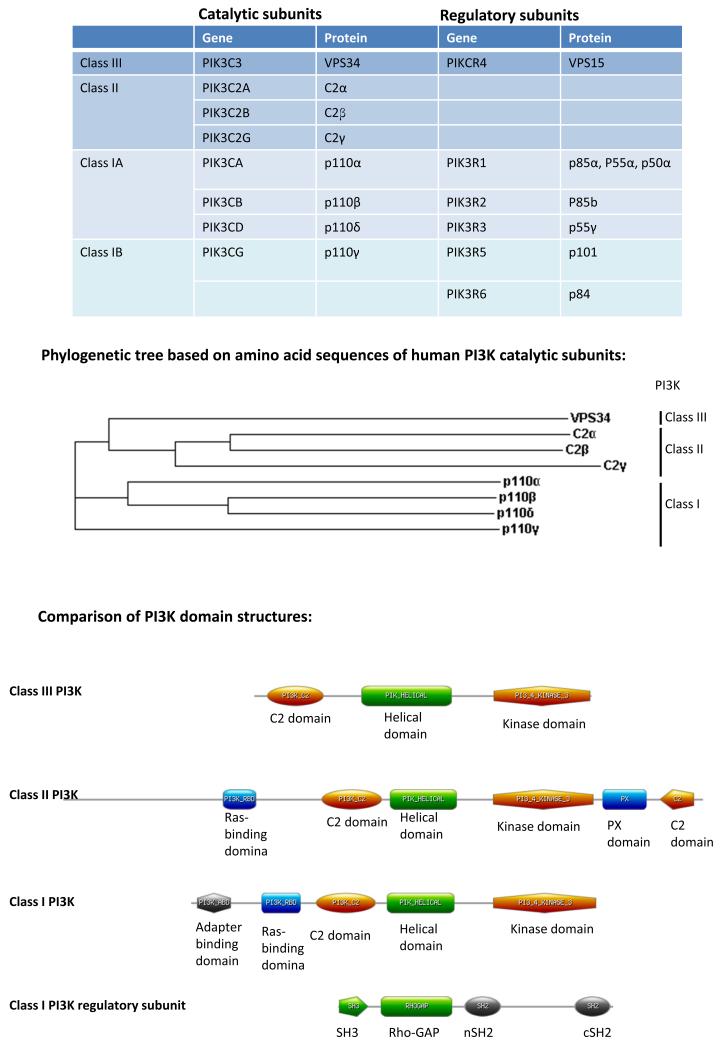
Phosphoinositide 3-kinases (PI3Ks) control many important aspects of immune cell development, differentiation, and function. Mammals have eight PI3K catalytic subunits that are divided into three classes based on similarities in structure and function. Specific roles for the class I PI3Ks have been broadly investigated and are relatively well understood, as is the function of their corresponding phosphatases. More recently, specific roles for the class II and class III PI3Ks have emerged. Through vertebrate evolution and in parallel with the evolution of adaptive immunity, there has been a dramatic increase not only in the genes for PI3K subunits but also in genes for phosphatases that act on 3-phosphoinositides and in 3-phosphoinositide-binding proteins. Our understanding of the PI3Ks in immunity is guided by fundamental discoveries made in simpler model organisms as well as by appreciating new adaptations of this signaling module in mammals in general and in immune cells in particular.
磷酸肌醇 3-激酶(PI3Ks)控制着免疫细胞发育、分化和功能的许多重要方面。哺乳动物有八种 PI3K 催化亚基,根据结构和功能的相似性分为三类。I 类 PI3Ks 的特定作用已被广泛研究,其相应的磷酸酶的功能也相对清楚。最近,II 类和 III 类 PI3Ks 的特定作用也逐渐显现。通过脊椎动物的进化,以及与适应性免疫的进化并行,不仅 PI3K 亚基的基因数量大幅增加,而且作用于 3-磷酸肌醇的磷酸酶基因以及与 3-磷酸肌醇结合的蛋白的基因数量也大幅增加。我们对免疫中 PI3Ks 的理解不仅受到在更简单的模式生物中取得的基础性发现的指导,还受到对该信号模块在哺乳动物中的一般适应性以及在免疫细胞中的特殊适应性的认识的指导。