Wu Yi-Ying, Huang Tzu-Chuan, Ye Ren-Hua, Fang Wen-Hui, Lai Shiue-Wei, Chang Ping-Ying, Liu Wei-Nung, Kuo Tai-Yu, Lee Cho-Hao, Tsai Wen-Chiuan, Lin Chin
Division of Hematology/Oncology, Department of Medicine, Tri-Service General Hospital, National Defense Medical Center, Taipei, Taiwan.
Family Medicine Division, Tri-Service General Hospital, National Defense Medical Center, Taipei, Taiwan.
JMIR Med Inform. 2020 Apr 8;8(4):e15963. doi: 10.2196/15963.
Bone marrow aspiration and biopsy remain the gold standard for the diagnosis of hematological diseases despite the development of flow cytometry (FCM) and molecular and gene analyses. However, the interpretation of the results is laborious and operator dependent. Furthermore, the obtained results exhibit inter- and intravariations among specialists. Therefore, it is important to develop a more objective and automated analysis system. Several deep learning models have been developed and applied in medical image analysis but not in the field of hematological histology, especially for bone marrow smear applications.
The aim of this study was to develop a deep learning model (BMSNet) for assisting hematologists in the interpretation of bone marrow smears for faster diagnosis and disease monitoring.
From January 1, 2016, to December 31, 2018, 122 bone marrow smears were photographed and divided into a development cohort (N=42), a validation cohort (N=70), and a competition cohort (N=10). The development cohort included 17,319 annotated cells from 291 high-resolution photos. In total, 20 photos were taken for each patient in the validation cohort and the competition cohort. This study included eight annotation categories: erythroid, blasts, myeloid, lymphoid, plasma cells, monocyte, megakaryocyte, and unable to identify. BMSNet is a convolutional neural network with the YOLO v3 architecture, which detects and classifies single cells in a single model. Six visiting staff members participated in a human-machine competition, and the results from the FCM were regarded as the ground truth.
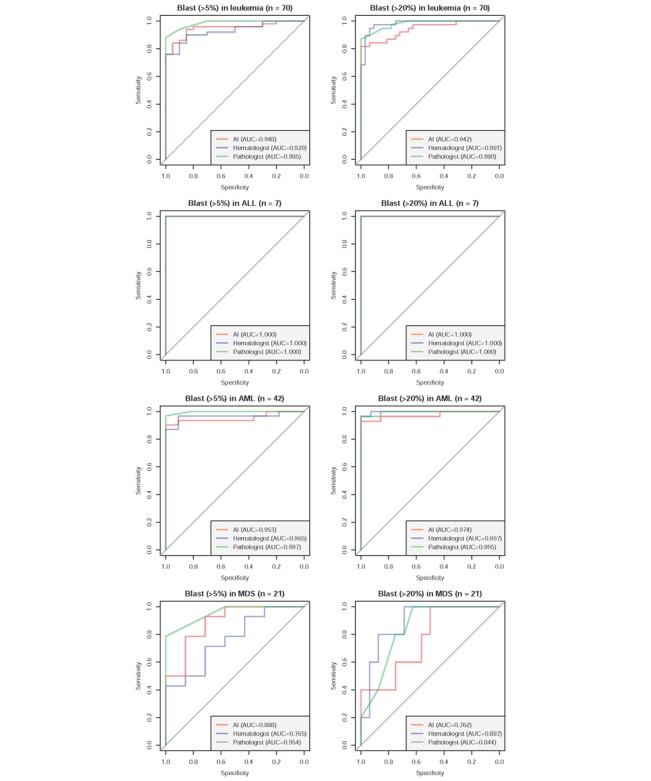
In the development cohort, according to 6-fold cross-validation, the average precision of the bounding box prediction without consideration of the classification is 67.4%. After removing the bounding box prediction error, the precision and recall of BMSNet were similar to those of the hematologists in most categories. In detecting more than 5% of blasts in the validation cohort, the area under the curve (AUC) of BMSNet (0.948) was higher than the AUC of the hematologists (0.929) but lower than the AUC of the pathologists (0.985). In detecting more than 20% of blasts, the AUCs of the hematologists (0.981) and pathologists (0.980) were similar and were higher than the AUC of BMSNet (0.942). Further analysis showed that the performance difference could be attributed to the myelodysplastic syndrome cases. In the competition cohort, the mean value of the correlations between BMSNet and FCM was 0.960, and the mean values of the correlations between the visiting staff and FCM ranged between 0.952 and 0.990.
Our deep learning model can assist hematologists in interpreting bone marrow smears by facilitating and accelerating the detection of hematopoietic cells. However, a detailed morphological interpretation still requires trained hematologists.
尽管流式细胞术(FCM)以及分子和基因分析技术不断发展,但骨髓穿刺和活检仍是血液系统疾病诊断的金标准。然而,结果的解读既费力又依赖操作人员。此外,不同专家对所得结果的解读存在个体间和个体内差异。因此,开发一个更客观、自动化的分析系统很重要。已有几种深度学习模型被开发并应用于医学图像分析,但尚未应用于血液组织学领域,尤其是骨髓涂片应用方面。
本研究旨在开发一种深度学习模型(BMSNet),以协助血液科医生解读骨髓涂片,实现更快的诊断和疾病监测。
从2016年1月1日至2018年12月31日,对122份骨髓涂片进行拍照,并分为一个开发队列(N = 42)、一个验证队列(N = 70)和一个竞赛队列(N = 10)。开发队列包括来自291张高分辨率照片的17319个标注细胞。在验证队列和竞赛队列中,每位患者共拍摄20张照片。本研究包括八个标注类别:红系、原始细胞、髓系、淋巴系、浆细胞、单核细胞、巨核细胞以及无法识别。BMSNet是一种采用YOLO v3架构的卷积神经网络,可在单个模型中对单个细胞进行检测和分类。六名访问工作人员参与了人机竞赛,FCM的结果被视为金标准。
在开发队列中,根据6折交叉验证,不考虑分类的边界框预测平均精度为67.4%。去除边界框预测误差后,BMSNet在大多数类别中的精度和召回率与血液科医生相似。在验证队列中检测到超过5%的原始细胞时,BMSNet的曲线下面积(AUC)(0.948)高于血液科医生的AUC(0.929),但低于病理科医生的AUC(0.985)。在检测到超过20%的原始细胞时,血液科医生(0.981)和病理科医生(0.980)的AUC相似且高于BMSNet的AUC(0.942)。进一步分析表明,性能差异可能归因于骨髓增生异常综合征病例。在竞赛队列中,BMSNet与FCM之间的相关性平均值为0.960,访问工作人员与FCM之间的相关性平均值在0.952至0.990之间。
我们的深度学习模型可通过促进和加速造血细胞检测来协助血液科医生解读骨髓涂片。然而,详细的形态学解读仍需要训练有素的血液科医生。