Department of Medicine, University of Vermont Cancer Center, University of Vermont, Burlington, VT.
MD Anderson Cancer Center, Houston, TX.
JCO Oncol Pract. 2020 Sep;16(9):e868-e874. doi: 10.1200/JOP.19.00697. Epub 2020 Apr 8.
Guidelines recommend venous thromboembolism (VTE) risk assessment in outpatients with cancer and pharmacologic thromboprophylaxis in selected patients at high risk for VTE. Although validated risk stratification tools are available, < 10% of oncologists use a risk assessment tool, and rates of VTE prophylaxis in high-risk patients are low in practice. We hypothesized that implementation of a systems-based program that uses the electronic health record (EHR) and offers personalized VTE prophylaxis recommendations would increase VTE risk assessment rates in patients initiating outpatient chemotherapy.
Venous Thromboembolism Prevention in the Ambulatory Cancer Clinic (VTEPACC) was a multidisciplinary program implemented by nurses, oncologists, pharmacists, hematologists, advanced practice providers, and quality partners. We prospectively identified high-risk patients using the Khorana and Protecht scores (≥ 3 points) via an EHR-based risk assessment tool. Patients with a predicted high risk of VTE during treatment were offered a hematology consultation to consider VTE prophylaxis. Results of the consultation were communicated to the treating oncologist, and clinical outcomes were tracked.
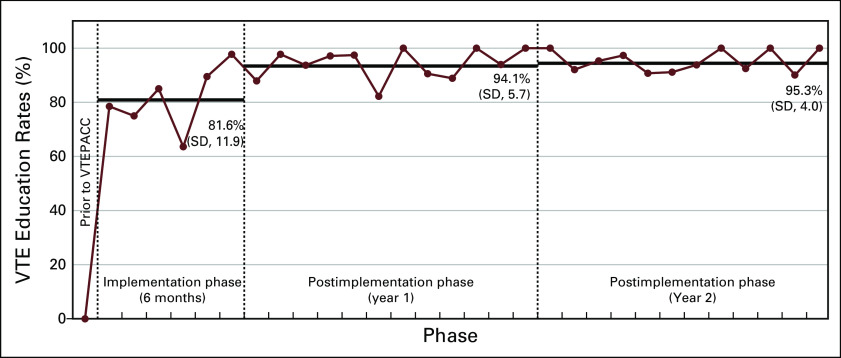
A total of 918 outpatients with cancer initiating cancer-directed therapy were evaluated. VTE monthly education rates increased from < 5% before VTEPACC to 81.6% (standard deviation [SD], 11.9; range, 63.6%-97.7%) during the implementation phase and 94.7% (SD, 4.9; range, 82.1%-100%) for the full 2-year postimplementation phase. In the postimplementation phase, 213 patients (23.2%) were identified as being at high risk for developing a VTE. Referrals to hematology were offered to 151 patients (71%), with 141 patients (93%) being assessed and 93.8% receiving VTE prophylaxis.
VTEPACC is a successful model for guideline implementation to provide VTE risk assessment and prophylaxis to prevent cancer-associated thrombosis in outpatients. Methods applied can readily translate into practice and overcome the current implementation gaps between guidelines and clinical practice.
指南建议对门诊癌症患者进行静脉血栓栓塞症(VTE)风险评估,并对 VTE 高危患者进行选择性药物预防血栓形成。尽管有经过验证的风险分层工具,但<10%的肿瘤学家使用风险评估工具,而高危患者实际 VTE 预防率很低。我们假设实施一种基于系统的方案,该方案使用电子健康记录(EHR)并提供个性化的 VTE 预防建议,将提高开始门诊化疗的患者的 VTE 风险评估率。
静脉血栓栓塞预防门诊癌症诊所(VTEPACC)是一项多学科计划,由护士、肿瘤学家、药剂师、血液学家、高级实践提供者和质量合作伙伴共同实施。我们通过基于 EHR 的风险评估工具,前瞻性地使用 Khorana 和 Protecht 评分(≥3 分)确定高危患者。在治疗过程中被预测为 VTE 高危的患者接受血液学咨询以考虑 VTE 预防。咨询结果传达给主治肿瘤学家,并跟踪临床结果。
共评估了 918 例开始癌症定向治疗的门诊癌症患者。VTE 每月教育率从 VTEPACC 实施前的<5%增加到实施期间的 81.6%(标准差[SD],11.9;范围,63.6%-97.7%)和实施后 2 年的 94.7%(SD,4.9;范围,82.1%-100%)。在实施后阶段,213 例(23.2%)患者被确定为有发生 VTE 的高风险。向血液科转介了 151 例患者(71%),对 141 例患者(93%)进行了评估,93.8%的患者接受了 VTE 预防。
VTEPACC 是实施指南的成功模式,可为门诊癌症患者提供 VTE 风险评估和预防血栓形成,以预防癌症相关血栓形成。应用的方法可以很容易地转化为实践,并克服指南与临床实践之间目前的实施差距。