• 文献检索
  • 文档翻译
  • 深度研究
  • 学术资讯
  • Suppr Zotero 插件Zotero 插件
  • 邀请有礼
  • 套餐&价格
  • 历史记录
应用&插件
Suppr Zotero 插件Zotero 插件浏览器插件Mac 客户端Windows 客户端微信小程序
定价
高级版会员购买积分包购买API积分包
服务
文献检索文档翻译深度研究API 文档MCP 服务
关于我们
关于 Suppr公司介绍联系我们用户协议隐私条款
关注我们

Suppr 超能文献

核心技术专利:CN118964589B侵权必究
粤ICP备2023148730 号-1Suppr @ 2026

文献检索

告别复杂PubMed语法,用中文像聊天一样搜索,搜遍4000万医学文献。AI智能推荐,让科研检索更轻松。

立即免费搜索

文件翻译

保留排版,准确专业,支持PDF/Word/PPT等文件格式,支持 12+语言互译。

免费翻译文档

深度研究

AI帮你快速写综述,25分钟生成高质量综述,智能提取关键信息,辅助科研写作。

立即免费体验

基于液体活检的 DNA 预测癌症相关静脉血栓栓塞症。

DNA liquid biopsy-based prediction of cancer-associated venous thromboembolism.

机构信息

Memorial Sloan Kettering Cancer Center, New York, NY, USA.

GenesisCare, University of Sydney, Sydney, New South Wales, Australia.

出版信息

Nat Med. 2024 Sep;30(9):2499-2507. doi: 10.1038/s41591-024-03195-0. Epub 2024 Aug 15.

DOI:10.1038/s41591-024-03195-0
PMID:39147831
原文链接:https://pmc.ncbi.nlm.nih.gov/articles/PMC11405286/
Abstract

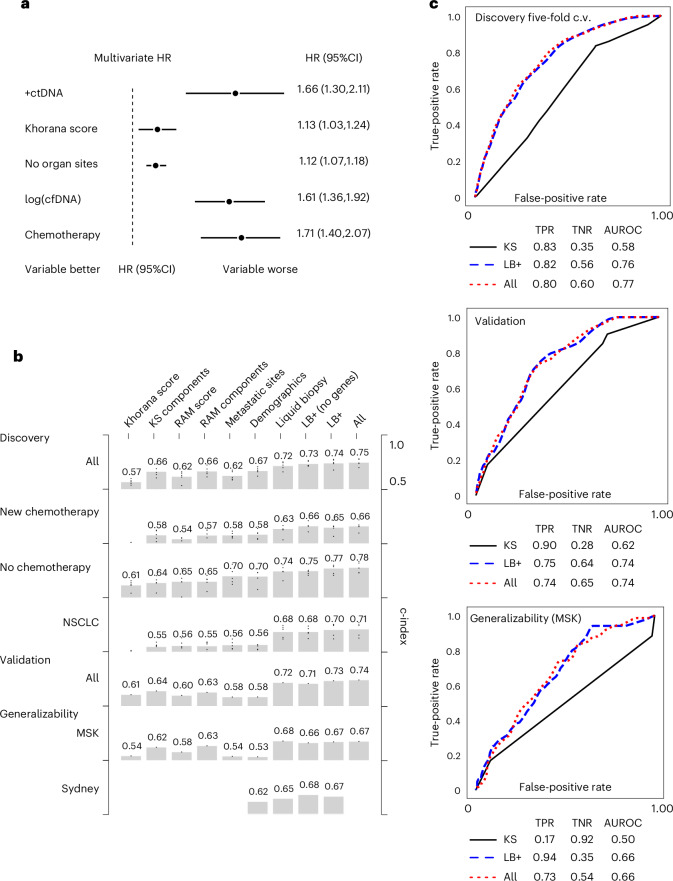
Cancer-associated venous thromboembolism (VTE) is a major source of oncologic cost, morbidity and mortality. Identifying high-risk patients for prophylactic anticoagulation is challenging and adds to clinician burden. Circulating tumor DNA (ctDNA) sequencing assays ('liquid biopsies') are widely implemented, but their utility for VTE prognostication is unknown. Here we analyzed three plasma sequencing cohorts: a pan-cancer discovery cohort of 4,141 patients with non-small cell lung cancer (NSCLC) or breast, pancreatic and other cancers; a prospective validation cohort consisting of 1,426 patients with the same cancer types; and an international generalizability cohort of 463 patients with advanced NSCLC. ctDNA detection was associated with VTE independent of clinical and radiographic features. A machine learning model trained on liquid biopsy data outperformed previous risk scores (discovery, validation and generalizability c-indices 0.74, 0.73 and 0.67, respectively, versus 0.57, 0.61 and 0.54 for the Khorana score). In real-world data, anticoagulation was associated with lower VTE rates if ctDNA was detected (n = 2,522, adjusted hazard ratio (HR) = 0.50, 95% confidence interval (CI): 0.30-0.81); ctDNA patients (n = 1,619) did not benefit from anticoagulation (adjusted HR = 0.89, 95% CI: 0.40-2.0). These results provide preliminary evidence that liquid biopsies may improve VTE risk stratification in addition to clinical parameters. Interventional, randomized prospective studies are needed to confirm the clinical utility of liquid biopsies for guiding anticoagulation in patients with cancer.

摘要

癌症相关的静脉血栓栓塞症(VTE)是肿瘤相关成本、发病率和死亡率的主要原因。确定需要预防性抗凝治疗的高危患者具有挑战性,并且会增加临床医生的负担。循环肿瘤 DNA(ctDNA)测序检测(“液体活检”)已广泛应用,但它们在 VTE 预后预测中的效用尚不清楚。在这里,我们分析了三个血浆测序队列:一个包含 4141 名非小细胞肺癌(NSCLC)或乳腺癌、胰腺癌和其他癌症患者的泛癌发现队列;一个由 1426 名具有相同癌症类型的患者组成的前瞻性验证队列;以及一个由 463 名晚期 NSCLC 患者组成的国际可推广性队列。ctDNA 检测与 VTE 独立于临床和影像学特征相关。一个基于液体活检数据训练的机器学习模型的表现优于先前的风险评分(发现、验证和可推广性 c 指数分别为 0.74、0.73 和 0.67,而 Khorana 评分分别为 0.57、0.61 和 0.54)。在真实世界的数据中,如果检测到 ctDNA,则抗凝与较低的 VTE 发生率相关(n=2522,调整后的危险比(HR)=0.50,95%置信区间(CI):0.30-0.81);ctDNA 患者(n=1619)未从抗凝治疗中获益(调整后的 HR=0.89,95%CI:0.40-2.0)。这些结果初步证明液体活检除了临床参数外,还可能改善 VTE 风险分层。需要进行干预性、随机前瞻性研究来确认液体活检在指导癌症患者抗凝治疗方面的临床效用。

https://cdn.ncbi.nlm.nih.gov/pmc/blobs/e133/11405286/b4156e12381b/41591_2024_3195_Fig13_ESM.jpg
https://cdn.ncbi.nlm.nih.gov/pmc/blobs/e133/11405286/056003adeee8/41591_2024_3195_Fig1_HTML.jpg
https://cdn.ncbi.nlm.nih.gov/pmc/blobs/e133/11405286/c7be15adc4d3/41591_2024_3195_Fig2_HTML.jpg
https://cdn.ncbi.nlm.nih.gov/pmc/blobs/e133/11405286/b9f5dceaf887/41591_2024_3195_Fig3_HTML.jpg
https://cdn.ncbi.nlm.nih.gov/pmc/blobs/e133/11405286/4b6cce975082/41591_2024_3195_Fig4_ESM.jpg
https://cdn.ncbi.nlm.nih.gov/pmc/blobs/e133/11405286/79a4cbb502a1/41591_2024_3195_Fig5_ESM.jpg
https://cdn.ncbi.nlm.nih.gov/pmc/blobs/e133/11405286/c1642b8898c5/41591_2024_3195_Fig6_ESM.jpg
https://cdn.ncbi.nlm.nih.gov/pmc/blobs/e133/11405286/1a3281d5668f/41591_2024_3195_Fig7_ESM.jpg
https://cdn.ncbi.nlm.nih.gov/pmc/blobs/e133/11405286/fdfbf4552854/41591_2024_3195_Fig8_ESM.jpg
https://cdn.ncbi.nlm.nih.gov/pmc/blobs/e133/11405286/de49addf699e/41591_2024_3195_Fig9_ESM.jpg
https://cdn.ncbi.nlm.nih.gov/pmc/blobs/e133/11405286/26b4bdd3d241/41591_2024_3195_Fig10_ESM.jpg
https://cdn.ncbi.nlm.nih.gov/pmc/blobs/e133/11405286/c54caa4251d3/41591_2024_3195_Fig11_ESM.jpg
https://cdn.ncbi.nlm.nih.gov/pmc/blobs/e133/11405286/e544de91caf2/41591_2024_3195_Fig12_ESM.jpg
https://cdn.ncbi.nlm.nih.gov/pmc/blobs/e133/11405286/b4156e12381b/41591_2024_3195_Fig13_ESM.jpg
https://cdn.ncbi.nlm.nih.gov/pmc/blobs/e133/11405286/056003adeee8/41591_2024_3195_Fig1_HTML.jpg
https://cdn.ncbi.nlm.nih.gov/pmc/blobs/e133/11405286/c7be15adc4d3/41591_2024_3195_Fig2_HTML.jpg
https://cdn.ncbi.nlm.nih.gov/pmc/blobs/e133/11405286/b9f5dceaf887/41591_2024_3195_Fig3_HTML.jpg
https://cdn.ncbi.nlm.nih.gov/pmc/blobs/e133/11405286/4b6cce975082/41591_2024_3195_Fig4_ESM.jpg
https://cdn.ncbi.nlm.nih.gov/pmc/blobs/e133/11405286/79a4cbb502a1/41591_2024_3195_Fig5_ESM.jpg
https://cdn.ncbi.nlm.nih.gov/pmc/blobs/e133/11405286/c1642b8898c5/41591_2024_3195_Fig6_ESM.jpg
https://cdn.ncbi.nlm.nih.gov/pmc/blobs/e133/11405286/1a3281d5668f/41591_2024_3195_Fig7_ESM.jpg
https://cdn.ncbi.nlm.nih.gov/pmc/blobs/e133/11405286/fdfbf4552854/41591_2024_3195_Fig8_ESM.jpg
https://cdn.ncbi.nlm.nih.gov/pmc/blobs/e133/11405286/de49addf699e/41591_2024_3195_Fig9_ESM.jpg
https://cdn.ncbi.nlm.nih.gov/pmc/blobs/e133/11405286/26b4bdd3d241/41591_2024_3195_Fig10_ESM.jpg
https://cdn.ncbi.nlm.nih.gov/pmc/blobs/e133/11405286/c54caa4251d3/41591_2024_3195_Fig11_ESM.jpg
https://cdn.ncbi.nlm.nih.gov/pmc/blobs/e133/11405286/e544de91caf2/41591_2024_3195_Fig12_ESM.jpg
https://cdn.ncbi.nlm.nih.gov/pmc/blobs/e133/11405286/b4156e12381b/41591_2024_3195_Fig13_ESM.jpg

相似文献

1
DNA liquid biopsy-based prediction of cancer-associated venous thromboembolism.基于液体活检的 DNA 预测癌症相关静脉血栓栓塞症。
Nat Med. 2024 Sep;30(9):2499-2507. doi: 10.1038/s41591-024-03195-0. Epub 2024 Aug 15.
2
Detection of circulating tumor DNA with ultradeep sequencing of plasma cell-free DNA for monitoring minimal residual disease and early detection of recurrence in early-stage lung cancer.通过对血浆游离DNA进行超深度测序检测循环肿瘤DNA,用于监测早期肺癌的微小残留病和复发的早期检测。
Cancer. 2024 May 15;130(10):1758-1765. doi: 10.1002/cncr.35263. Epub 2024 Feb 29.
3
Unlocking the future of cancer diagnosis - promises and challenges of ctDNA-based liquid biopsies in non-small cell lung cancer.解锁癌症诊断的未来——ctDNA 液体活检在非小细胞肺癌中的前景与挑战。
Transl Res. 2024 Oct;272:41-53. doi: 10.1016/j.trsl.2024.05.014. Epub 2024 Jun 3.
4
Predictors of active cancer thromboembolic outcomes: validation of the Khorana score among patients with lung cancer.活动性癌症血栓栓塞结局的预测因素:肺癌患者中Khorana评分的验证
J Thromb Haemost. 2016 Sep;14(9):1773-8. doi: 10.1111/jth.13378. Epub 2016 Sep 9.
5
Periprocedural interruption of anticoagulation in patients with cancer-associated venous thromboembolism: An analysis of thrombotic and bleeding outcomes.癌症相关静脉血栓栓塞症患者围手术期抗凝中断:血栓形成和出血结局分析。
J Thromb Haemost. 2019 Jul;17(7):1171-1178. doi: 10.1111/jth.14468. Epub 2019 May 29.
6
Incidence, outcome and risk stratification tools for venous thromboembolism in advanced pancreatic cancer - A retrospective cohort study.晚期胰腺癌患者静脉血栓栓塞症的发病率、转归和风险分层工具 - 一项回顾性队列研究。
Thromb Res. 2017 Sep;157:9-15. doi: 10.1016/j.thromres.2017.06.021. Epub 2017 Jun 20.
7
Improving Prediction of Survival and Progression in Metastatic Non-Small Cell Lung Cancer After Immunotherapy Through Machine Learning of Circulating Tumor DNA.通过循环肿瘤 DNA 的机器学习提高免疫治疗后转移性非小细胞肺癌的生存和进展预测。
JCO Precis Oncol. 2024 Jun;8:e2300718. doi: 10.1200/PO.23.00718.
8
High plasma levels of soluble P-Selectin and Factor VIII predict venous thromboembolism in non-small cell lung cancer patients: The Thrombo-Nsclc risk score.高血浆可溶性 P 选择素和因子 VIII 水平可预测非小细胞肺癌患者的静脉血栓栓塞:血栓-Nsclc 风险评分。
Thromb Res. 2020 Dec;196:349-354. doi: 10.1016/j.thromres.2020.09.021. Epub 2020 Sep 16.
9
Single tube liquid biopsy for advanced non-small cell lung cancer.单管液体活检用于晚期非小细胞肺癌。
Int J Cancer. 2019 Jun 15;144(12):3127-3137. doi: 10.1002/ijc.32056. Epub 2019 Jan 28.
10
ALK-Rearranged Non-Small-Cell Lung Cancer Is Associated With a High Rate of Venous Thromboembolism.间变性淋巴瘤激酶(ALK)重排的非小细胞肺癌与静脉血栓栓塞的高发生率相关。
Clin Lung Cancer. 2017 Mar;18(2):156-161. doi: 10.1016/j.cllc.2016.10.007. Epub 2016 Oct 26.

引用本文的文献

1
Implementation of circulating tumor DNA (ctDNA) testing in precision oncology: A four-year experience from a tertiary cancer center in India.循环肿瘤DNA(ctDNA)检测在精准肿瘤学中的应用:来自印度一家三级癌症中心的四年经验。
J Liq Biopsy. 2025 Jul 26;9:100319. doi: 10.1016/j.jlb.2025.100319. eCollection 2025 Sep.
2
Research trends and hotspots of circulating tumor DNA in colorectal cancer: a bibliometric study.结直肠癌中循环肿瘤DNA的研究趋势与热点:一项文献计量学研究
Front Oncol. 2025 May 14;15:1492880. doi: 10.3389/fonc.2025.1492880. eCollection 2025.
3
Association between tumour somatic mutations and venous thromboembolism in the 100,000 Genomes Project cancer cohort: a study protocol.

本文引用的文献

1
Machine learning-based markers for CAD.基于机器学习的冠心病标志物
Lancet. 2023 Jul 15;402(10397):183. doi: 10.1016/S0140-6736(23)01062-0.
2
Associations between detectable circulating tumor DNA and tumor glucose uptake measured by F-FDG PET/CT in early-stage non-small cell lung cancer.早期非小细胞肺癌中检测到的循环肿瘤 DNA 与 F-FDG PET/CT 测量的肿瘤葡萄糖摄取之间的关联。
BMC Cancer. 2023 Jul 11;23(1):646. doi: 10.1186/s12885-023-11147-z.
3
Trends in the use of liquid biopsy in oncology.肿瘤学中液体活检的应用趋势。
10万基因组计划癌症队列中肿瘤体细胞突变与静脉血栓栓塞之间的关联:一项研究方案
Wellcome Open Res. 2024 Dec 24;9:640. doi: 10.12688/wellcomeopenres.23156.1. eCollection 2024.
4
The role of germline and somatic mutations in predicting cancer-associated thrombosis: a narrative review.生殖系和体细胞突变在预测癌症相关血栓形成中的作用:一篇叙述性综述。
Curr Opin Hematol. 2025 May 1;32(3):138-145. doi: 10.1097/MOH.0000000000000861. Epub 2025 Jan 28.
5
A Review of Circulating Tumor DNA (ctDNA) in Pancreatic Cancer: Ready for the Clinic?胰腺癌循环肿瘤DNA(ctDNA)综述:准备好应用于临床了吗?
J Gastrointest Cancer. 2025 Jan 21;56(1):50. doi: 10.1007/s12029-024-01151-2.
6
Blood hypercoagulability and thrombosis mechanisms in cancer patients -A brief review.癌症患者的血液高凝性与血栓形成机制——简要综述
Heliyon. 2024 Oct 1;10(19):e38831. doi: 10.1016/j.heliyon.2024.e38831. eCollection 2024 Oct 15.
7
Circulating tumor DNA predicts venous thromboembolism in patients with cancers.循环肿瘤DNA可预测癌症患者的静脉血栓栓塞。
J Thromb Haemost. 2025 Jan;23(1):139-148. doi: 10.1016/j.jtha.2024.09.009. Epub 2024 Sep 26.
Nat Rev Drug Discov. 2023 Aug;22(8):612-613. doi: 10.1038/d41573-023-00111-y.
4
Direct Oral Anticoagulants vs Low-Molecular-Weight Heparin and Recurrent VTE in Patients With Cancer: A Randomized Clinical Trial.直接口服抗凝剂与低分子肝素在癌症患者中的疗效比较:一项随机临床试验。
JAMA. 2023 Jun 13;329(22):1924-1933. doi: 10.1001/jama.2023.7843.
5
Tracking early lung cancer metastatic dissemination in TRACERx using ctDNA.使用 ctDNA 追踪 TRACERx 中的早期肺癌转移扩散。
Nature. 2023 Apr;616(7957):553-562. doi: 10.1038/s41586-023-05776-4. Epub 2023 Apr 13.
6
Fine Tuning Venous Thromboembolism Risk Prediction in Patients With Cancer.癌症患者静脉血栓栓塞风险预测的微调
J Clin Oncol. 2023 Jun 1;41(16):2881-2883. doi: 10.1200/JCO.23.00100. Epub 2023 Mar 27.
7
A Clinical-Genetic Risk Score for Predicting Cancer-Associated Venous Thromboembolism: A Development and Validation Study Involving Two Independent Prospective Cohorts.一种用于预测癌症相关静脉血栓栓塞症的临床-遗传风险评分:涉及两个独立前瞻性队列的开发和验证研究。
J Clin Oncol. 2023 Jun 1;41(16):2911-2925. doi: 10.1200/JCO.22.00255. Epub 2023 Feb 2.
8
Derivation and Validation of a Clinical Risk Assessment Model for Cancer-Associated Thrombosis in Two Unique US Health Care Systems.在两个独特的美国医疗保健系统中,癌症相关血栓形成的临床风险评估模型的推导和验证。
J Clin Oncol. 2023 Jun 1;41(16):2926-2938. doi: 10.1200/JCO.22.01542. Epub 2023 Jan 10.
9
Histopathological Features of Cancer-Associated Venous Thromboembolism: Presence of Intrathrombus Cancer Cells and Prothrombotic Factors.癌症相关静脉血栓栓塞的组织病理学特征:血栓内存在癌细胞和促血栓形成因子。
Arterioscler Thromb Vasc Biol. 2023 Jan;43(1):146-159. doi: 10.1161/ATVBAHA.122.318463. Epub 2022 Nov 17.
10
Overall survival with circulating tumor DNA-guided therapy in advanced non-small-cell lung cancer.晚期非小细胞肺癌中循环肿瘤DNA引导治疗的总生存期
Nat Med. 2022 Nov;28(11):2353-2363. doi: 10.1038/s41591-022-02047-z. Epub 2022 Nov 10.