Hernández Flores José Luis, Salinas Landaverde Diana, Pacheco Huerta Yonuen, Guerra Castillo Vania Lizeth, Barrios Sánchez María de Los Ángeles, Arvizu Hernández Iván, Ramos López Miguel Ángel, Álvarez Hidalgo Erika, H Jones George, Campos Guillén Juan
Laboratorio de Bioseguridad y Análisis de Riesgo, Departamento de Ingeniería Genética, Centro de Investigación y de Estudios Avanzados del IPN, Irapuato 36824, Mexico.
Facultad de Química, Universidad Autónoma de Querétaro, Cerro de las Campanas S/N, Querétaro 76010, Mexico.
Microorganisms. 2020 Apr 6;8(4):524. doi: 10.3390/microorganisms8040524.
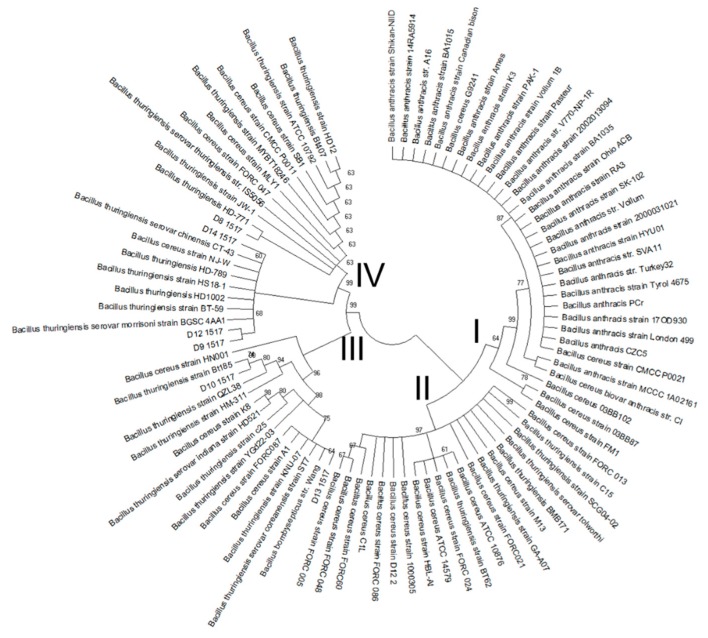
Endospore-forming bacteria related to the group produce toxins that cause illnesses in organisms from invertebrates to mammals, including foodborne illnesses in humans. As commercial bee pollen can be contaminated with these bacteria, a comprehensive microbiological risk assessment of commercial bee pollen must be incorporated into the relevant regulatory requirements, including those that apply in Mexico. To facilitate detection of members of this group of bacteria, we have developed a PCR strategy that is based on the amplification of the single-copy tRNA gene and specific genes associated with tRNA to detect (). This tRNA-PCR-based approach was used to examine commercial bee pollen for endospore-forming bacteria. Our analysis revealed that 3% of the endospore-forming colonies isolated from a commercial source of bee pollen were related to and this result was corroborated by phylogenetic analysis, bacterial identification via MALDI-TOF MS, and detection of enterotoxin genes encoding the HBL and NHE complexes. The results show that the isolated colonies are closely related phylogenetically to , and . Our results indicate that the tRNA-PCR, combined with other molecular tools, will be a useful approach for identifying and will assist in controlling the spread of potential pathogens.
与该菌属相关的产芽孢细菌会产生毒素,导致从无脊椎动物到哺乳动物的生物体患病,包括人类的食源性疾病。由于商业蜂花粉可能被这些细菌污染,因此必须将商业蜂花粉的全面微生物风险评估纳入相关监管要求,包括适用于墨西哥的那些要求。为便于检测这类细菌的成员,我们开发了一种基于单拷贝tRNA基因和与tRNA相关的特定基因扩增的PCR策略,以检测(该菌属)。这种基于tRNA-PCR的方法用于检测商业蜂花粉中的产芽孢细菌。我们的分析表明,从商业蜂花粉来源分离出的产芽孢菌落中有3%与该菌属相关,这一结果通过系统发育分析、基质辅助激光解吸电离飞行时间质谱(MALDI-TOF MS)进行细菌鉴定以及检测编码HBL和NHE复合物的肠毒素基因得到了证实。结果表明,分离出的菌落与该菌属在系统发育上密切相关。我们的结果表明,tRNA-PCR与其他分子工具相结合,将是鉴定该菌属的一种有用方法,并将有助于控制潜在病原体的传播。