Department of Ocean Science, Division of Life Science and Hong Kong Branch of the Southern Marine Science and Engineering Guangdong Laboratory (Guanzhou), The Hong Kong University of Science and Technology, Hong Kong, China.
X-STAR, Japan Agency for Marine-Earth Science and Technology (JAMSTEC), 2-15 Natsushima-cho, Yokosuka, Kanagawa, 237-0061, Japan.
Nat Commun. 2020 Apr 8;11(1):1657. doi: 10.1038/s41467-020-15522-3.
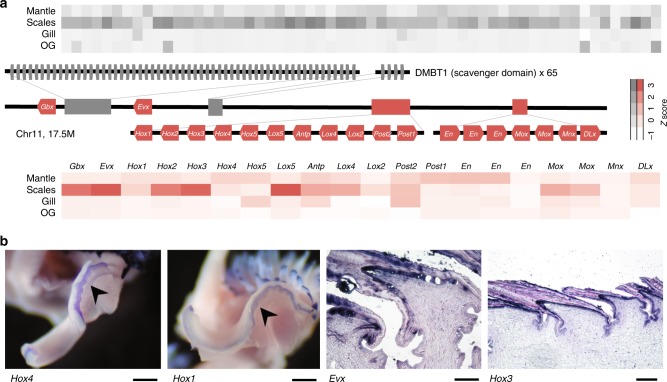
The Scaly-foot Snail, Chrysomallon squamiferum, presents a combination of biomineralised features, reminiscent of enigmatic early fossil taxa with complex shells and sclerites such as sachtids, but in a recently-diverged living species which even has iron-infused hard parts. Thus the Scaly-foot Snail is an ideal model to study the genomic mechanisms underlying the evolutionary diversification of biomineralised armour. Here, we present a high-quality whole-genome assembly and tissue-specific transcriptomic data, and show that scale and shell formation in the Scaly-foot Snail employ independent subsets of 25 highly-expressed transcription factors. Comparisons with other lophotrochozoan genomes imply that this biomineralisation toolkit is ancient, though expression patterns differ across major lineages. We suggest that the ability of lophotrochozoan lineages to generate a wide range of hard parts, exemplified by the remarkable morphological disparity in Mollusca, draws on a capacity for dynamic modification of the expression and positioning of toolkit elements across the genome.
鳞脚蜗牛 Chrysomallon squamiferum 呈现出生物矿化特征的组合,让人联想到具有复杂外壳和骨片的神秘早期化石类群,如 sachtids,但它是一个最近分化的活物种,甚至有铁渗透的硬体部分。因此,鳞脚蜗牛是研究生物矿化装甲进化多样化的基因组机制的理想模型。在这里,我们提供了一个高质量的全基因组组装和组织特异性转录组数据,并表明鳞脚蜗牛的鳞片和贝壳形成使用了 25 个高度表达的转录因子的独立子集。与其他担轮动物基因组的比较表明,这种生物矿化工具包是古老的,尽管表达模式在主要谱系之间存在差异。我们认为,担轮动物谱系产生广泛硬体部分的能力,以软体动物中显著的形态差异为代表,是基于在基因组中动态修饰工具包元素的表达和定位的能力。