Department of Medical Oncology, Sir Charles Gairdner Hospital, Perth, Western Australia, Australia.
School of Biomedical Sciences, University of Western Australia, Perth, Western Australia, Australia.
Sci Rep. 2020 Apr 8;10(1):6083. doi: 10.1038/s41598-020-63180-8.
This study compares the detection sensitivity of two separate liquid biopsy sources, cell-free (cf) DNA/RNA and extracellular vesicle (EV)-associated DNA/RNA (EV-DNA/RNA), to identify circulating Human Papilloma Virus (HPV) DNA/RNA in plasma obtained from patients with oropharyngeal squamous cell carcinoma (OPCSCC). We also report on the longitudinal changes observed in HPV-DNA levels in response to treatment.
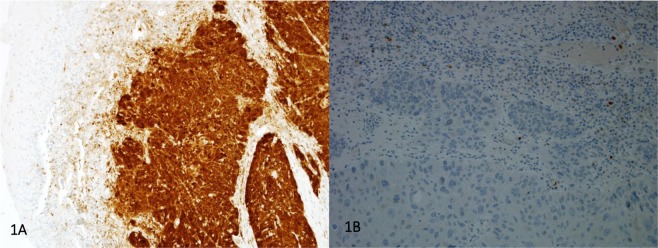
A prospective study was conducted that included 22 patients with locally advanced disease and six patients with metastatic OPCSCC. Twenty-three patients had HPV-related OPCSCC defined by p16 immunohistochemistry. Levels of circulating HPV-DNA and HPV-RNA from plasma-derived cf-DNA/RNA and EV-DNA/RNA were quantified using digital droplet PCR.
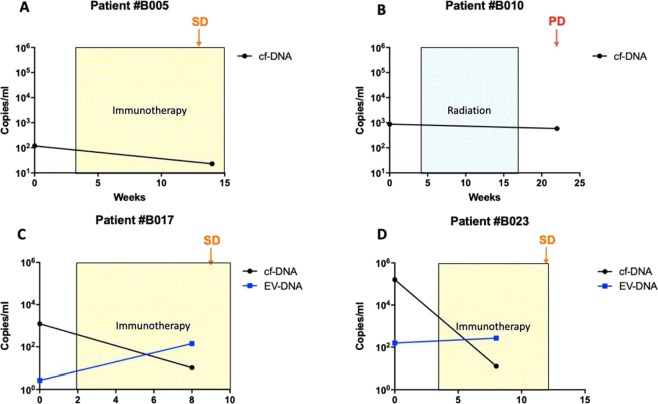
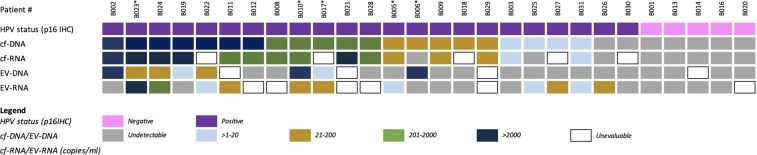
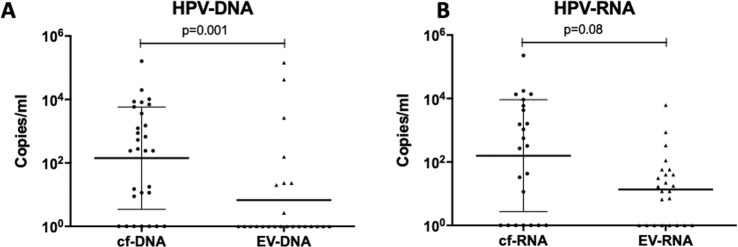
Circulating HPV-DNA was detected with higher sensitivity in cf-DNA compared to EV-DNA at 91% vs. 42% (p = <0.001). Similarly, circulating tumoral HPV-RNA was detected at a higher sensitivity in cf-RNA compared to EV-RNA, at 83% vs. 50% (p = 0.0019). In the locally advanced cohort, 100% (n = 16) of HPV-OPCSCC patients demonstrated a reduction in circulating HPV-DNA levels in cf-DNA following curative treatment, with 81% of patients demonstrating complete clearance to undetectable levels. However, in metastatic HPV-OPCSCC patients (n = 4), HPV-DNA levels did not correlate with treatment response.
Our study demonstrates that although HPV-DNA/RNA can be detected in EV associated DNA/RNA, cf-DNA/RNA is the more sensitive liquid biopsy medium. As circulating HPV-DNA levels were found to only correlate with treatment response in the locally advanced but not metastatic setting in our small cohort of patients, the use of HPV-DNA as a dynamic biomarker to monitor treatment response requires further evaluation.
本研究比较了两种不同的液体活检来源(游离(cf)DNA/RNA 和细胞外囊泡(EV)相关 DNA/RNA(EV-DNA/RNA))的检测灵敏度,以鉴定从患有口咽鳞状细胞癌(OPCSCC)的患者的血浆中循环的人乳头瘤病毒(HPV)DNA/RNA。我们还报告了治疗后 HPV-DNA 水平的纵向变化。
进行了一项前瞻性研究,包括 22 例局部晚期疾病患者和 6 例转移性 OPCSCC 患者。23 例患者的 p16 免疫组化定义为 HPV 相关 OPCSCC。使用数字液滴 PCR 定量检测来自血浆衍生的 cf-DNA/RNA 和 EV-DNA/RNA 的循环 HPV-DNA 和 HPV-RNA 水平。
与 EV-DNA 相比,cf-DNA 检测到循环 HPV-DNA 的灵敏度更高,为 91%对 42%(p<0.001)。同样,cf-RNA 中循环肿瘤 HPV-RNA 的检测灵敏度高于 EV-RNA,为 83%对 50%(p=0.0019)。在局部晚期队列中,100%(n=16)的 HPV-OPCSCC 患者在根治性治疗后 cf-DNA 中循环 HPV-DNA 水平降低,81%的患者达到无法检测的水平。然而,在转移性 HPV-OPCSCC 患者(n=4)中,HPV-DNA 水平与治疗反应无关。
我们的研究表明,尽管可以在 EV 相关 DNA/RNA 中检测到 HPV-DNA/RNA,但 cf-DNA/RNA 是更敏感的液体活检介质。由于在我们的小患者队列中,仅在局部晚期而非转移性环境中发现循环 HPV-DNA 水平与治疗反应相关,因此将 HPV-DNA 用作监测治疗反应的动态生物标志物需要进一步评估。