Park Joonhong, Yoo Han Mo, Sul Hae Jung, Shin Soyoung, Lee Seung Woo, Kim Jeong Goo
Department of Laboratory Medicine, College of Medicine, The Catholic University of Korea, Seoul, Korea.
Department of Surgery, College of Medicine, The Catholic University of Korea, Seoul, Korea.
J Gastric Cancer. 2020 Mar;20(1):29-40. doi: 10.5230/jgc.2020.20.e2. Epub 2019 Dec 27.
Gastrointestinal stromal tumors (GISTs) frequently harbor activating gene mutations in either or platelet-derived growth factor receptor A () and are highly responsive to several selective tyrosine kinase inhibitors. In this study, a targeted next-generation sequencing (NGS) assay with an Oncomine Focus Assay (OFA) panel was used for the genetic characterization of molecular targets in 30 Korean patients with GIST.
Using the OFA that enables rapid and simultaneous detection of hotspots, single nucleotide variants (SNVs), insertion and deletions (Indels), copy number variants (CNVs), and gene fusions across 52 genes relevant to solid tumors, targeted NGS was performed using genomic DNA extracted from formalin-fixed and paraffin-embedded samples of 30 GISTs.
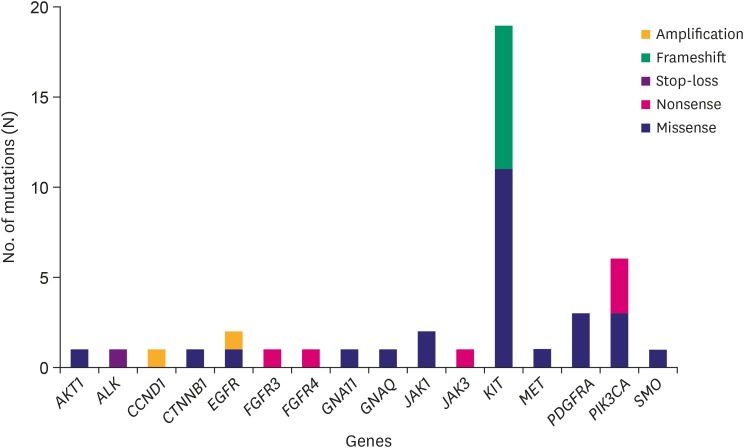
Forty-three hotspot/other likely pathogenic variants (33 SNVs, 8 Indels, and 2 amplifications) in 16 genes were identified in 26 of the 30 GISTs. variants were most frequent (44%, 19/43), followed by 6 variants in , 3 in , 2 each in and , and 1 each in , , , , , , , , , , and . Based on the mutation types, majority of the variants carried missense mutations (60%, 26/43), followed by 8 frameshifts, 6 nonsense, 1 stop-loss, and 2 amplifications.
Our study confirmed the advantage of using targeted NGS with a cancer gene panel to efficiently identify mutations associated with GISTs. These findings may provide a molecular genetic basis for developing new drugs targeting these gene mutations for GIST therapy.
胃肠道间质瘤(GIST)常携带KIT基因或血小板衍生生长因子受体A(PDGFRA)的激活基因突变,并且对多种选择性酪氨酸激酶抑制剂高度敏感。在本研究中,采用Oncomine Focus Assay(OFA)检测板进行靶向二代测序(NGS)分析,以对30例韩国GIST患者的分子靶点进行基因特征分析。
使用能够快速同时检测与实体瘤相关的52个基因的热点、单核苷酸变异(SNV)、插入和缺失(Indel)、拷贝数变异(CNV)以及基因融合的OFA,对从30例GIST的福尔马林固定石蜡包埋样本中提取的基因组DNA进行靶向NGS分析。
在30例GIST中的26例中,鉴定出16个基因中的43个热点/其他可能的致病变异(33个SNV、8个Indel和2个扩增)。KIT变异最为常见(44%,19/43),其次是PDGFRA中的6个变异、NRAS中的3个变异、BRAF和PIK3CA中的各2个变异,以及KRAS、NRAS、BRAF、PIK3CA、AKT1、NF1、PTEN、RB1、TP53、SMAD4、CDKN2A、CTNNB1和FBXW7中的各1个变异。基于突变类型,大多数变异为错义突变(60%,26/43),其次是8个移码突变、6个无义突变、1个终止密码子丢失突变和2个扩增。
我们的研究证实了使用癌症基因检测板进行靶向NGS以有效鉴定与GIST相关突变的优势。这些发现可能为开发针对这些基因突变的GIST治疗新药提供分子遗传学基础。