Chow Simon C Y, Wong Randolph H L, Yu Peter S Y, Ho Jacky Y K, Chan Joyce W Y, Kwok Micky W T, Wan Song, Fujikawa Takuya, Underwood Malcolm J
Division of Cardiothoracic Surgery, Department of Surgery, The Chinese University of Hong Kong, Prince of Wales Hospital, 30-32 Ngan Shing Street, Shatin, New Territories Hong Kong, China.
J Thorac Dis. 2020 Mar;12(3):803-812. doi: 10.21037/jtd.2019.12.72.
Coronary artery bypass grafting (CABG) is the standard of care for patients with ischemic cardiomyopathy (ICM). Despite recent evidence supporting the role of CABG, long term outcomes for patients with ICM remain poor and 10-year results post CABG in ICM patients are under-reported, especially among Asians. Uncertainty on whether CABG improves cardiac performance and survival in the long term remains. In this study, we aim to analyze 10-year results concerning cardiac performance and survival post CABG in Asian patients with left ventricular ejection fraction (LVEF) ≤35% and predominant heart failure symptoms, and identify perioperative risk factors affecting long term survival and cardiac function.
Thirty-six patients with LVEF <35% who had CABG performed between the year 2006-2009 were selected from local hospital records for retrospective analysis. Outcomes of interest included post-operative cardiac symptoms, LVEF & 10-year all-cause and cardiac-event free survival. Survival analysis was performed using Kaplan Meier analysis, and predictive factors were identified with log- rank test and logistic regression analysis.
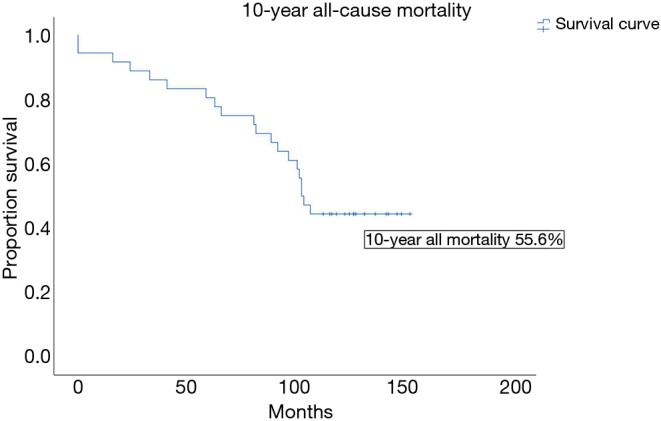
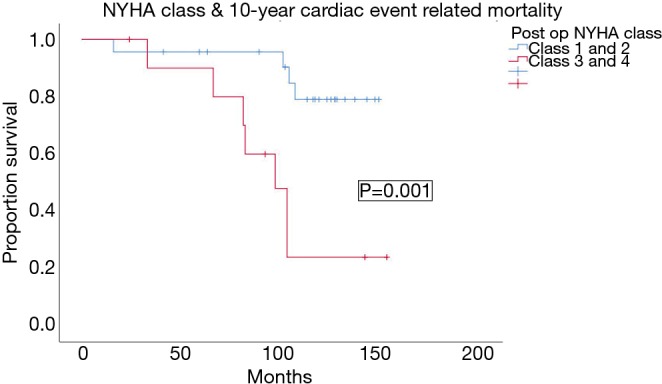
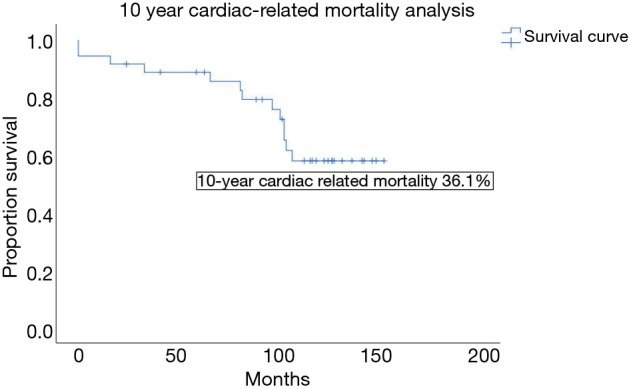
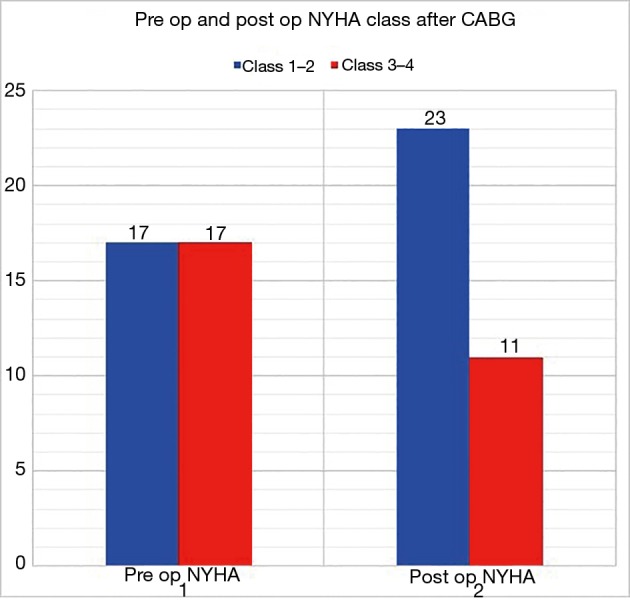
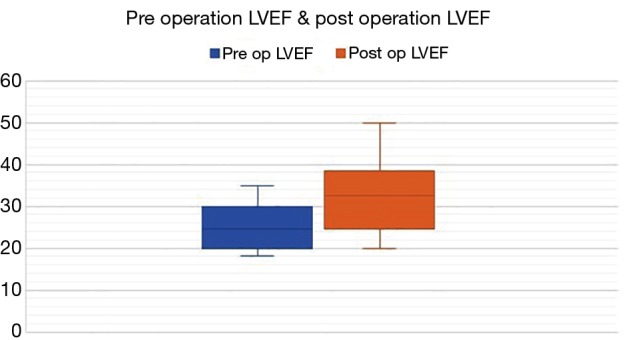
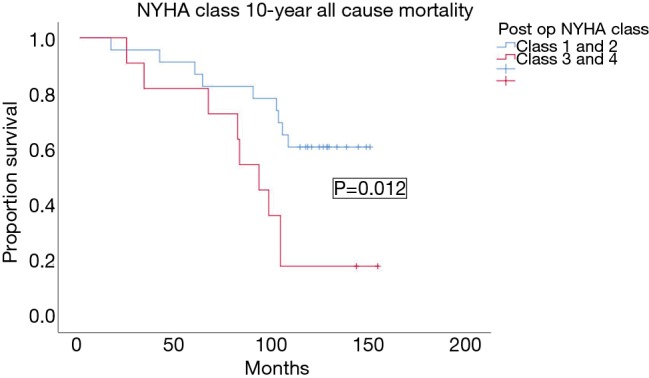
The mean age of the cohort was 62.9±9.9 years. Operative mortality within 30 days was 5.6%. The 10-year all-cause mortality rate was 55.6%. The mean duration of survival was 105.9±8.3 months. Of the patients who did not survive till 10 years, 65.0% died of cardiac-related causes, with non-ST elevation myocardial infarction being the commonest cause. CABG improved LVEF (24.9% to 32.2%; P<0.001) and 66.7% of patients remained with impaired LVEF ≤35% post CABG. Post op NYHA class 3-4 symptoms (OR: 6.3; P=0.012) was the only predictive factor for 10 year all-cause mortality and post op LVEF improvement ≥5% (OR: 5.8; 95% CI, 1.1-29.9; P=0.036) was associated with improvement in NYHA class. Completeness of revascularization and viability of myocardium were not predictive of survival or changes in LVEF or NYHA class.
The 10-year survival rates of Asian patients with ICM were similarly disappointing as its counterparts in the west. A majority of patients still suffered from cardiac-event related deaths. Post CABG NYHA class was found to be important in determining success and adequacy of treatment in patients with ICM and improvement in LVEF ≥5% was predictive of improvement of symptoms. Neither completeness of revascularization or presence of myocardial viability had any impact on survival in our patient cohort.
冠状动脉旁路移植术(CABG)是缺血性心肌病(ICM)患者的标准治疗方法。尽管最近有证据支持CABG的作用,但ICM患者的长期预后仍然很差,ICM患者CABG术后10年的结果报道不足,尤其是在亚洲人中。CABG能否长期改善心脏功能和生存率仍不确定。在本研究中,我们旨在分析亚洲左心室射血分数(LVEF)≤35%且主要有心力衰竭症状的患者CABG术后10年的心脏功能和生存结果,并确定影响长期生存和心脏功能的围手术期危险因素。
从当地医院记录中选取2006年至2009年间接受CABG的36例LVEF<35%的患者进行回顾性分析。感兴趣的结果包括术后心脏症状、LVEF以及10年全因生存率和无心脏事件生存率。采用Kaplan-Meier分析进行生存分析,并通过对数秩检验和逻辑回归分析确定预测因素。
该队列的平均年龄为62.9±9.9岁。30天内的手术死亡率为5.6%。10年全因死亡率为55.6%。平均生存时间为105.9±8.3个月。在未存活至10年的患者中,65.0%死于心脏相关原因,非ST段抬高型心肌梗死是最常见的原因。CABG改善了LVEF(从24.9%提高到32.2%;P<0.001),66.7%的患者CABG术后LVEF仍受损≤35%。术后纽约心脏协会(NYHA)3-4级症状(OR:6.3;P=0.012)是10年全因死亡率的唯一预测因素,术后LVEF改善≥5%(OR:5.8;95%CI,1.1-29.9;P=0.036)与NYHA分级改善相关。血运重建的完整性和心肌活力不是生存、LVEF或NYHA分级变化的预测因素。
亚洲ICM患者的10年生存率与西方患者同样令人失望。大多数患者仍死于心脏事件相关原因。发现CABG术后NYHA分级对于确定ICM患者治疗的成功和充分性很重要,LVEF改善≥5%可预测症状改善。在我们的患者队列中,血运重建的完整性或心肌活力的存在对生存均无影响。