Department of Cell and Developmental Biology, University College London, London, United Kingdom.
Department of Applied Mathematics, University of Waterloo, Waterloo, Canada.
PLoS Comput Biol. 2020 Apr 10;16(4):e1007783. doi: 10.1371/journal.pcbi.1007783. eCollection 2020 Apr.
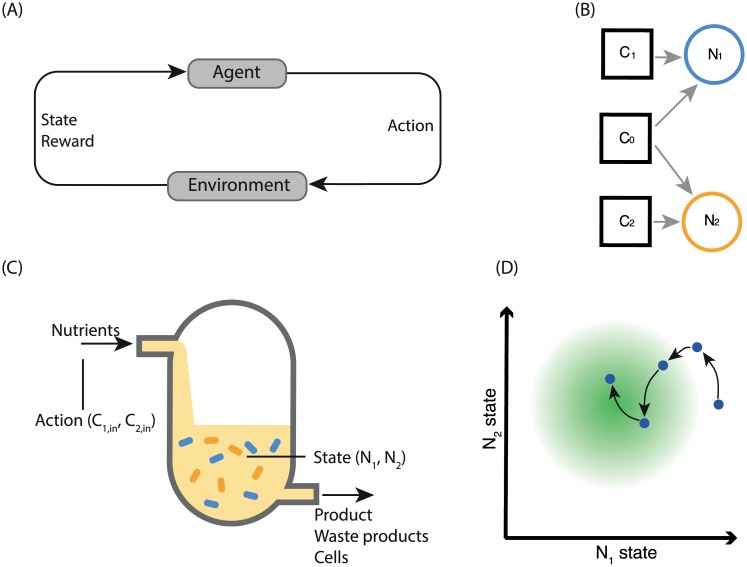
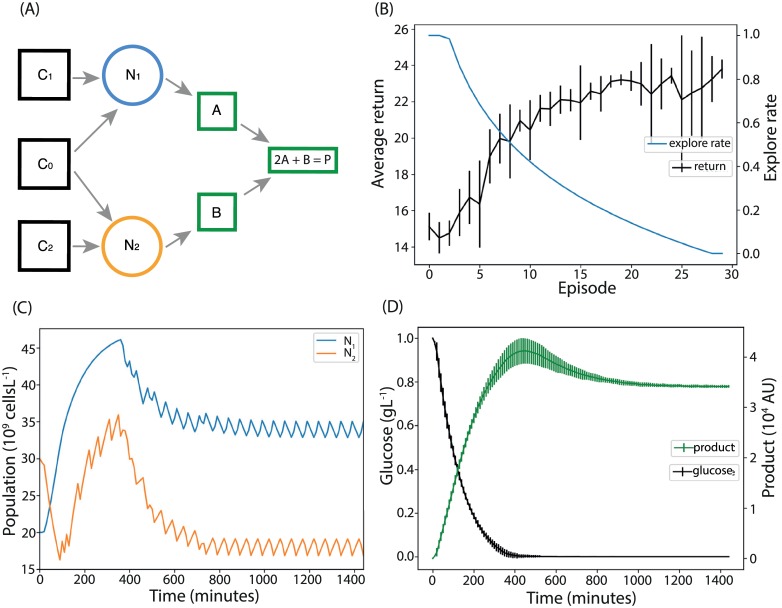
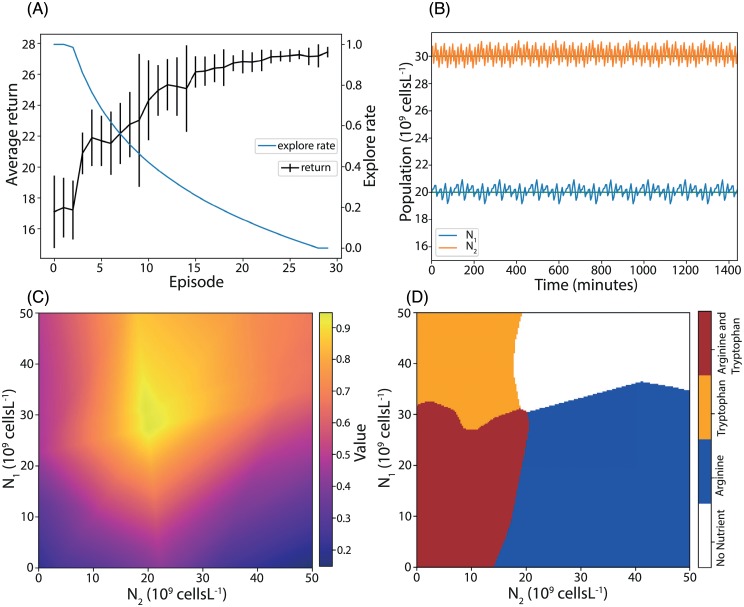
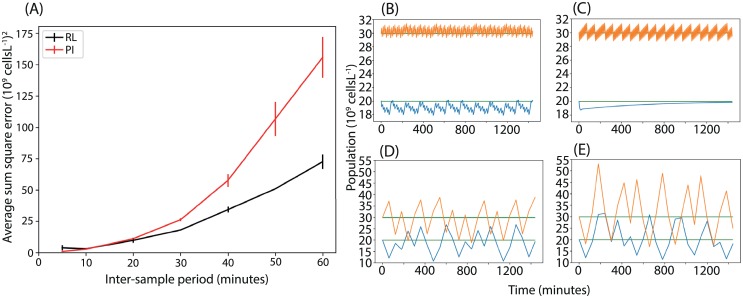
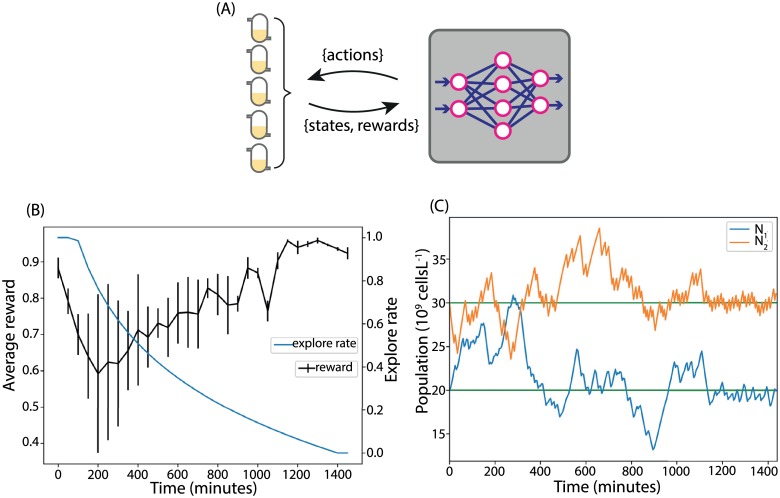
Multi-species microbial communities are widespread in natural ecosystems. When employed for biomanufacturing, engineered synthetic communities have shown increased productivity in comparison with monocultures and allow for the reduction of metabolic load by compartmentalising bioprocesses between multiple sub-populations. Despite these benefits, co-cultures are rarely used in practice because control over the constituent species of an assembled community has proven challenging. Here we demonstrate, in silico, the efficacy of an approach from artificial intelligence-reinforcement learning-for the control of co-cultures within continuous bioreactors. We confirm that feedback via a trained reinforcement learning agent can be used to maintain populations at target levels, and that model-free performance with bang-bang control can outperform a traditional proportional integral controller with continuous control, when faced with infrequent sampling. Further, we demonstrate that a satisfactory control policy can be learned in one twenty-four hour experiment by running five bioreactors in parallel. Finally, we show that reinforcement learning can directly optimise the output of a co-culture bioprocess. Overall, reinforcement learning is a promising technique for the control of microbial communities.
多物种微生物群落广泛存在于自然生态系统中。当用于生物制造时,与单培养物相比,工程合成群落显示出更高的生产力,并通过在多个亚群之间划分生物过程来减少代谢负荷。尽管有这些好处,但共培养物在实践中很少使用,因为控制组装群落的组成物种已被证明具有挑战性。在这里,我们通过人工智能强化学习,从计算机模拟的角度,展示了一种控制连续生物反应器中共培养物的方法的有效性。我们证实,通过经过训练的强化学习代理进行反馈,可以用于将种群维持在目标水平,并且在面对不频繁的采样时,具有无模型性能的 bang-bang 控制可以胜过具有连续控制的传统比例积分控制器。此外,我们通过在五个生物反应器中并行运行实验,展示了在一个二十四小时的实验中,可以学习到令人满意的控制策略。最后,我们表明,强化学习可以直接优化共培养物生物过程的输出。总体而言,强化学习是控制微生物群落的一种很有前途的技术。