College of Liberal Arts and Sciences, Portland State University, Portland, Oregon, United States of America.
The Nature Conservancy, Portland, Oregon, United States of America.
PLoS One. 2020 Apr 10;15(4):e0230424. doi: 10.1371/journal.pone.0230424. eCollection 2020.
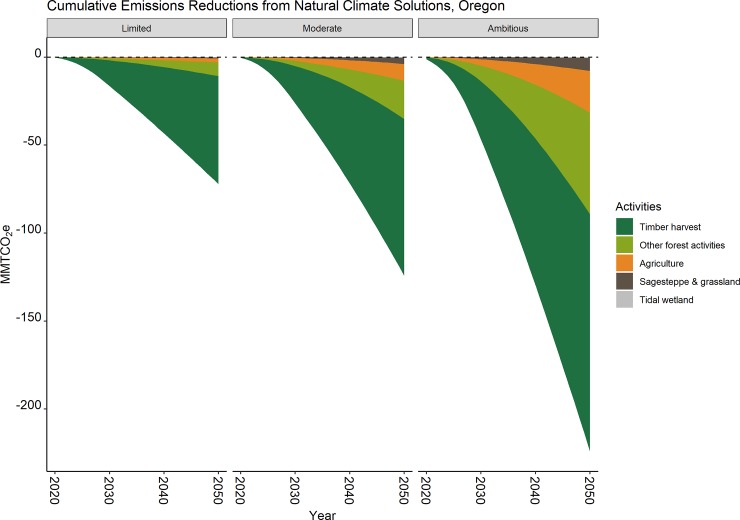
Increasing concentrations of greenhouse gases (GHGs) are causing global climate change and decreasing the stability of the climate system. Long-term solutions to climate change will require reduction in GHG emissions as well as the removal of large quantities of GHGs from the atmosphere. Natural climate solutions (NCS), i.e., changes in land management, ecosystem restoration, and avoided conversion of habitats, have substantial potential to meet global and national greenhouse gas (GHG) reduction targets and contribute to the global drawdown of GHGs. However, the relative role of NCS to contribute to GHG reduction at subnational scales is not well known. We examined the potential for 12 NCS activities on natural and working lands in Oregon, USA to reduce GHG emissions in the context of the state's climate mitigation goals. We evaluated three alternative scenarios wherein NCS implementation increased across the applicable private or public land base, depending on the activity, and estimated the annual GHG reduction in carbon dioxide equivalents (CO2e) attributable to NCS from 2020 to 2050. We found that NCS within Oregon could contribute annual GHG emission reductions of 2.7 to 8.3 MMT CO2e by 2035 and 2.9 to 9.8 MMT CO2e by 2050. Changes in forest-based activities including deferred timber harvest, riparian reforestation, and replanting after wildfires contributed most to potential GHG reductions (76 to 94% of the overall annual reductions), followed by changes to agricultural management through no-till, cover crops, and nitrogen management (3 to 15% of overall annual reductions). GHG reduction benefits are relatively high per unit area for avoided conversion of forests (125-400 MT CO2e ha-1). However, the existing land use policy in Oregon limits the current geographic extent of active conversion of natural lands and thus, avoided conversions results in modest overall potential GHG reduction benefits (i.e., less than 5% of the overall annual reductions). Tidal wetland restoration, which has high per unit area carbon sequestration benefits (8.8 MT CO2e ha-1 yr-1), also has limited possible geographic extent resulting in low potential (< 1%) of state-level GHG reduction contributions. However, co-benefits such as improved habitat and water quality delivered by restoration NCS pathways are substantial. Ultimately, reducing GHG emissions and increasing carbon sequestration to combat climate change will require actions across multiple sectors. We demonstrate that the adoption of alternative land management practices on working lands and avoided conversion and restoration of native habitats can achieve meaningful state-level GHG reductions.
不断增加的温室气体(GHG)浓度正在导致全球气候变化,并降低气候系统的稳定性。要解决气候变化问题,长期方案不仅需要减少温室气体排放,还需要从大气中大量去除温室气体。自然气候解决方案(NCS),即土地管理、生态系统恢复和避免生境转换的变化,具有很大潜力,可以实现全球和国家温室气体(GHG)减排目标,并有助于全球温室气体减排。然而,在国家以下各级,NCS 对温室气体减排的相对作用尚不清楚。我们研究了美国俄勒冈州自然和工作土地上 12 种 NCS 活动的潜力,以根据该州的气候缓解目标减少温室气体排放。我们评估了三种替代方案,其中根据活动的不同,NCS 的实施范围可以扩大到适用的私人或公共土地基础,估计了从 2020 年到 2050 年,NCS 每年在二氧化碳当量(CO2e)方面减少的温室气体排放量。我们发现,到 2035 年,俄勒冈州的 NCS 每年可减少 270 万至 830 万吨二氧化碳当量的温室气体排放,到 2050 年,每年可减少 290 万至 980 万吨二氧化碳当量的温室气体排放。森林活动的变化,包括推迟采伐、河岸造林和野火后重新造林,对潜在温室气体减排的贡献最大(占整体年度减排量的 76%至 94%),其次是通过免耕、覆盖作物和氮管理来改变农业管理(占整体年度减排量的 3%至 15%)。避免森林转换的单位面积温室气体减排效益相对较高(每公顷 125 至 400 公吨二氧化碳当量)。然而,俄勒冈州现有的土地使用政策限制了自然土地的当前活跃转换的地理范围,因此,避免转换导致温室气体减排的整体潜在效益适度(即,不到整体年度减排量的 5%)。具有高单位面积碳封存效益(每年每公顷 8.8 公吨二氧化碳当量)的潮汐湿地恢复,由于可能的地理范围有限,因此对减少温室气体排放的贡献潜力较低(<1%)。然而,恢复 NCS 途径带来的改善生境和水质等共同效益是巨大的。最终,要减少温室气体排放和增加碳封存以应对气候变化,需要跨多个部门采取行动。我们证明,在工作土地上采用替代土地管理实践,以及避免原生栖息地的转换和恢复,可以实现有意义的国家温室气体减排。