Department of Medicine and the Lunenfeld-Tanenbaum Research Institute, Mt. Sinai Hospital, University of Toronto, Toronto, Ontario, Canada.
Department of Medicine and the Lunenfeld-Tanenbaum Research Institute, Mt. Sinai Hospital, University of Toronto, Toronto, Ontario, Canada.
Mol Metab. 2020 Jul;37:100990. doi: 10.1016/j.molmet.2020.100990. Epub 2020 Apr 9.
Glucagon-like peptide-1 is a nutrient-sensitive hormone secreted from enteroendocrine L cells within the small and large bowel. Although GLP-1 levels rise rapidly in response to food ingestion, the greatest density of L cells is localized to the distal small bowel and colon. Here, we assessed the importance of the distal gut in the acute L cell response to diverse secretagogues.
Circulating levels of glucose and plasma GLP-1 were measured in response to the administration of L cell secretagogues in wild-type mice and in mice with (1) genetic reduction of Gcg expression throughout the small bowel and large bowel (Gcg) and (2) selective reduction of Gcg expression in the distal gut (Gcg).
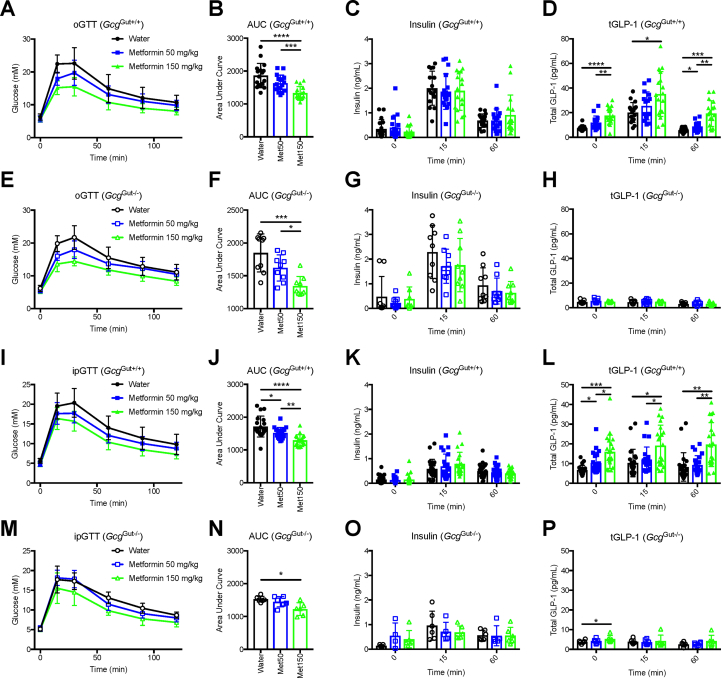
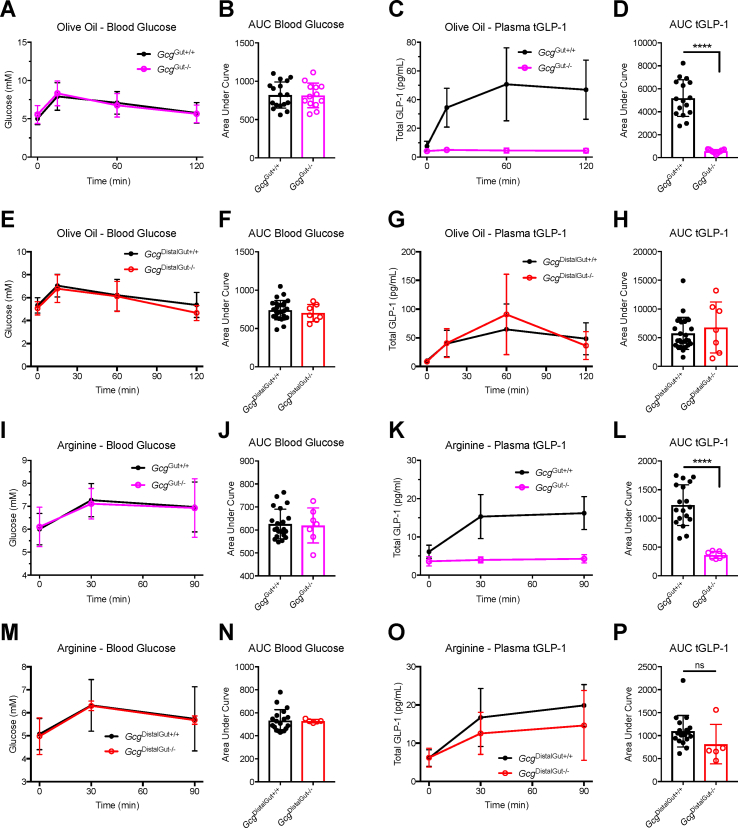
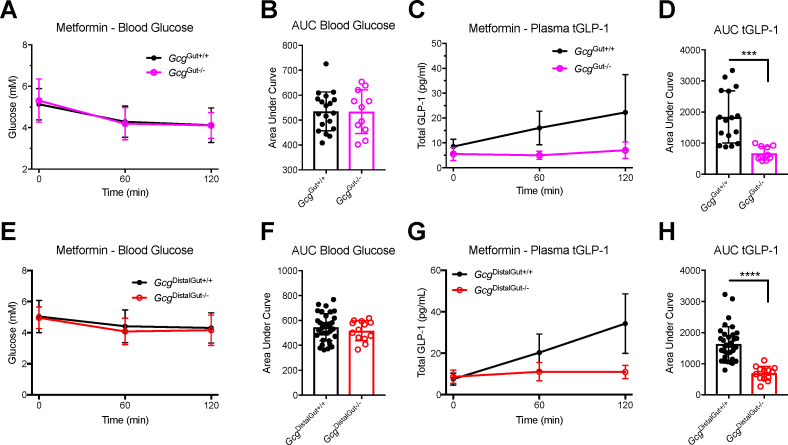
The acute GLP-1 response to olive oil or arginine administration was markedly diminished in Gcg but preserved in Gcg mice. In contrast, the increase in plasma GLP-1 levels following the administration of the GPR119 agonist AR231453, or the melanocortin-4 receptor (MC4R) agonist LY2112688, was markedly diminished in the Gcg mice. The GLP-1 response to LPS was also markedly attenuated in the Gcg mice and remained submaximal in the Gcg mice. Doses of metformin sufficient to lower glucose and increase GLP-1 levels in the Gcg mice retained their glucoregulatory activity, yet they failed to increase GLP-1 levels in the Gcg mice. Surprisingly, the actions of metformin to increase plasma GLP-1 levels were substantially attenuated in the Gcg mice.
These findings further establish the importance of the proximal gut for the acute response to nutrient-related GLP-1 secretagogues. In contrast, we identify essential contributions of the distal gut to (i) the rapid induction of circulating GLP-1 levels in response to pharmacological selective agonism of G-protein-coupled receptors, (ii) the increased GLP-1 levels following the activation of Toll-Like Receptors with LPS, and iii) the acute GLP-1 response to metformin. Collectively, these results reveal that distal gut Gcg + endocrine cells are rapid responders to structurally and functionally diverse GLP-1 secretagogues.
胰高血糖素样肽-1 是一种营养敏感激素,由小肠和大肠中的肠内分泌 L 细胞分泌。尽管 GLP-1 水平在进食后迅速升高,但 L 细胞的最大密度位于小肠和结肠的远端。在这里,我们评估了远端肠道在急性 L 细胞对各种分泌素反应中的重要性。
在野生型小鼠和(1)整个小肠和大肠中 Gcg 表达减少的小鼠(Gcg)和(2)远端肠道 Gcg 表达减少的小鼠(Gcg)中,测量 L 细胞分泌素给药后循环葡萄糖和血浆 GLP-1 水平。
橄榄油或精氨酸给药后,Gcg 小鼠的急性 GLP-1 反应明显减弱,但 Gcg 小鼠的 GLP-1 反应得到保留。相比之下,GPR119 激动剂 AR231453 或黑皮质素-4 受体(MC4R)激动剂 LY2112688 给药后血浆 GLP-1 水平升高,Gcg 小鼠明显减弱。Gcg 小鼠的 LPS 引起的 GLP-1 反应也明显减弱,而 Gcg 小鼠的 GLP-1 反应仍未达到最大。在 Gcg 小鼠中降低葡萄糖并增加 GLP-1 水平的二甲双胍剂量保留了其葡萄糖调节活性,但未能增加 Gcg 小鼠的 GLP-1 水平。令人惊讶的是,二甲双胍增加血浆 GLP-1 水平的作用在 Gcg 小鼠中明显减弱。
这些发现进一步确立了近端肠道对营养相关 GLP-1 分泌素的急性反应的重要性。相比之下,我们确定了远端肠道对以下方面的重要贡献:(i)对 G 蛋白偶联受体的药理学选择性激动剂的快速诱导循环 GLP-1 水平,(ii)LPS 激活 Toll 样受体后 GLP-1 水平升高,和(iii)二甲双胍的急性 GLP-1 反应。总之,这些结果表明,远端肠道 Gcg+内分泌细胞对结构和功能多样化的 GLP-1 分泌素具有快速反应能力。