Shao Zhufeng, Zhang Yufeng, Yang Xiujuan, Zhong Min
College of New Energy, Bohai University, Jinzhou, Liaoning, 121000 China.
ACS Omega. 2020 Mar 27;5(13):7503-7518. doi: 10.1021/acsomega.0c00299. eCollection 2020 Apr 7.
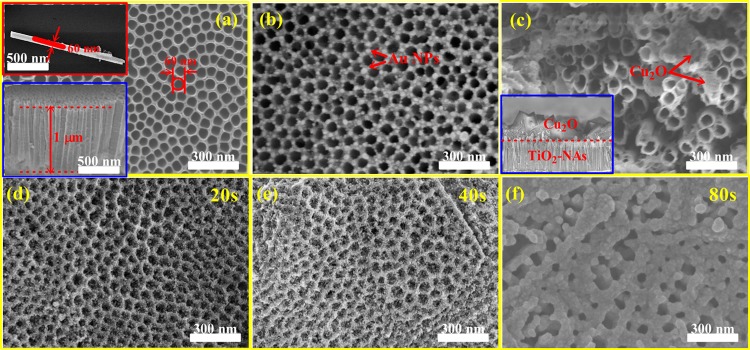
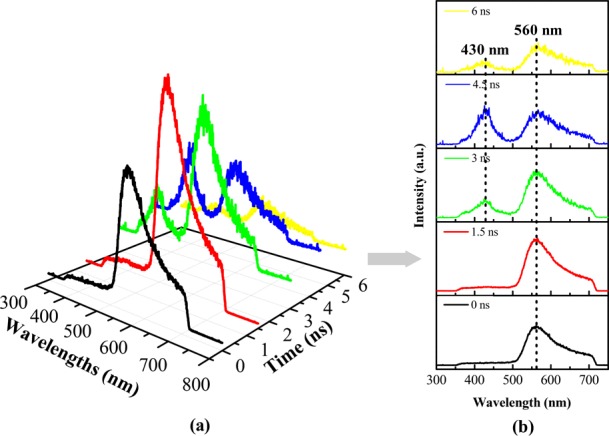
Based on a facile three-step preparation method, CuO/Au/TiO-NAs ternary heterojunction nanocomposites have been successfully synthesized by electrodepositing a CuO layer on the surface of Au nanoparticles (NPs) decorated highly ordered TiO nanotube arrays (NAs). The structure, surface morphology, chemical composition, and optical and intrinsic defects properties of the as-prepared samples are characterized by transmission and scanning electron microscopy (TEM and SEM), X-ray diffraction (XRD), UV-vis light absorbance spectra, Raman scattering, and X-ray photoelectron spectroscopy (XPS). Simultaneously, the CuO/Au/TiO-NAs ternary nanohybrids exhibited progressively improved photoelectrocatalytic (PEC) performance compared with the dual CuO/TiO-NAs type-II nanoheterojunctions, confirming by the photocurrent density versus testing time curve (amperometric - curve), open-circuit potential versus testing time curve ( - curve), and electrochemical impedance spectroscopy (EIS) measurements, which were mainly ascribed to the synergistic effect of reduced interfacial charge transfer resistance and boosted energetic charge carriers generation associated with embedding Au NPs. Furthermore, the self-consistent charge transfer mechanism of Z-scheme and interband transitions mediated with Au NPs for CuO/Au/TiO-NAs triple nanocomposites is proposed, which was evaluated by nanosecond time-resolved transient photoluminescence (NTRT-PL) spectra excited by 266 and 400 nm, respectively. Following this scheme, UV-vis light photocatalytic activities of CuO/Au/TiO-NAs ternary nanohybrids were elaborated toward photodegradation of methyl orange (MO) in aqueous solution, and the photodegradation rate of optimum triple nanocomplex was found to be 90%.
基于一种简便的三步制备方法,通过在高度有序的TiO纳米管阵列(NAs)表面电沉积一层CuO层,成功合成了CuO/Au/TiO-NAs三元异质结纳米复合材料。通过透射电子显微镜和扫描电子显微镜(TEM和SEM)、X射线衍射(XRD)、紫外-可见吸光光谱、拉曼散射以及X射线光电子能谱(XPS)对所制备样品的结构、表面形貌、化学成分以及光学和本征缺陷性质进行了表征。同时,与双CuO/TiO-NAs II型纳米异质结相比,CuO/Au/TiO-NAs三元纳米杂化物表现出逐渐提高的光电催化(PEC)性能,这通过光电流密度与测试时间曲线(安培曲线)、开路电位与测试时间曲线(-曲线)以及电化学阻抗谱(EIS)测量得到证实,这主要归因于界面电荷转移电阻降低和与嵌入Au NPs相关的高能电荷载流子生成的协同效应。此外,还提出了CuO/Au/TiO-NAs三元纳米复合材料的Z型自洽电荷转移机制以及由Au NPs介导的带间跃迁,分别通过266和400 nm激发的纳秒时间分辨瞬态光致发光(NTRT-PL)光谱对其进行了评估。按照该方案,阐述了CuO/Au/TiO-NAs三元纳米杂化物对水溶液中甲基橙(MO)的紫外-可见光光催化活性,发现最佳三元纳米复合物的光降解率为90%。