Frey Christoph, Göpfrich Kerstin, Pashapour Sadaf, Platzman Ilia, Spatz Joachim P
Department of Cellular Biophysics, Max Planck Institute for Medical Research, Jahnstraße 29, 69120 Heidelberg, Germany.
Department of Biophysical Chemistry, University of Heidelberg, Im Neuenheimer Feld 253, 69120 Heidelberg, Germany.
ACS Omega. 2020 Mar 23;5(13):7529-7536. doi: 10.1021/acsomega.0c00344. eCollection 2020 Apr 7.
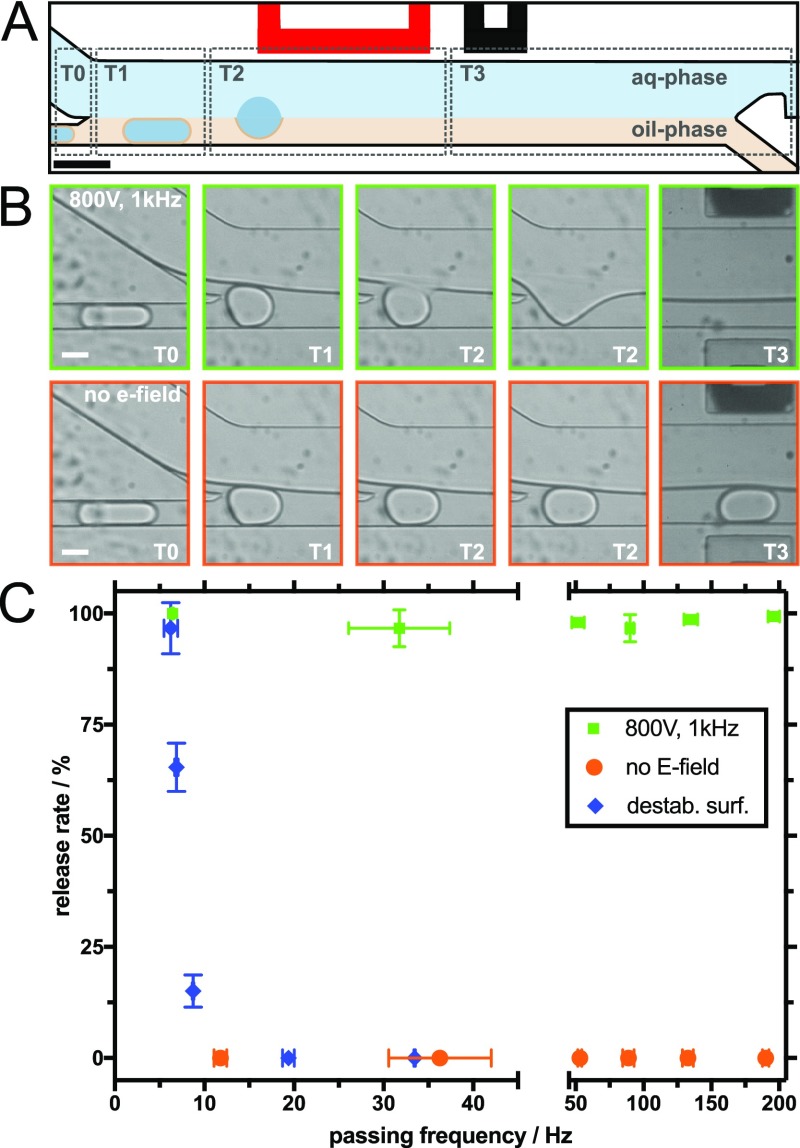
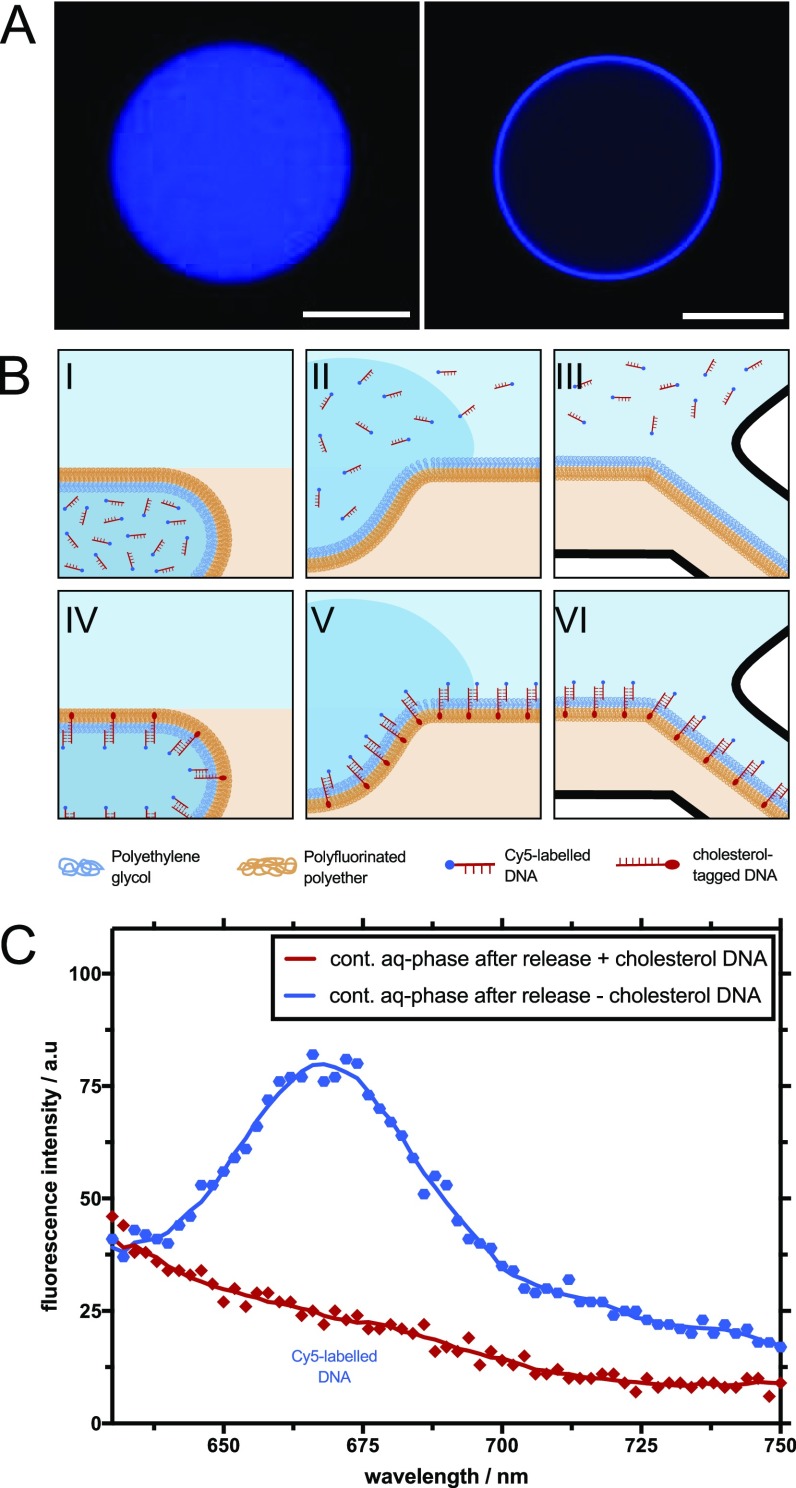
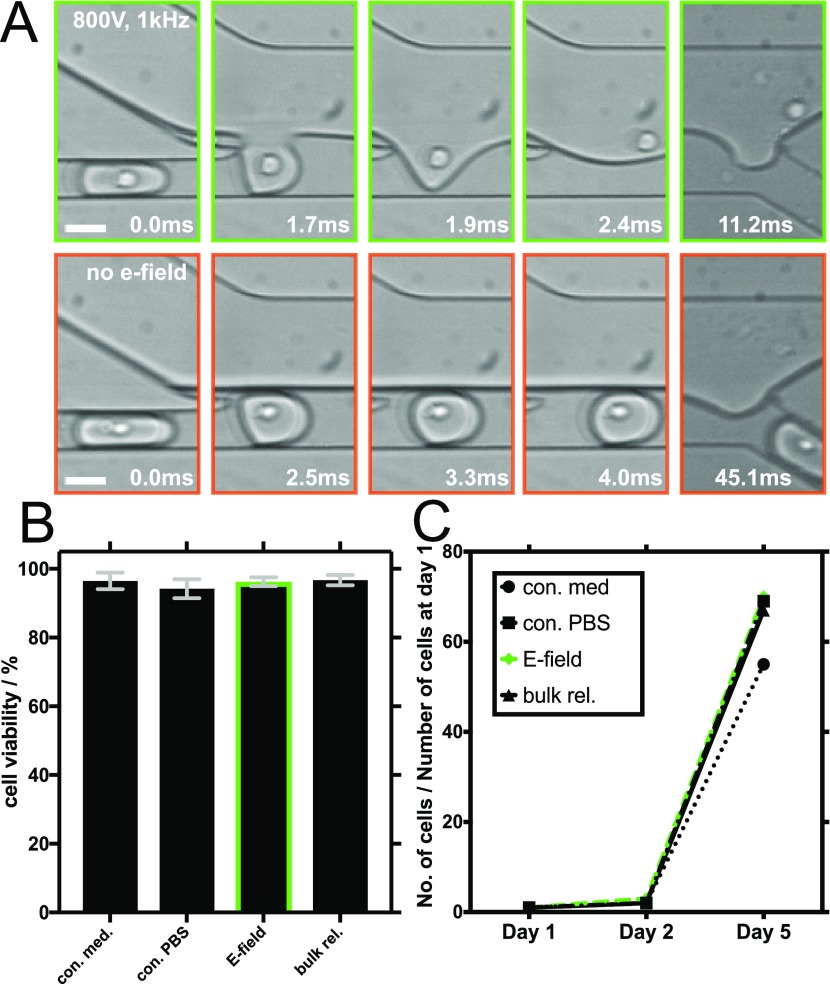
Droplet-based microfluidics have emerged as an important tool for diverse biomedical and biological applications including, but not limited to, drug screening, cellular analysis, and bottom-up synthetic biology. Each microfluidic water-in-oil droplet contains a well-defined biocontent that, following its manipulation/maturation, has to be released into a physiological environment toward possible end-user investigations. Despite the progress made in recent years, considerable challenges still loom at achieving a precise control over the content release with sufficient speed and sensitivity. Here, we present a quantitative study in which we compare the effectiveness and biocompatibility of chemical and physical microfluidic release methods. We show the advantages of electrocoalescence of water-in-oil droplets in terms of high-throughput release applications. Moreover, we apply programmable DNA nanotechnology to achieve a segregation of the biochemical content within the droplets for the controlled filtration of the encapsulated materials. We envision that the developed bifunctional microfluidic approach, capable of content segregation and selective release, will expand the microfluidic toolbox for cell biology, synthetic biology, and biomedical applications.
基于液滴的微流控技术已成为一种重要工具,可用于多种生物医学和生物学应用,包括但不限于药物筛选、细胞分析和自下而上的合成生物学。每个微流控油包水液滴都含有明确的生物成分,在其操作/成熟后,必须释放到生理环境中,以供最终用户进行可能的研究。尽管近年来取得了进展,但在以足够的速度和灵敏度实现对内容物释放的精确控制方面,仍存在相当大的挑战。在此,我们进行了一项定量研究,比较了化学和物理微流控释放方法的有效性和生物相容性。我们展示了油包水液滴电聚结在高通量释放应用方面的优势。此外,我们应用可编程DNA纳米技术实现液滴内生化成分的分离,以对封装材料进行可控过滤。我们设想,所开发的能够进行成分分离和选择性释放的双功能微流控方法,将扩展用于细胞生物学、合成生物学和生物医学应用的微流控工具库。