Zhang Fangyuan, Zhai Tianhua, Haider Shozeb, Liu Yanhong, Huang Zuyi Jacky
Department of Chemical Engineering, Villanova University, 800 E Lancaster Avenue, Villanova, Pennsylvania 19085, United States.
School of Pharmacy, University College London (UCL), London WC1E 6BT, U.K.
ACS Omega. 2020 Mar 23;5(13):7537-7544. doi: 10.1021/acsomega.0c00352. eCollection 2020 Apr 7.
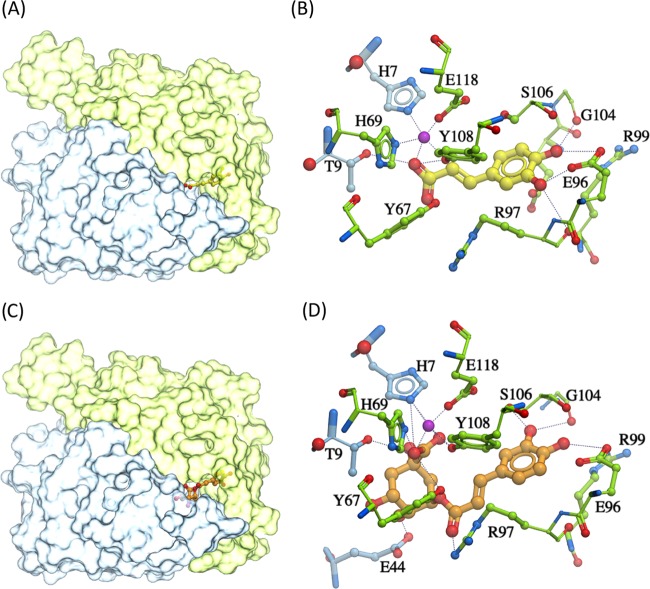
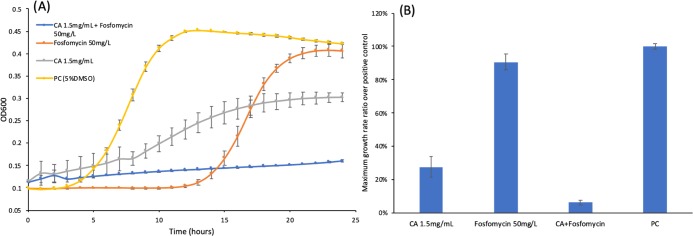
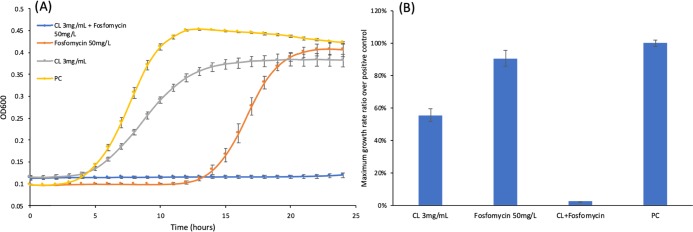
, a human foodborne pathogen that causes listeriosis with high-rate mortality, has been reported to be resistant to commonly used antibiotics. New antibiotics or cocktails of existing antibiotics with synergistic compounds are in high demand for treating this multi-drug-resistant pathogen. Fosfomycin is one of the novel and promising therapeutic antibiotics for the treatment of listeriosis. However, some strains with the gene were recently reported to survive from the fosfomycin treatment. This work aims to identify FosX inhibitors that can revive fosfomycin in treating resistant . Since structures and activities of the FosX protein in have been well studied, we used an integrated computational and experimental approach to identify FosX inhibitors that show synergistic effect with fosfomycin in treating resistant . Specifically, automated ligand docking was implemented to perform virtual screening of the Indofine natural-product database and FDA-approved drugs to identify potential inhibitors. An in vitro bacterial growth inhibition test was then utilized to verify the effectiveness of identified compounds combined with fosfomycin in inhibiting the resistant strains. Two phenolic acids, i.e., caffeic acid and chlorogenic acid, were predicted as high-affinity FosX inhibitors from the ligand-docking platform. Experiments with these compounds indicated that the cocktail of either caffeic acid (1.5 mg/mL) or chlorogenic acid (3 mg/mL) with fosfomycin (50 mg/L) was able to significantly inhibit the growth of the pathogen. The finding of this work implies that the combination of fosfomycin with either caffeic acid or chlorogenic acid is of potential to be used in the clinical treatment of infections.
李斯特菌是一种可导致李氏杆菌病且死亡率很高的食源性病原体,据报道它对常用抗生素具有抗性。治疗这种多重耐药病原体急需新型抗生素或现有抗生素与协同化合物的组合。磷霉素是治疗李斯特菌病的新型且有前景的治疗性抗生素之一。然而,最近有报道称一些携带该基因的菌株在磷霉素治疗下存活了下来。这项工作旨在鉴定能够恢复磷霉素治疗耐药李斯特菌效果的FosX抑制剂。由于李斯特菌中FosX蛋白的结构和活性已得到充分研究,我们采用计算与实验相结合的方法来鉴定在治疗耐药李斯特菌时与磷霉素具有协同作用的FosX抑制剂。具体而言,通过自动配体对接对Indofine天然产物数据库和FDA批准的药物进行虚拟筛选,以鉴定潜在抑制剂。然后利用体外细菌生长抑制试验来验证所鉴定化合物与磷霉素联合抑制耐药李斯特菌菌株的有效性。从配体对接平台预测出两种酚酸,即咖啡酸和绿原酸为高亲和力FosX抑制剂。用这些化合物进行的实验表明咖啡酸(1.5毫克/毫升)或绿原酸(3毫克/毫升)与磷霉素(50毫克/升)的组合能够显著抑制病原体的生长。这项工作的发现意味着磷霉素与咖啡酸或绿原酸的组合有潜力用于临床治疗李斯特菌感染。