
基于基因组生物标志物的模型用于对经过长期随访的非异型增生 Barrett 食管患者进行癌症风险分层;来自荷兰监测队列的结果。
A genomic biomarker-based model for cancer risk stratification of non-dysplastic Barrett's esophagus patients after extended follow up; results from Dutch surveillance cohorts.
机构信息
Center for Experimental and Molecular Medicine, Amsterdam UMC, University of Amsterdam, Amsterdam, The Netherlands.
Department of Gastroenterology and Hepatology, Amsterdam UMC, Amsterdam, The Netherlands.
出版信息
PLoS One. 2020 Apr 13;15(4):e0231419. doi: 10.1371/journal.pone.0231419. eCollection 2020.
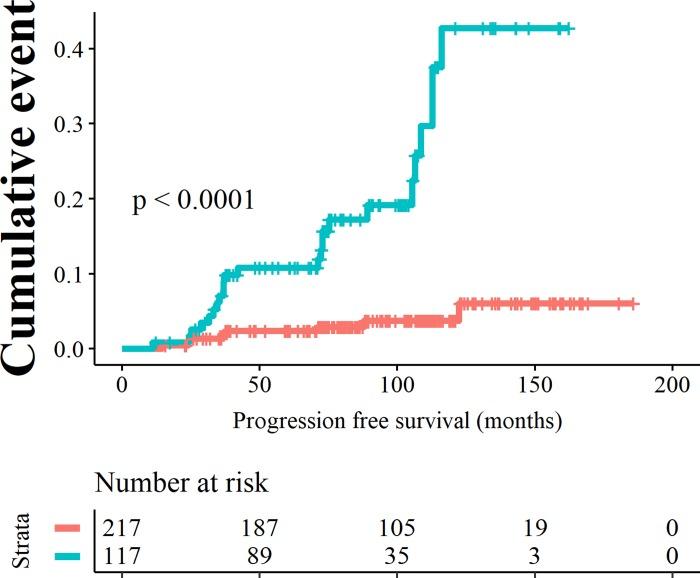
Barrett's esophagus is the only known mucosal precursor for the highly malignant esophageal adenocarcinoma. Malignant degeneration of non-dysplastic Barrett's esophagus occurs in < 0.6% per year in Dutch surveillance cohorts. Therefore, it has been proposed to increase the surveillance intervals from 3 to 5 years, potentially increasing development of advanced stage interval cancers. To prevent such cases robust biomarkers for more optimal stratification over longer follow up periods for non-dysplastic Barrett's patients are required. In this multi-center study, aberrations for chromosomes 7, 17, and structural abnormalities for c-MYC, CDKN2A, TP53, Her-2/neu and 20q assessed by DNA fluorescence in situ hybridization on brush cytology specimens, were used to determine marker scores and to perform clonal diversity measurements, as described previously. In this study, these genetic biomarkers were combined with clinical variables and analyzed to obtain the most efficient cancer prediction model after an extended period of follow-up (median time of 7 years) by applying Cox regression modeling, bootstrapping and leave-one-out analyses. A total of 334 patients with Barrett's esophagus without dysplasia from 6 community hospitals (n = 220) and one academic center (n = 114) were included. The annual progression rate to high grade dysplasia and/or esophageal adenocarcinoma was 1.3%, and to adenocarcinoma alone 0.85%. A prediction model including age, Barrett circumferential length, and a clonicity score over the genomic set including chromosomes 7, 17, 20q and c-MYC, resulted in an area under the curve of 0.88. The sensitivity and specificity of this model were 0.91 and 0.38. The positive and negative predictive values were 0.13 (95% CI 0.09 to 0.19) and 0.97 (95% CI 0.93 to 0.99). We propose the implementation of the model to identify non-dysplastic Barrett's patients, who are required to remain in surveillance programs with 3-yearly surveillance intervals from those that can benefit from less frequent or no surveillance.
巴雷特食管是唯一已知的食管高度恶性腺癌黏膜前体。在荷兰监测队列中,非异型增生性巴雷特食管的恶性转化发生率每年<0.6%。因此,有人建议将监测间隔从 3 年增加到 5 年,这可能会增加晚期间隔癌的发生。为了防止这种情况,需要为非异型增生性巴雷特食管患者提供更优的分层和更长的随访时间的稳健生物标志物。在这项多中心研究中,使用 DNA 荧光原位杂交技术在刷取细胞学标本上评估了染色体 7、17 的异常,以及 c-MYC、CDKN2A、TP53、Her-2/neu 和 20q 的结构异常,以确定标记物评分并进行克隆多样性测量,如前所述。在这项研究中,这些遗传生物标志物与临床变量相结合,并通过应用 Cox 回归建模、引导和留一法分析,在延长随访时间(中位时间为 7 年)后,对最有效的癌症预测模型进行分析。共纳入了来自 6 家社区医院(n=220)和 1 家学术中心(n=114)的 334 例无异型增生的巴雷特食管患者。高级别异型增生和/或食管腺癌的年进展率为 1.3%,腺癌单独的进展率为 0.85%。包括年龄、巴雷特食管周径、7 号、17 号染色体、20q 和 c-MYC 基因组集上的克隆性评分在内的预测模型,曲线下面积为 0.88。该模型的灵敏度和特异性分别为 0.91 和 0.38。阳性和阴性预测值分别为 0.13(95%CI 0.09 至 0.19)和 0.97(95%CI 0.93 至 0.99)。我们建议实施该模型,以识别需要进行 3 年监测间隔的非异型增生性巴雷特食管患者,这些患者可以从较少或无需监测中受益。



 Zotero 插件