Department of Head and Neck, Division of Oral Surgery and Implantology, Institute of Clinical Dentistry, Università Cattolica del Sacro Cuore, Fondazione Policlinico Universitario Gemelli, 00168 Rome, Italy.
Internal Medicine Department, Fondazione Policlinico A. Gemelli, Catholic University of Sacred Heart, 00168 Rome, Italy.
Int J Environ Res Public Health. 2020 Apr 9;17(7):2575. doi: 10.3390/ijerph17072575.
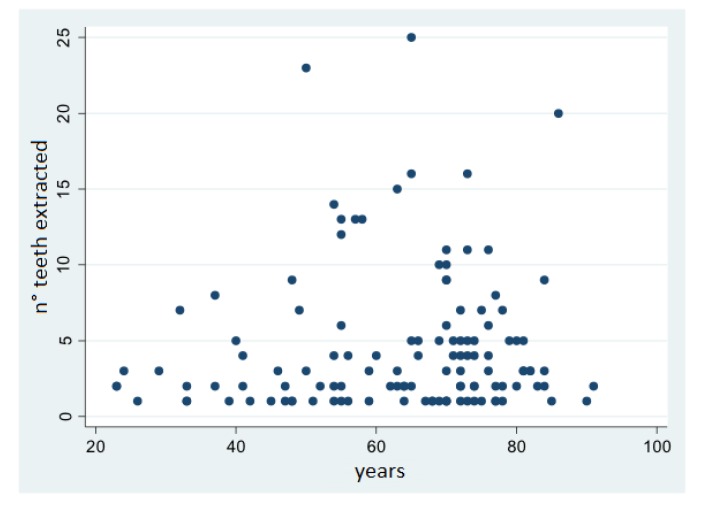
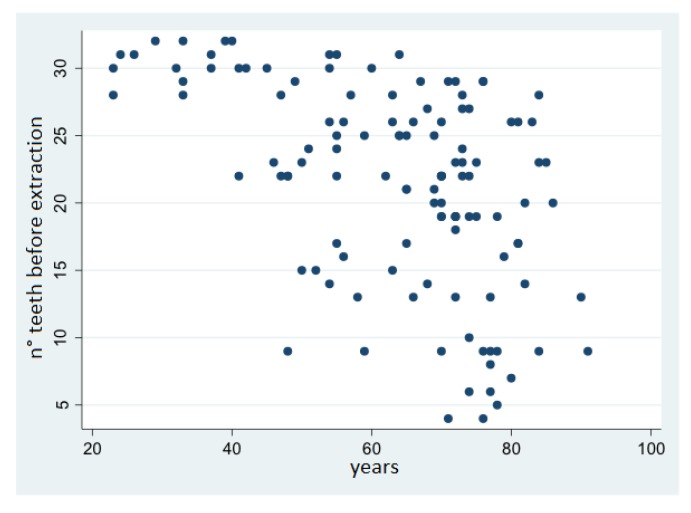
: The aim of this study was to evaluate oral status, the reasons for tooth extractions and related risk factors in adult patients attending a hospital dental practice. : 120 consecutive patients ranging from 23 to 91 years in age (mean age of 63.3 ± 15.8) having a total of 554 teeth extracted were included. Surveys about general health status were conducted and potential risk factors such as smoking, diabetes and age were investigated. : a total of 1795 teeth were missing after extraction procedures and the mean number of remaining teeth after the extraction process was 16.8 ± 9.1 per patient. Caries (52.2%) was the most common reason for extraction along with periodontal disease (35.7%). Males were more prone to extractions, with 394 of the teeth extracted out of the total of 554 (71.1%). Male sex (β = 2.89; 95% CI 1.26, 4.53; p = 0.001) and smoking habit (β = 2.95; 95% CI 1.12, 4.79; p = 0.002) were related to a higher number of teeth extracted. Age (β = -0.24; 95% CI -0.31, -0.16; p < 0.001) and diabetes (β = -4.47; 95% CI -7.61, -1.33; p = 0.006) were related to a higher number of missing teeth at evaluation time. Moreover, periodontal disease was more common as a reason of extraction among diabetic patients than among non-diabetic ones (p = 0.04). : caries and periodontal disease were the most common causes of extraction in a relatively old study population: further screening strategies might be required for the early interception of caries and periodontal disease.
: 本研究旨在评估在医院牙科就诊的成年患者的口腔状况、拔牙原因及相关危险因素。 : 共纳入 120 例年龄在 23 至 91 岁之间(平均年龄 63.3 ± 15.8 岁)的连续患者,共拔除 554 颗牙齿。调查了患者的一般健康状况,并调查了吸烟、糖尿病和年龄等潜在危险因素。 : 拔牙后共有 1795 颗牙齿缺失,每位患者拔牙后平均剩余牙齿数为 16.8 ± 9.1 颗。龋齿(52.2%)是最常见的拔牙原因,其次是牙周病(35.7%)。男性更倾向于拔牙,在总共 554 颗牙齿中,有 394 颗被拔除(71.1%)。男性(β=2.89;95%CI 1.26,4.53;p=0.001)和吸烟习惯(β=2.95;95%CI 1.12,4.79;p=0.002)与拔牙数量增加有关。年龄(β=-0.24;95%CI -0.31,-0.16;p<0.001)和糖尿病(β=-4.47;95%CI -7.61,-1.33;p=0.006)与评估时缺失牙齿数量增加有关。此外,与非糖尿病患者相比,糖尿病患者中牙周病作为拔牙原因更为常见(p=0.04)。 : 龋齿和牙周病是该研究中相对较老年患者拔牙的最常见原因:可能需要进一步的筛查策略来早期发现龋齿和牙周病。