Department of Preventive Dental Sciences, College of Dentistry, Imam Abdulrahman Bin Faisal University, Dammam, Saudi Arabia.
ScientificWorldJournal. 2021 Feb 22;2021:5534455. doi: 10.1155/2021/5534455. eCollection 2021.
To evaluate the reasons for permanent teeth extractions and related factors among adult patients visiting dental clinics in the Eastern Province of Saudi Arabia.
This retrospective cross-sectional study included data of patients who underwent teeth extractions. Data were collected from public and private dental clinics in different cities of the Eastern Province of Saudi Arabia (January-March 2020). The demographic information of patients and their reasons for teeth extractions were obtained from participating dentists.
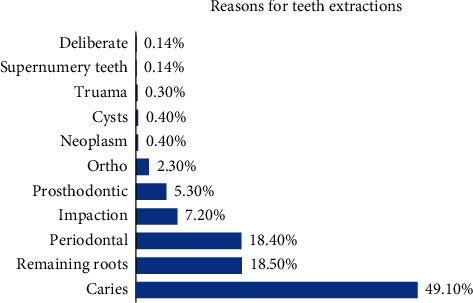
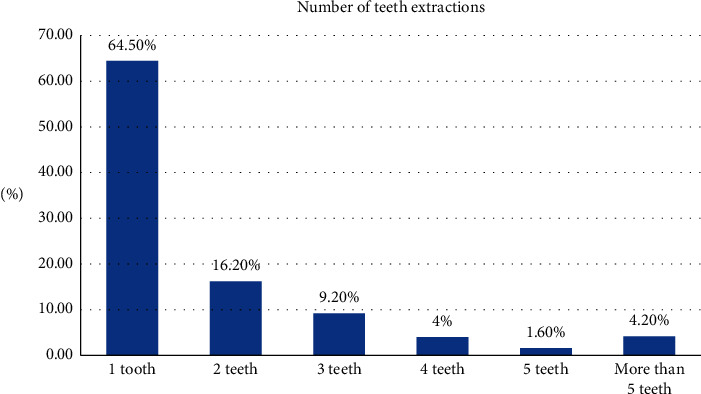
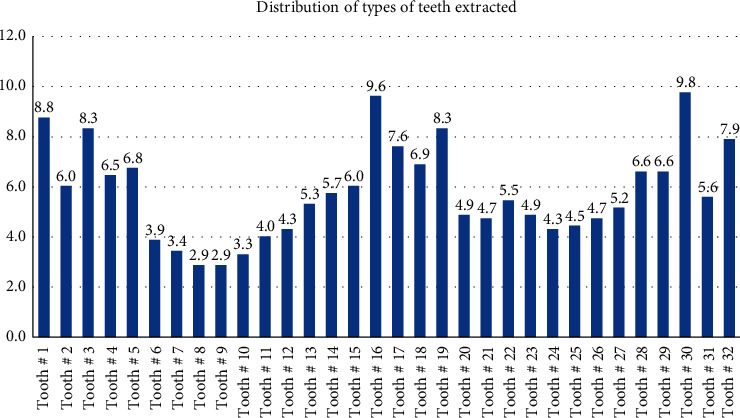
The study included data of 696 patients with 55.9% of males and 44.1% of females. The mean number of teeth extractions in the sample was 1.86 ± 1.8, and it increased significantly with advancing age ( ≤ 0.001). Saudi (1.97 ± 1.98) versus non-Saudi patients (1.55 ± 1.11) (=0.02) and patients in public practice (2.03 ± 1.95) versus patients in private practice (1.50 ± 1.38) ( ≤ 0.001) showed significantly higher teeth extractions. Dental caries was the most common reason for teeth extractions (49.1%), followed by remaining roots (18.5%), periodontal disease (18.4%), and impactions (7.2%). Most commonly extracted teeth included tooth # 30 (9.8%), followed by tooth #16 (9.6%), tooth # 1 (8.8%), tooth # 19 (8.3%), and tooth # 4 (8.3%). On the other hand, upper incisors were the least commonly extracted teeth.
Dental caries, remaining roots, periodontal disease, and impactions were the most common reasons for teeth extractions in our sample of patients. The extractions increased significantly with increasing age. Saudis and patients in public clinics underwent significantly higher teeth extractions. Measures aimed at the prevention and treatment of oral conditions can help reduce teeth extractions and improve the quality of life of patients.
评估沙特阿拉伯东部省份牙科诊所就诊的成年患者拔牙的原因及相关因素。
本回顾性横断面研究纳入了接受拔牙治疗的患者数据。数据来自沙特阿拉伯东部省份不同城市的公立和私立牙科诊所(2020 年 1 月至 3 月)。患者的人口统计学信息及其拔牙原因由参与研究的牙医获取。
本研究纳入了 696 名患者的数据,其中男性占 55.9%,女性占 44.1%。样本中平均拔牙数为 1.86±1.8 颗,且随年龄增长而显著增加(≤0.001)。沙特患者(1.97±1.98 颗)与非沙特患者(1.55±1.11 颗)(=0.02)以及公立诊所患者(2.03±1.95 颗)与私立诊所患者(1.50±1.38 颗)(≤0.001)相比,拔牙数显著更高。龋齿是拔牙的最常见原因(49.1%),其次是残根(18.5%)、牙周病(18.4%)和阻生牙(7.2%)。最常拔除的牙齿是 30 号牙(9.8%),其次是 16 号牙(9.6%)、1 号牙(8.8%)、19 号牙(8.3%)和 4 号牙(8.3%)。另一方面,上颌切牙是最少拔除的牙齿。
在本研究患者样本中,龋齿、残根、牙周病和阻生牙是拔牙的最常见原因。拔牙数随年龄增长显著增加。沙特人和公立诊所患者拔牙数显著更高。针对口腔疾病的预防和治疗措施有助于减少拔牙并提高患者的生活质量。