Roth|McFarlane Hand and Upper Limb Centre, St Joseph's Health Care, London, ON, Canada.
The School of Rehabilitation Science, McMaster University, Hamilton, ON, Canada.
BMC Musculoskelet Disord. 2020 Apr 13;21(1):228. doi: 10.1186/s12891-020-03238-w.
Total shoulder arthroplasty (TSA) is considered as the standard reconstructive surgery for patients suffering from severe shoulder pain and dysfunction caused by arthrosis. Multiple patient-reported outcome measures (PROMs) have been developed and validated that can be used to evaluate TSA outcomes. When selecting an outcome measure both content and psychometric properties must be considered. Most research to date has focused on psychometric properties. Therefore, the current study aims to summarize what PROMs are being used to assess TSA outcomes, to classify the type of measure (International society for quality of life (ISOQOL) using definitions of functioning, disability, and health (FDH), quality of life (QoL) and health-related quality of life (HRQoL)) and to compare the content of these measures by linking them to the International Classification of Functioning, Disability and Health (ICF) framework.
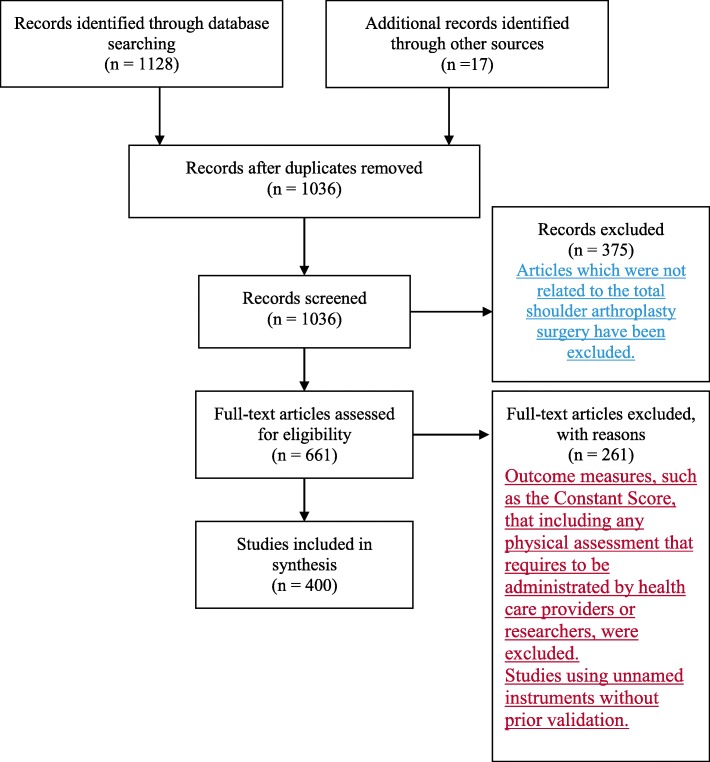
A literature review was performed in three databases including MEDLINE, EMBASE, and CINAHL to identify PROMs that were used in TSA studies. Meaningful concepts of the identified measures were extracted and linked to the relevant second-level ICF codes using standard linking rules. Outcome measures were classified as being FDH, HRQoL or QoL measures based on the content analysis.
Thirty-five measures were identified across 400 retrieved studies. The most frequently used PROM was the American Shoulder and Elbow Society score accounting for 21% (246) of the total citations, followed by the single item pain-related scale like visual analog scale (17%) and Simple Shoulder Test (12%). Twelve PROMs with 190 individual items fit inclusion criteria for conceptual analysis. Most codes (65%) fell under activity and participation categories. The top 3 most predominant codes were: sensation of pain (b280; 13%), hand and arm use (d445; 13%), recreational activity (d920; 8%). Ten PROMs included in this study were categorized as FDH measures, one as HRQoL measure, and one as unknown.
Our study demonstrated that there is an inconsistency and lack of clarity in conceptual frameworks of identified PROMs. Despite this, common core constructs are evaluated. Decision-making about individual studies or core sets for outcome measurement for TSA would be advanced by considering our results, patient priorities and measurement properties.
全肩关节置换术(TSA)被认为是治疗因关节炎导致严重肩部疼痛和功能障碍患者的标准重建手术。已经开发和验证了多种患者报告的结果测量(PROM),可用于评估 TSA 结果。选择结果测量时,必须考虑内容和心理测量特性。迄今为止,大多数研究都集中在心理测量特性上。因此,本研究旨在总结用于评估 TSA 结果的 PROM,对测量类型(国际生活质量协会(ISOQOL)使用功能、残疾和健康(FDH)、生活质量(QoL)和健康相关生活质量(HRQoL)的定义)进行分类,并通过将这些措施与国际功能、残疾和健康分类(ICF)框架联系起来,比较这些措施的内容。
在 MEDLINE、EMBASE 和 CINAHL 这三个数据库中进行文献检索,以确定用于 TSA 研究的 PROM。从已确定的测量中提取有意义的概念,并使用标准链接规则将其链接到相关的第二级 ICF 代码。根据内容分析,将结果测量分为 FDH、HRQoL 或 QoL 测量。
在 400 篇检索到的研究中,共确定了 35 种测量方法。使用最频繁的 PROM 是美国肩肘协会评分,占总引用量的 21%(246 次),其次是视觉模拟量表等单项疼痛相关量表(17%)和简单肩部测试(12%)。12 种符合概念分析纳入标准的 PROM 有 190 个单项。大多数代码(65%)属于活动和参与类别。前 3 个最主要的代码是:疼痛感觉(b280;13%)、手和手臂使用(d445;13%)、娱乐活动(d920;8%)。本研究纳入的 10 种 PROM 被归类为 FDH 测量,1 种归类为 HRQoL 测量,1 种归类为未知。
我们的研究表明,已确定的 PROM 的概念框架存在不一致和缺乏清晰度。尽管如此,仍评估了共同的核心结构。考虑到我们的研究结果、患者的优先事项和测量特性,将有助于 TSA 的个体化研究或核心集的决策。