
通过基于密度的尿液分级分离解析前列腺癌中细胞外囊泡的蛋白质组学格局
Unravelling the proteomic landscape of extracellular vesicles in prostate cancer by density-based fractionation of urine.
作者信息
Dhondt Bert, Geeurickx Edward, Tulkens Joeri, Van Deun Jan, Vergauwen Glenn, Lippens Lien, Miinalainen Ilkka, Rappu Pekka, Heino Jyrki, Ost Piet, Lumen Nicolaas, De Wever Olivier, Hendrix An
机构信息
Laboratory of Experimental Cancer Research, Department of Human Structure and Repair, Ghent University, Ghent, Belgium.
Cancer Research Institute Ghent, Ghent, Belgium.
出版信息
J Extracell Vesicles. 2020 Mar 11;9(1):1736935. doi: 10.1080/20013078.2020.1736935. eCollection 2020.
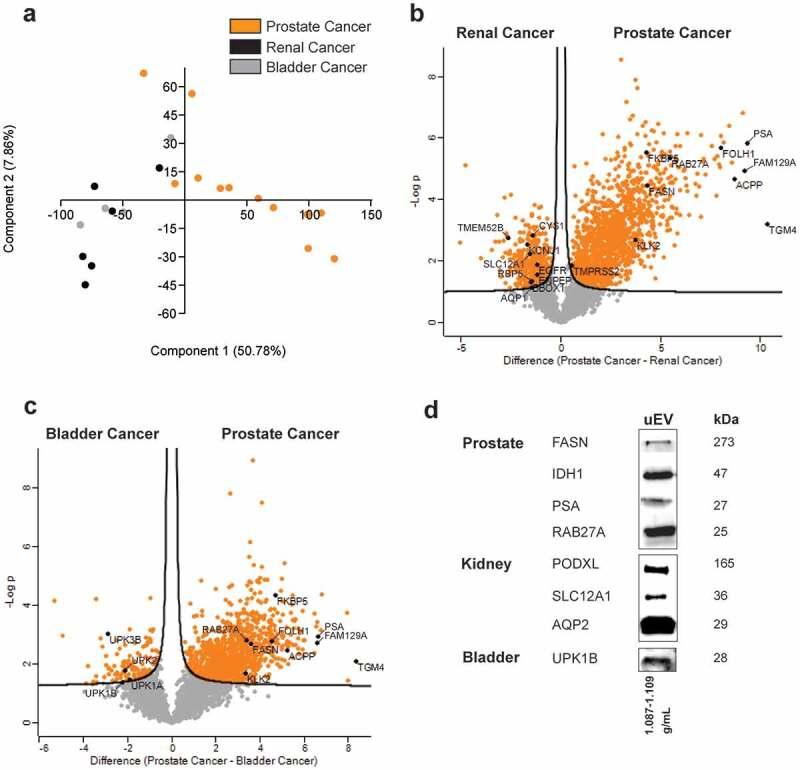
Extracellular vesicles (EV) are increasingly being recognized as important vehicles of intercellular communication and promising diagnostic and prognostic biomarkers in cancer. Despite this enormous clinical potential, the plethora of methods to separate EV from biofluids, providing material of highly variable purity, and lacking knowledge regarding methodological repeatability pose a barrier to clinical translation. Urine is considered an ideal proximal fluid for the study of EV in urological cancers due to its direct contact with the urogenital system. We demonstrate that density-based fractionation of urine by bottom-up Optiprep density gradient centrifugation separates EV and soluble proteins with high specificity and repeatability. Mass spectrometry-based proteomic analysis of urinary EV (uEV) in men with benign and malignant prostate disease allowed us to significantly expand the known human uEV proteome with high specificity and identifies a unique biological profile in prostate cancer not uncovered by the analysis of soluble proteins. In addition, profiling the proteome of EV separated from prostate tumour conditioned medium and matched uEV confirms the specificity of the identified uEV proteome for prostate cancer. Finally, a comparative proteomic analysis with uEV from patients with bladder and renal cancer provided additional evidence of the selective enrichment of protein signatures in uEV reflecting their respective cancer tissues of origin. In conclusion, this study identifies hundreds of previously undetected proteins in uEV of prostate cancer patients and provides a powerful toolbox to map uEV content and contaminants ultimately allowing biomarker discovery in urological cancers.
细胞外囊泡(EV)越来越被认为是细胞间通讯的重要载体,也是癌症中很有前景的诊断和预后生物标志物。尽管具有巨大的临床潜力,但从生物流体中分离EV的方法繁多,所提供材料的纯度高度可变,且缺乏关于方法可重复性的知识,这对临床转化构成了障碍。由于尿液与泌尿生殖系统直接接触,因此被认为是研究泌尿系统癌症中EV的理想近端流体。我们证明,通过自下而上的Optiprep密度梯度离心法对尿液进行基于密度的分级分离,可以高特异性和可重复性地分离EV和可溶性蛋白质。对患有良性和恶性前列腺疾病的男性尿液中的EV(uEV)进行基于质谱的蛋白质组分析,使我们能够以高特异性显著扩展已知的人类uEV蛋白质组,并识别出前列腺癌中独特的生物学特征,而可溶性蛋白质分析并未发现这一特征。此外,对从前列腺肿瘤条件培养基中分离的EV和匹配的uEV进行蛋白质组分析,证实了所鉴定的uEV蛋白质组对前列腺癌的特异性。最后,与膀胱癌和肾癌患者的uEV进行比较蛋白质组分析,进一步证明了uEV中反映其各自癌症组织起源的蛋白质特征的选择性富集。总之,本研究在前列腺癌患者的uEV中鉴定出数百种以前未检测到的蛋白质,并提供了一个强大的工具箱来绘制uEV的内容和污染物,最终实现泌尿系统癌症生物标志物的发现。


 Zotero 插件