CCMAR - Centre of Marine Sciences, University of Algarve, 8005-139, Faro, Portugal.
Centro de Conservación Marina and CeBiB, Facultad de Ciencias Biológicas, Pontificia Universidad Católica de Chile, Santiago, Chile.
Sci Data. 2020 Apr 14;7(1):119. doi: 10.1038/s41597-020-0459-x.
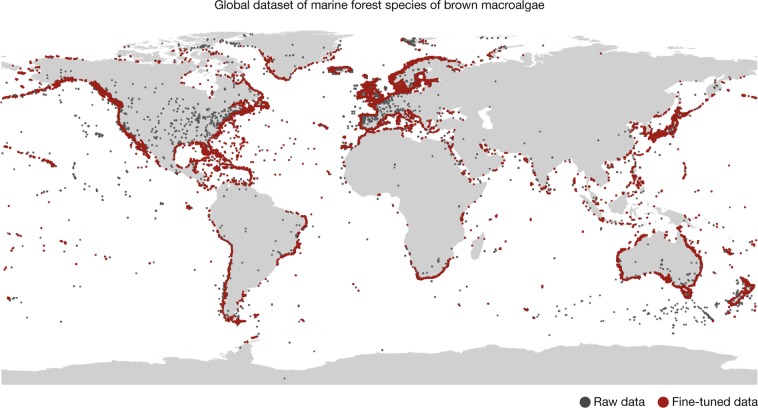
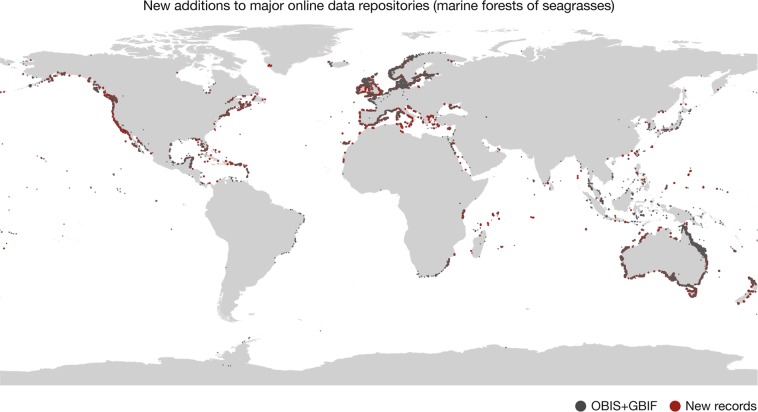
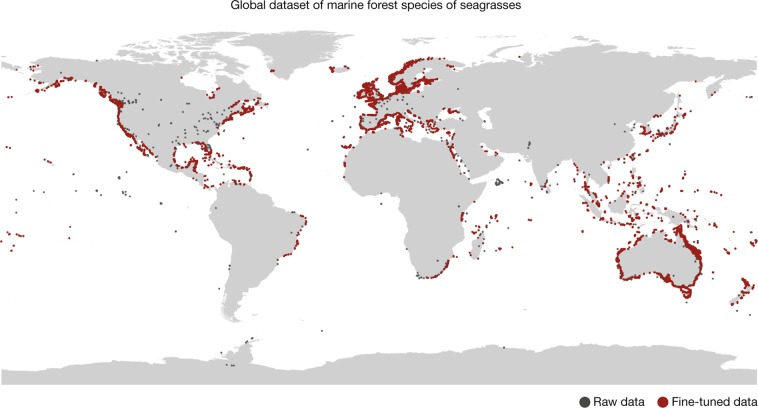
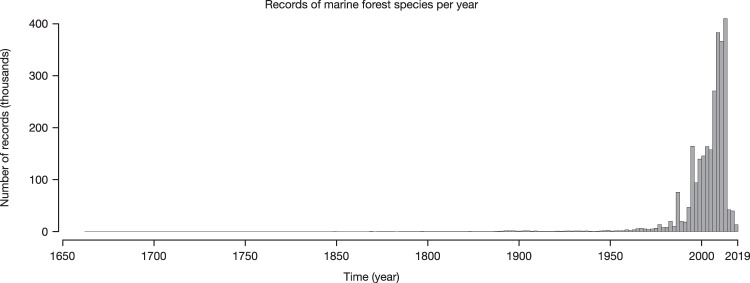
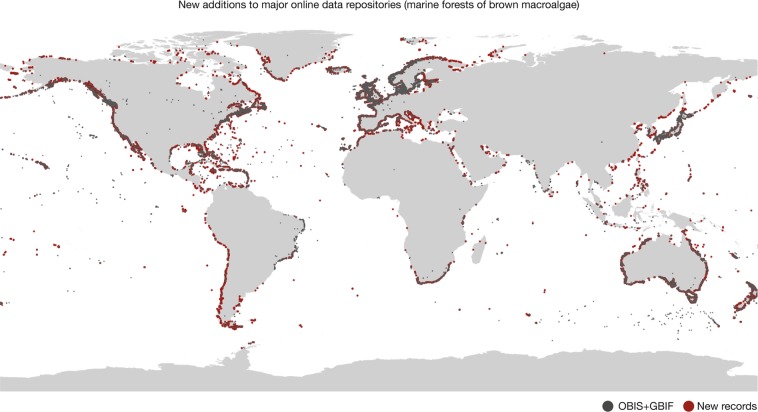
Species distribution records are a prerequisite to follow climate-induced range shifts across space and time. However, synthesizing information from various sources such as peer-reviewed literature, herbaria, digital repositories and citizen science initiatives is not only costly and time consuming, but also challenging, as data may contain thematic and taxonomic errors and generally lack standardized formats. We address this gap for important marine ecosystem-structuring species of large brown algae and seagrasses. We gathered distribution records from various sources and provide a fine-tuned dataset with ~2.8 million dereplicated records, taxonomically standardized for 682 species, and considering important physiological and biogeographical traits. Specifically, a flagging system was implemented to signal potentially incorrect records reported on land, in regions with limiting light conditions for photosynthesis, and outside the known distribution of species, as inferred from the most recent published literature. We document the procedure and provide a dataset in tabular format based on Darwin Core Standard (DwC), alongside with a set of functions in R language for data management and visualization.
物种分布记录是跟踪跨时空气候引起的分布范围变化的前提。然而,从同行评议文献、标本馆、数字存储库和公民科学倡议等各种来源综合信息不仅成本高且耗时,而且具有挑战性,因为数据可能包含主题和分类错误,并且通常缺乏标准化格式。我们针对大型褐藻和海草等重要海洋生态系统结构形成物种解决了这一差距。我们从各种来源收集分布记录,并提供一个经过微调的数据集,其中包含约 280 万条去重记录,针对 682 个物种进行了分类标准化,并考虑了重要的生理和生物地理特征。具体来说,实施了一个标记系统,以标记可能报告在陆地上、在光合作用受限的区域以及根据最新发表的文献推断出的物种已知分布范围之外的记录。我们记录了该过程,并提供了基于 Darwin Core Standard (DwC) 的表格格式数据集,以及一套用于数据管理和可视化的 R 语言函数。