Department of Public Health, Faculty of Medicine, University of Toyama, Toyama, Japan.
Department of Mental Health Policy, National Institute of Mental Health, National Center of Neurology and Psychiatry, Kodaira, Tokyo, Japan.
Sci Rep. 2020 Apr 14;10(1):6390. doi: 10.1038/s41598-020-63268-1.
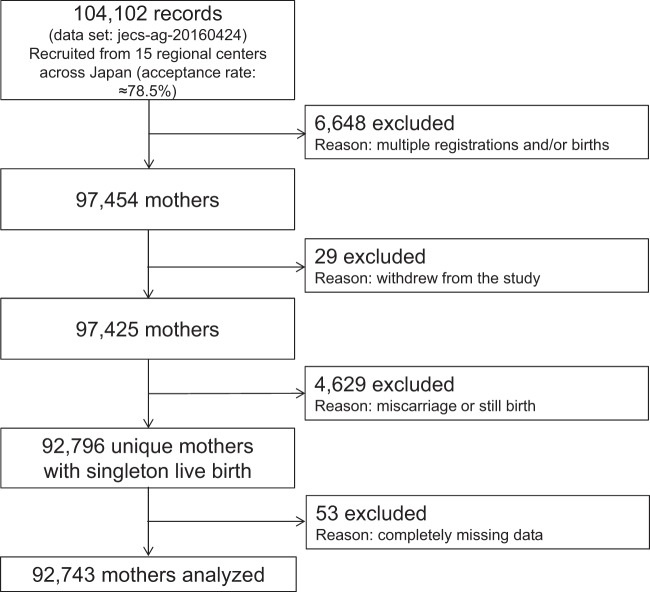
Evidence is mixed on the associations between physical activity during pregnancy and perinatal depression, and it is limited for different physical activity intensities. Data for 92,743 pregnant women from the Japan Environment and Children's Study were analyzed in this study. Psychological distress during pregnancy was assessed as moderate or severe using the Kessler Psychological Distress Scale (K6 5-12 and ≥13, respectively). Postpartum depression was assessed using the Edinburgh Postpartum Depression Scale (EPDS; cut-off score 9). Women with only light physical activity had significantly lower odds of psychological distress during pregnancy than those with no physical activity (K6 5-12: adjusted odds ratio [AOR] 0.86, 95% confidence interval [95%CI] 0.82, 0.90; K6 ≥ 13: AOR 0.64, 95%CI 0.58, 0.72). Women with a combination of light, moderate and vigorous physical activity had significantly higher odds of psychological distress during pregnancy (K6 5-12: AOR 1.32, 95%CI 1.18, 1.48; K6 ≥ 13: AOR 1.45, 95%CI 1.16, 1.81) and depression after childbirth (EPDS ≥ 9: AOR 1.42, 95%CI 1.24, 1.61). Physical activity intensity should be considered when assessing psychological distress risk during pregnancy and depression risk after delivery. Future research should evaluate specific physical activity programs with optimal intensity for pregnant women to prevent and treat their psychological distress and depression.
有证据表明,孕妇的身体活动与围产期抑郁之间的关联存在差异,而且对于不同的身体活动强度的关联证据有限。本研究分析了来自日本环境与儿童研究的 92743 名孕妇的数据。使用 Kessler 心理困扰量表(K6 5-12 和≥13,分别为中度或重度心理困扰)评估孕妇怀孕期间的心理困扰。使用爱丁堡产后抑郁量表(EPDS;截断值 9)评估产后抑郁。与没有身体活动的孕妇相比,只有轻度身体活动的孕妇怀孕期间出现心理困扰的可能性显著降低(K6 5-12:调整后的优势比 [AOR] 0.86,95%置信区间 [95%CI] 0.82, 0.90;K6≥13:AOR 0.64, 95%CI 0.58, 0.72)。同时进行轻度、中度和剧烈身体活动的孕妇怀孕期间出现心理困扰的可能性显著更高(K6 5-12:AOR 1.32, 95%CI 1.18, 1.48;K6≥13:AOR 1.45, 95%CI 1.16, 1.81)和产后抑郁(EPDS≥9:AOR 1.42, 95%CI 1.24, 1.61)。评估怀孕期间心理困扰风险和产后抑郁风险时应考虑身体活动强度。未来的研究应该评估针对孕妇的最佳强度的特定身体活动方案,以预防和治疗她们的心理困扰和抑郁。