Department of International Health, Bloomberg School of Public Health, Johns Hopkins University, Baltimore, Maryland, United States of America.
Johns Hopkins University-Bangladesh, Dhaka, Bangladesh.
PLoS One. 2020 Apr 14;15(4):e0231490. doi: 10.1371/journal.pone.0231490. eCollection 2020.
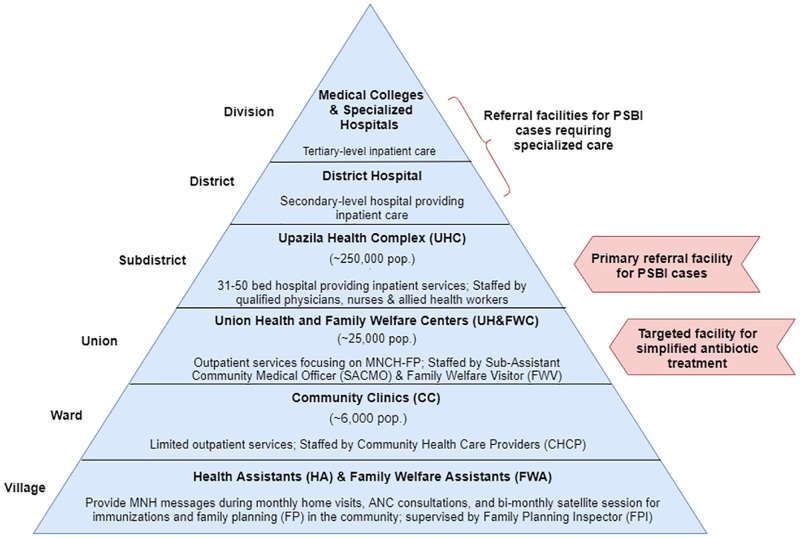
Many infants with possible serious bacterial infections (PSBI) do not receive inpatient treatment because hospital care may not be affordable, accessible, or acceptable for families. In 2015, WHO issued guidelines for managing PSBI in young infants (0-59 days) with simpler antibiotic regimens when hospital care is not feasible. Bangladesh adopted WHO's guidelines for implementation in outpatient primary health centers. We report results of an implementation research study that assessed caregiver acceptability of the guidelines in three rural sub-districts of Bangladesh during early implementation (October 2015-August 2016).
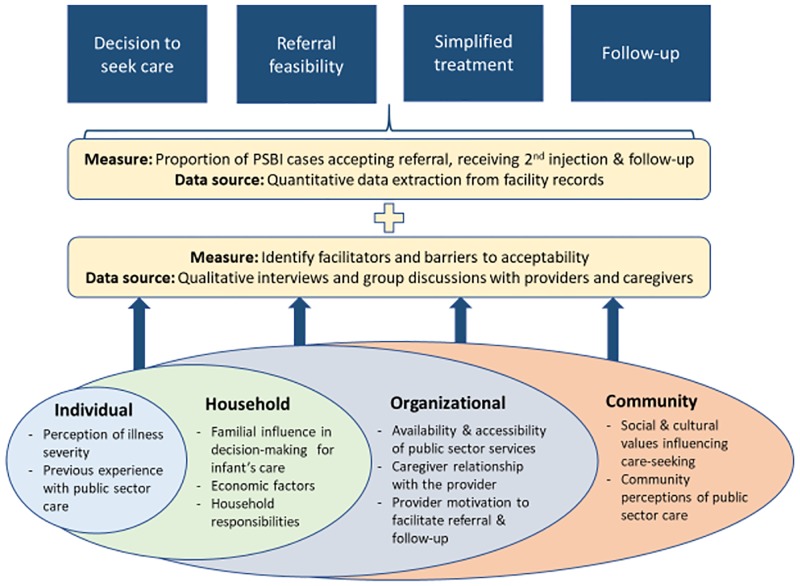
We included 19 outpatient primary health centers involved in the initial rollout of the infection management guidelines. We extracted data for all PSBI cases (N = 192) from facility registers to identify gaps in referral feasibility, simplified antibiotic treatment, and follow-up. Focus group discussions (FGD) and in-depth interviews (IDI) were conducted with both caregivers (6 FGDs; 23 IDIs) and providers (2 FGDs; 28 IDIs) to assess caregiver acceptability of the guidelines.
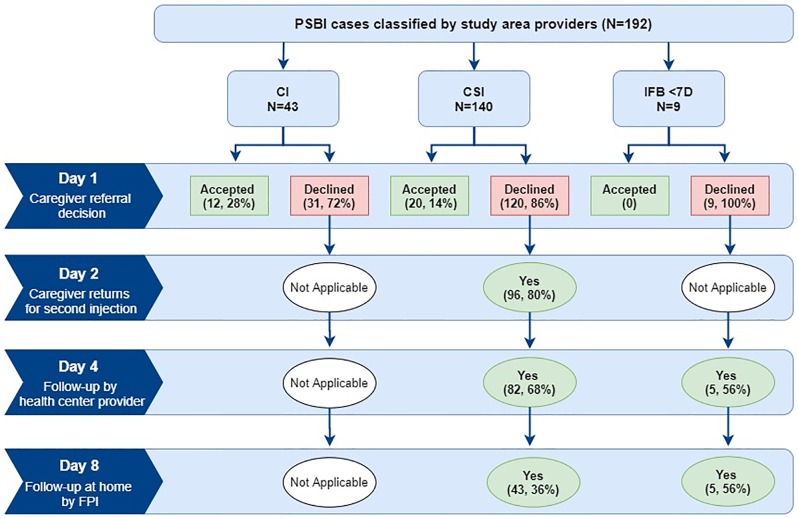
Referral to the hospital was not feasible for many families (83.3%; N = 160/192) and acceptance varied by infection severity. Barriers to referral feasibility included economic and household factors, and previous experiences with poor quality of care at the sub-district hospital. Conversely, providers and caregivers indicated high acceptability of simplified antibiotic treatment. 80% (N = 96/120) of infants with clinical severe infection for whom referral was not feasible returned to the facility for the second antibiotic injection. Some providers reported developing local solutions-including engaging informal providers in treatment of the infant-to address organizational barriers and promote treatment compliance. Follow-up of young infants receiving simplified treatment is critical, but only 67.4% (N = 87/129) of infants received fourth day follow-up. Some providers' reported deviations from the guidelines that shifted responsibility of follow-up to the caregiver, which may have contributed to lapses.
Caregivers' perception of trust and communication with providers were influential in caregiver acceptability of care. Few caregivers accepted referral to the sub-district hospital, suggesting low acceptability of this option. When referral was not feasible, many caregivers reported satisfaction with simplified antibiotic treatment. Local solutions described by providers require further examination in this context to assess the safety and potential value of these strategies in outpatient treatment. Our findings suggest strengthening providers' interpersonal skills could improve caregiver acceptability of the guidelines.
许多患有潜在严重细菌感染(PSBI)的婴儿没有接受住院治疗,因为对于家庭来说,住院治疗可能负担不起、无法获得或无法接受。2015 年,世卫组织发布了管理患有 PSBI 的 0-59 天龄婴儿的指南,当住院治疗不可行时,采用更简单的抗生素方案。孟加拉国采用了世卫组织在基层门诊保健中心实施的指南。我们报告了在孟加拉国三个农村分区实施早期(2015 年 10 月至 2016 年 8 月)期间评估指南在照顾者中可接受性的实施研究结果。
我们纳入了参与感染管理指南初步推出的 19 个基层门诊保健中心。我们从设施登记册中提取了所有 PSBI 病例(N=192)的数据,以确定转诊可行性、简化抗生素治疗和随访方面的差距。对照顾者(6 个焦点小组讨论;23 个深入访谈)和提供者(2 个焦点小组讨论;28 个深入访谈)进行了焦点小组讨论(FGD)和深入访谈(IDI),以评估指南在照顾者中的可接受性。
对于许多家庭来说,转诊到医院是不可行的(83.3%;N=160/192),接受程度因感染严重程度而异。转诊可行性的障碍包括经济和家庭因素,以及以前在分区医院就医质量差的经历。相反,提供者和照顾者表示对简化抗生素治疗的高度接受。80%(N=96/120)患有临床严重感染且转诊不可行的婴儿返回该设施接受第二次抗生素注射。一些提供者报告制定了当地解决方案-包括让非正规提供者参与婴儿的治疗-以解决组织障碍并促进治疗依从性。接受简化治疗的幼儿的随访至关重要,但只有 67.4%(N=87/129)的幼儿接受了第四天的随访。一些提供者报告的偏离指南的行为将随访责任转移给了照顾者,这可能导致了疏忽。
照顾者对提供者的信任和沟通的看法对照顾者对护理的接受程度有影响。很少有照顾者接受转诊到分区医院,这表明他们对这一选择的接受程度较低。当转诊不可行时,许多照顾者对简化抗生素治疗表示满意。提供者描述的当地解决方案需要进一步在这种情况下进行检查,以评估这些策略在门诊治疗中的安全性和潜在价值。我们的研究结果表明,加强提供者的人际交往能力可以提高照顾者对指南的接受程度。