Tuteja Narendra, Tuteja Renu
International Centre for Genetic Engineering and Biotechnology (ICGEB), Aruna Asaf Ali Marg, New Delhi 110 067, India.
Physica A. 2006 Dec 1;372(1):70-83. doi: 10.1016/j.physa.2006.05.014. Epub 2006 Jun 5.
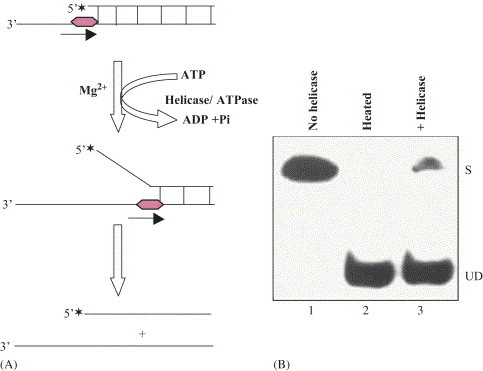
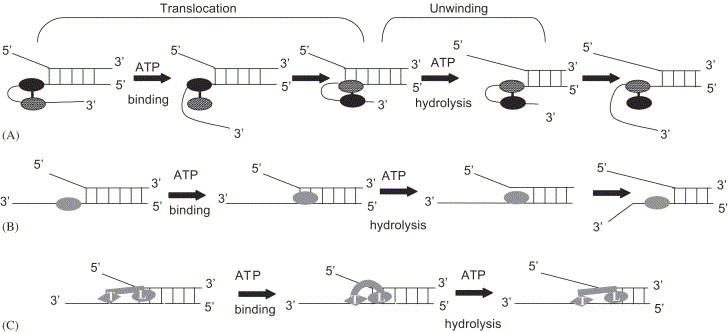
Helicases are one of the smallest motors of biological system, which harness the chemical free energy of ATP hydrolysis to catalyze the opening of energetically stable duplex nucleic acids and thereby are involved in almost all aspect of nucleic acid metabolism including replication, repair, recombination, transcription, translation, and ribosome biogenesis. Basically, they break the hydrogen bonding between the duplex helix and translocate unidirectionally along the bound strand. Mostly all the helicases contain some conserved signature motifs, which act as an engine to power the unwinding. After the discovery of the first prokaryotic DNA helicase from bacteria in 1976 and the first eukaryotic one from the lily plant in 1978, many more (>100) have been isolated. All the helicases share some common properties, including nucleic acid binding, NTP hydrolysis and unwinding of the duplex. Many helicases have been crystallized and their structures have revealed an underlying common structural fold for their function. The defects in helicases gene have also been reported to be responsible for variety of human genetic disorders, which can lead to cancer, premature aging or mental retardation. Recently, a new role of a helicase in abiotic stress signaling in plant has been discovered. Overall, helicases act as essential molecular tools for cellular machinery and help in maintaining the integrity of genome. Here an overview of helicases has been covered which includes history, biochemical assay, properties, classification, role in human disease and mechanism of unwinding and translocation.
解旋酶是生物系统中最小的分子马达之一,它利用ATP水解的化学自由能来催化能量稳定的双链核酸的解旋,从而参与核酸代谢的几乎所有方面,包括复制、修复、重组、转录、翻译和核糖体生物合成。基本上,它们破坏双链螺旋之间的氢键,并沿着结合链单向移位。几乎所有的解旋酶都包含一些保守的特征基序,这些基序作为驱动解旋的引擎。自1976年从细菌中发现第一个原核DNA解旋酶以及1978年从百合植物中发现第一个真核解旋酶后,更多(超过100种)解旋酶被分离出来。所有解旋酶都具有一些共同特性,包括核酸结合、NTP水解和双链解旋。许多解旋酶已被结晶,其结构揭示了其功能背后的共同结构折叠。据报道,解旋酶基因的缺陷也与多种人类遗传疾病有关,这些疾病可导致癌症、早衰或智力迟钝。最近,人们发现了解旋酶在植物非生物胁迫信号传导中的新作用。总体而言,解旋酶是细胞机制的重要分子工具,有助于维持基因组的完整性。本文概述了解旋酶,包括其历史、生化分析、特性、分类、在人类疾病中的作用以及解旋和移位机制。