Instituto de Bioingeniería, Universidad Miguel Hernández, Campus de Elche, 03202 Elche, Spain.
Int J Mol Sci. 2019 Feb 28;20(5):1056. doi: 10.3390/ijms20051056.
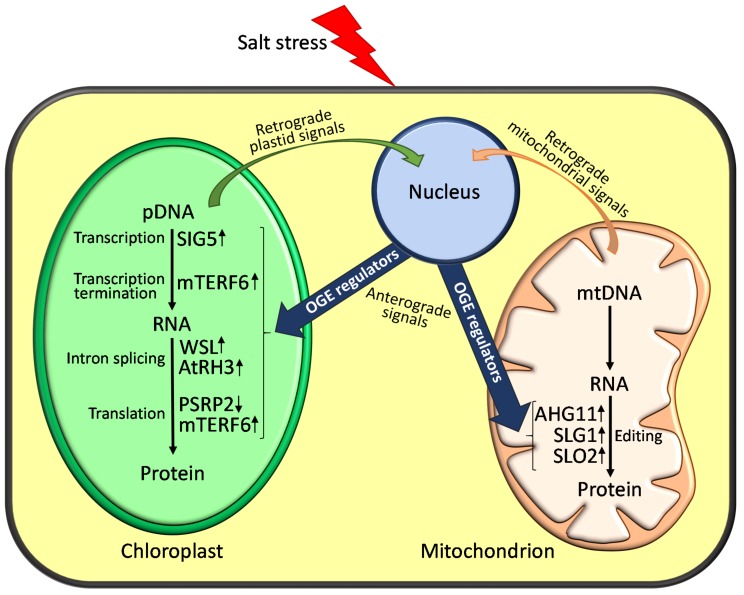
Given their endosymbiotic origin, chloroplasts and mitochondria genomes harbor only between 100 and 200 genes that encode the proteins involved in organellar gene expression (OGE), photosynthesis, and the electron transport chain. However, as the activity of these organelles also needs a few thousand proteins encoded by the nuclear genome, a close coordination of the gene expression between the nucleus and organelles must exist. In line with this, OGE regulation is crucial for plant growth and development, and is achieved mainly through post-transcriptional mechanisms performed by nuclear genes. In this way, the nucleus controls the activity of organelles and these, in turn, transmit information about their functional state to the nucleus by modulating nuclear expression according to the organelles' physiological requirements. This adjusts organelle function to plant physiological, developmental, or growth demands. Therefore, OGE must appropriately respond to both the endogenous signals and exogenous environmental cues that can jeopardize plant survival. As sessile organisms, plants have to respond to adverse conditions to acclimate and adapt to them. Salinity is a major abiotic stress that negatively affects plant development and growth, disrupts chloroplast and mitochondria function, and leads to reduced yields. Information on the effects that the disturbance of the OGE function has on plant tolerance to salinity is still quite fragmented. Nonetheless, many plant mutants which display altered responses to salinity have been characterized in recent years, and interestingly, several are affected in nuclear genes encoding organelle-localized proteins that regulate the expression of organelle genes. These results strongly support a link between OGE and plant salt tolerance, likely through retrograde signaling. Our review analyzes recent findings on the OGE functions required by plants to respond and tolerate salinity, and highlights the fundamental role that chloroplast and mitochondrion homeostasis plays in plant adaptation to salt stress.
鉴于它们的内共生起源,叶绿体和线粒体基因组仅拥有 100 到 200 个基因,这些基因编码参与细胞器基因表达(OGE)、光合作用和电子传递链的蛋白质。然而,由于这些细胞器的活性还需要几千个由核基因组编码的蛋白质,因此核基因组和细胞器之间的基因表达必须密切协调。与此一致,OGE 调节对于植物的生长和发育至关重要,主要通过核基因的转录后机制来实现。通过这种方式,核控制细胞器的活性,而这些细胞器反过来通过根据细胞器的生理需求调节核表达来向核传递其功能状态的信息。这会根据植物的生理、发育或生长需求来调整细胞器的功能。因此,OGE 必须适当地响应内源性信号和外源性环境线索,这些信号和线索可能会危及植物的生存。作为固着生物,植物必须对不利条件做出反应,以适应和适应它们。盐度是一种主要的非生物胁迫,它会对植物的发育和生长产生负面影响,破坏叶绿体和线粒体的功能,并导致产量降低。关于 OGE 功能紊乱对植物耐盐性的影响的信息仍然相当零散。尽管如此,近年来已经对表现出对盐度改变反应的许多植物突变体进行了特征描述,有趣的是,其中几个突变体受到编码定位于细胞器的蛋白质的核基因的影响,这些蛋白质调节细胞器基因的表达。这些结果强烈支持 OGE 与植物耐盐性之间的联系,可能通过逆行信号传递。我们的综述分析了植物对盐度做出响应和耐受所需的 OGE 功能的最新发现,并强调了叶绿体和线粒体稳态在植物适应盐胁迫中的基本作用。