Huo Xiang, Cui Lun-Biao, Chen Cong, Wang Dayan, Qi Xian, Zhou Ming-Hao, Guo Xiling, Wang Fengming, Liu William J, Kong Weirong, Ni Daxin, Chi Ying, Ge Yiyue, Huang Haodi, Hu Feifei, Li Chao, Zhao Xiang, Ren Ruiqi, Bao Chang-Jun, Gao George F, Zhu Feng-Cai
Key Laboratories of Enteric Pathogenic Microbiology (Ministry of Health), Jiangsu Provincial Center for Disease Control and Prevention, Nanjing 210009, China; Key Laboratory of Infectious Diseases, School of Public Health, Nanjing Medical University, Nanjing 211166, China.
Changzhou Center for Disease Control and Prevention, Changzhou 213022, China.
Sci Bull (Beijing). 2018 Aug 30;63(16):1043-1050. doi: 10.1016/j.scib.2018.07.003. Epub 2018 Jul 19.
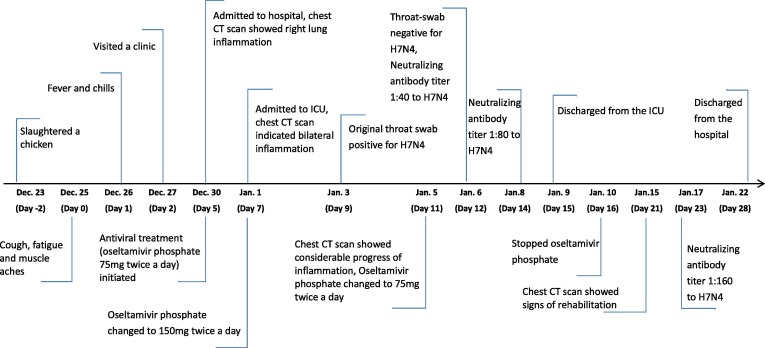
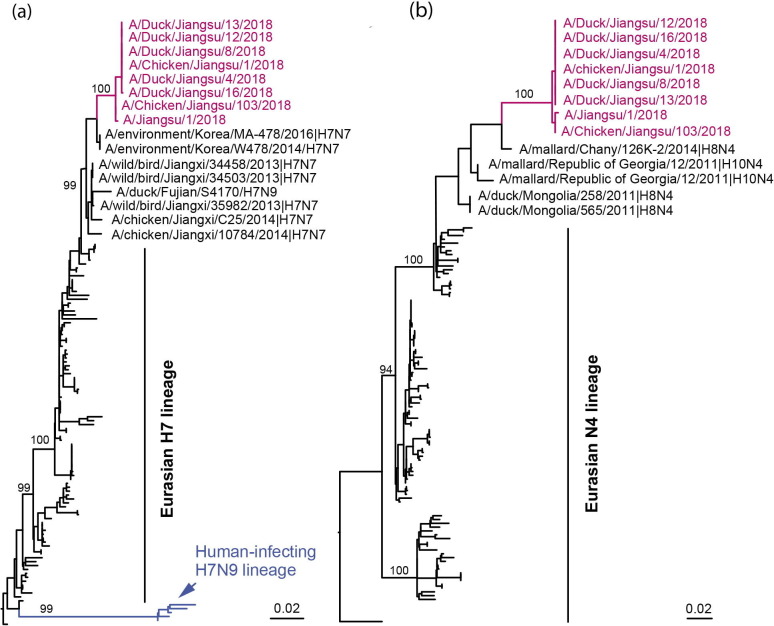
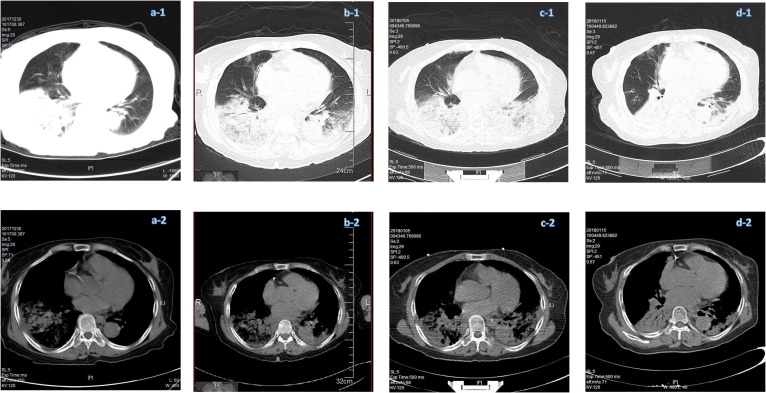
Human infections with influenza H7 subtypes, such as H7N9, have raised concerns worldwide. Here, we report a human infection with a novel influenza A(H7N4) virus. A 68 years-old woman with cardiovascular and cholecystic comorbidities developed rapidly progressed pneumonia with influenza-like-illness as initial symptom, recovered after 23 days-hospitalization including 8 days in ICU. Laboratory indicators for liver and blood coagulation dysfunction were observed. Oseltamivir phosphate, glucocorticoids and antibiotics were jointly implemented, with nasal catheterization of oxygen inhalation for this patient. We obtained the medical records and collected serial respiratory and blood specimens from her. We collected throat, cloacal and/or feces samples of poultry and wild birds from the patient's backyard, neighborhood, local live poultry markets (LPMs) and the nearest lake. All close contacts of the patient were followed up and sampled with throat swabs and sera. Influenza viruses and other respiratory pathogens were tested by real-time RT-PCR, viral culturing and/or sequencing for human respiratory and bird samples. Micro-neutralizing assay was performed for sera. A novel reassortant wild bird-origin H7N4 virus is identified from the patient and her backyard poultry (chickens and ducks) by sequencing, which is distinct from previously-reported avian H7N4 and H7N9 viruses. At least four folds increase of neutralizing antibodies to H7N4 was detected in her convalescent sera. No samples from close contacts, wild birds or other poultry were tested positive for H7N4 by real-time RT-PCR.
人类感染H7亚型流感病毒,如H7N9,已引起全球关注。在此,我们报告1例人类感染新型甲型H7N4流感病毒的病例。1名68岁患有心血管和胆囊合并症的女性,最初症状为流感样疾病,随后迅速发展为肺炎,住院23天(包括在重症监护病房8天)后康复。观察到肝脏和凝血功能障碍的实验室指标。对该患者联合使用磷酸奥司他韦、糖皮质激素和抗生素,并采用鼻导管吸氧。我们获取了该患者的病历,并采集了其系列呼吸道和血液样本。我们从患者后院、社区、当地活禽市场(LPM)和最近的湖泊采集了家禽和野鸟的咽喉、泄殖腔和/或粪便样本。对患者的所有密切接触者进行随访,并用咽拭子和血清采样。对人类呼吸道和鸟类样本,通过实时逆转录聚合酶链反应(RT-PCR)、病毒培养和/或测序检测流感病毒和其他呼吸道病原体。对血清进行微量中和试验。通过测序从患者及其后院家禽(鸡和鸭)中鉴定出一种新型重配的野生鸟类源H7N4病毒,该病毒与先前报道的禽H7N4和H7N9病毒不同。在其恢复期血清中检测到针对H7N4的中和抗体至少增加了4倍。密切接触者、野鸟或其他家禽的样本经实时RT-PCR检测,H7N4均为阴性。