Department of International Business, Chien Hsin University of Science and Technology, Taoyuan 32097, Taiwan.
Int J Environ Res Public Health. 2020 Apr 10;17(7):2615. doi: 10.3390/ijerph17072615.
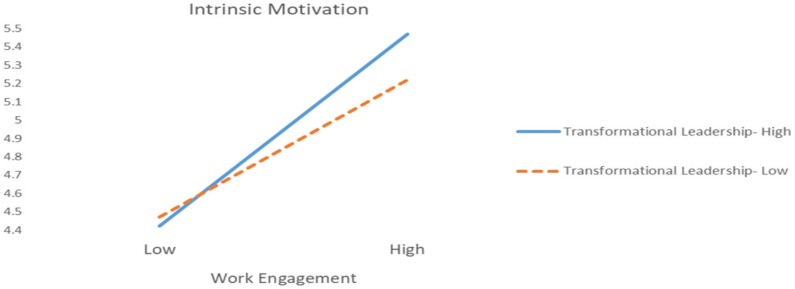
Based on the perspective of conservation of resources (COR) theory, this study adopts a multilevel approach to examine the influences of employees' personal resources (i.e., work engagement and intrinsic motivation) and external resources (i.e., transformational leadership) on knowledge sharing. This study conducts a survey to explore the interrelationships among transformational leadership, work engagement, intrinsic motivation, and knowledge sharing. The sample includes 33 healthcare work groups consisting of 214 group members. The results show that an individual's personal and external resources are positive and benefit the promotion of knowledge sharing. As for personal resources, work engagement has a positive impact on knowledge sharing by increasing intrinsic motivation. Regarding external resources, transformational leadership acts as a facilitator for knowledge sharing. Specifically, the conditional indirect effects of work engagement on knowledge sharing through intrinsic motivation are more positive under high levels of transformational leadership, rather than low levels of transformational leadership. Based on the COR theory, this is the first study to argue that knowledge sharing could be considered as an active activity and that individuals could be eager to perform knowledge sharing when they possess significant personal and external resources. The results of this study provide new insights into knowledge sharing.
基于资源保存理论(COR)的视角,本研究采用多层次方法考察员工个人资源(即工作投入和内在动机)和外部资源(即变革型领导)对知识共享的影响。本研究通过调查来探讨变革型领导、工作投入、内在动机和知识共享之间的相互关系。样本包括 33 个医疗保健工作群体,共 214 名群体成员。结果表明,个人的个人和外部资源是积极的,并有助于促进知识共享。就个人资源而言,工作投入通过提高内在动机对知识共享产生积极影响。关于外部资源,变革型领导是知识共享的促进因素。具体来说,在变革型领导水平较高的情况下,工作投入通过内在动机对知识共享的间接影响更为积极,而不是变革型领导水平较低的情况下。基于 COR 理论,这是第一个认为知识共享可以被视为一种积极活动的研究,并且当个人拥有重要的个人和外部资源时,他们可能会渴望进行知识共享。本研究的结果为知识共享提供了新的见解。